Which wing size should you choose?
In brief Wind first, then your weight. In the brands’ guides, the size goes down as the wind rises and goes up…
What wing size?
Your weight, the wind, your level: a starting wing size.
Indicative reference. Median of the size guides from 7 brands, not a guarantee: your board, your foil and the water conditions matter. WindUnity rule version 2026-10-31.1 of 31/10/2026. Our method
In brief
Wind first, then your weight. In the brands’ guides, the size goes down as the wind rises and goes up with weight. Example for 75 kg and 18 knots, intermediate level: the calculator gives about 5 m², and the 7 brands range from 4.5 to 5.5 m².
The result is the median of the guides of 7 brands (Duotone, Gong, Cabrinha, F-One, North, Slingshot, Armstrong), rounded to the nearest half square meter. It is a starting point, not a guarantee.
It takes neither your foil nor your board into account. In its FAQ, Slingshot cites weight, foil size, board volume and wind strength for choosing a size, without giving a value for the foil or the board.
What the brands publish
Each brand has its own way of saying which size to take. Duotone publishes a full weight × wind matrix, its Sizefinder, for the Unit. For its Droid 2026, Gong gives the wind range of each size for three weight classes. Cabrinha, F-One, North, Slingshot and Armstrong give one wind range per size; only Cabrinha specifies the reference rider’s weight, 75 kg. Naish and Ozone, also consulted, had no usable numerical table for the wing as of October 31, 2026: they are not in the calculation.

| Size | Cabrinha Mantis 2027 | F-One Strike V6 |
|---|---|---|
| 3 m² | 17 to 36 | 28 to 38 |
| 4 m² | 15 to 30 | 22 to 32 |
| 5 m² | 11 to 26 | 14 to 25 |
| 6 m² | 7 to 20 | 10 to 20 |
For a 5 m², Cabrinha announces 11 to 26 knots and F-One 14 to 25: same size, different ranges. A wind range is not a recommended size for you, which is why we cross several guides rather than follow just one.
Level, according to Gong
The brand warns: “Don’t overestimate the power of wings. An 85 kg rider needs 15/20 kts in a 5 m² to fly at the start. After about fifteen sessions, they will fly at 15 kts in a 5 m².” It is the only numerical source on level we found: it sets our beginner and advanced correction.
The method
Wing: the median of 7 brands’ guides
WindUnity rule version 2026-10-31.1 of 31/10/2026. Indicative reference: the rule is adjusted as feedback comes in, and the version changes with each adjustment.
Each brand publishes its own size chart. For your weight and your wind, we calculate the size each of the 7 charts gives, then keep the median, rounded to the nearest half square meter. The range shown goes from the smallest to the largest of the 7 values.
Sources
- Duotone, Unit 2026/2027 (Sizefinder) (weight × wind matrix), checked on 31/10/2026
- Gong, Droid 2026 (wind range by size, three weight classes), checked on 31/10/2026
- Cabrinha, Mantis 2027 (wind range by size), checked on 31/10/2026
- F-One, Strike V6 (wind range by size), checked on 31/10/2026
- North, Nova 2025 (wind range by size), checked on 31/10/2026
- Slingshot, SlingWing NXT V2 (wind range by size), checked on 31/10/2026
- Armstrong, A-Wing XPS Mk II (wind range by size), checked on 27/10/2026
Assumptions and limitations
- Only Duotone and Gong publish the effect of weight. For the five other brands, it is modeled (reference weight 75 kg, exponent 0.5).
- The effect of skill level rests on a single Gong text: beginners need a bit more area; advanced riders, a bit less.
- Below 12 to 15 knots for riders over 70 kg, the guides stop at 6 to 6.5 m²: the calculation does not extrapolate beyond that, and says so.
- The foil, the board, the riding style (wave, freestyle, downwind) and the water conditions affect the size you actually need: no brand factors them into its size guide.
- Range covered: 40 to 120 kg and 7 to 40 knots.
Different from what you see on the water? Tell us.
Which size for your weight and the wind?
Here is the median of the 7 guides for six weights and seven average winds. A cell followed by a “+” is at the edge of what the guides cover: for at least 4 of the 7 brands, the calculated size exceeds their largest size, and the calculation does not extrapolate beyond it.
| Weight / wind (knots) | 10 | 12 | 15 | 18 | 22 | 25 | 30 |
|---|---|---|---|---|---|---|---|
| 50 kg | 6 + | 6 | 5 | 4 | 3.5 | 3 | 2.5 |
| 60 kg | 6 + | 6 + | 5.5 | 4.5 | 3.5 | 3 | 2.5 |
| 70 kg | 6 + | 6 + | 6 | 5 | 4 | 3.5 | 3 |
| 80 kg | 6 + | 6 + | 6 + | 5 | 4.5 | 3.5 | 3 |
| 90 kg | 6 + | 6 + | 6 + | 5.5 | 4.5 | 4 | 3.5 |
| 100 kg | 6 + | 6 + | 6 + | 6 | 5 | 4 | 3.5 |
From 70 kg, the cells at 10, 12 and 15 knots all show 6 m²: that is the top of the guides’ range, not a consensus. Light-wind wings go further. F-One offers its Strike CWC in 6, 7, 8 and 9 m². On the Mantis 2027 page, Cabrinha recommends the Vision, with its fuller canopy, for the low end of the wind range, and specifies that the Mantis’s larger sizes are chosen more according to the rider’s build.
Level shifts the result. For 75 kg and 18 knots, the rule gives 6 m² for a beginner, 5 m² for an intermediate and 4 m² for an advanced rider. That gap rests on a single brand text: read the method before relying on it.
What the number doesn’t tell you
A starting size is not a final size. On its SlingWing NXT V2 page, Slingshot invites you to choose according to the rider’s weight, foil size, board volume and wind strength, then to go bigger to take off sooner and smaller to keep control in strong wind. Also keep in mind:
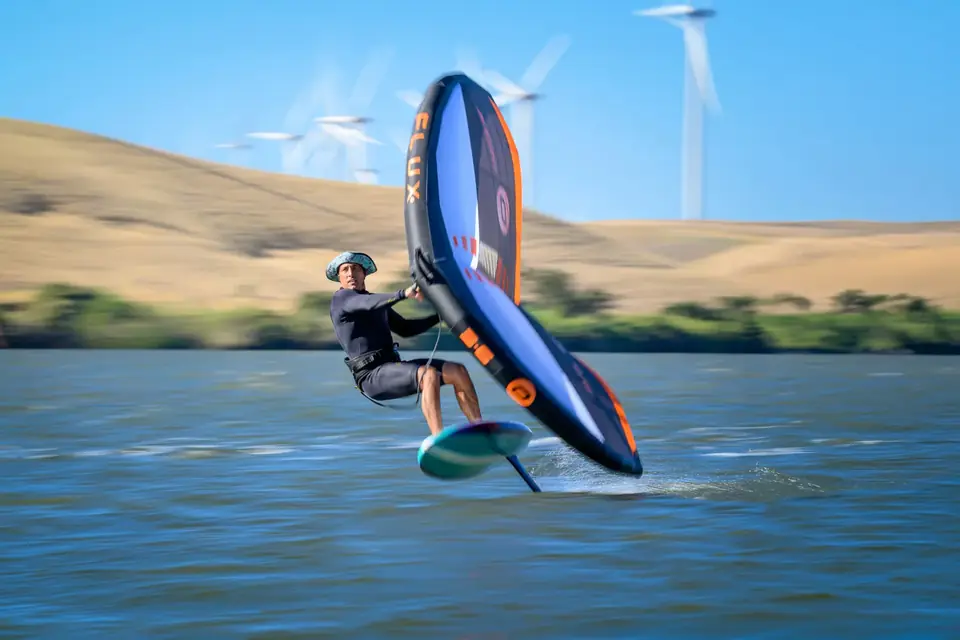
- Average wind is not gust wind. The brands don’t say which one they use.
- The weight is the rider’s. No brand specifies whether it includes the wetsuit, ballast or vest.
- One model per brand. Ranges and wind ranges change from one model to another, and from one model year to the next.
Do you kite too? The kite calculator has its own page, and the guide to choosing your kitesurfing kite details the types and shapes.
Wings to compare

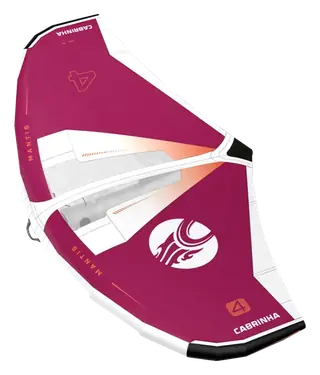
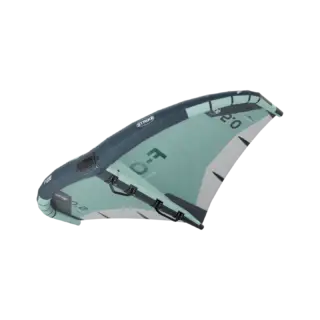
All the wings are in the wing catalog, with their sizes, their wind ranges and rider reviews.
Related reading
Guides How to choose the right kite size for your kitesurfing conditions?Wondering which kite size to choose to get the most out of your kitesurfing sessions? With the WindUnity online calculator, no more…
 How do you choose a kitesurfing and wing pump?Kitesurfing and wing pump: manual double action or electric? Duotone Pump, Multi Pump, Lazepump, Ride Engine Air Box Mini: pressure, volume, dated prices.
- How to choose a kitesurfing kite?In brief To start out, and for most sessions: an all-round inflatable kite (LEI), in a delta, bow or hybrid shape. It…