Skip to content
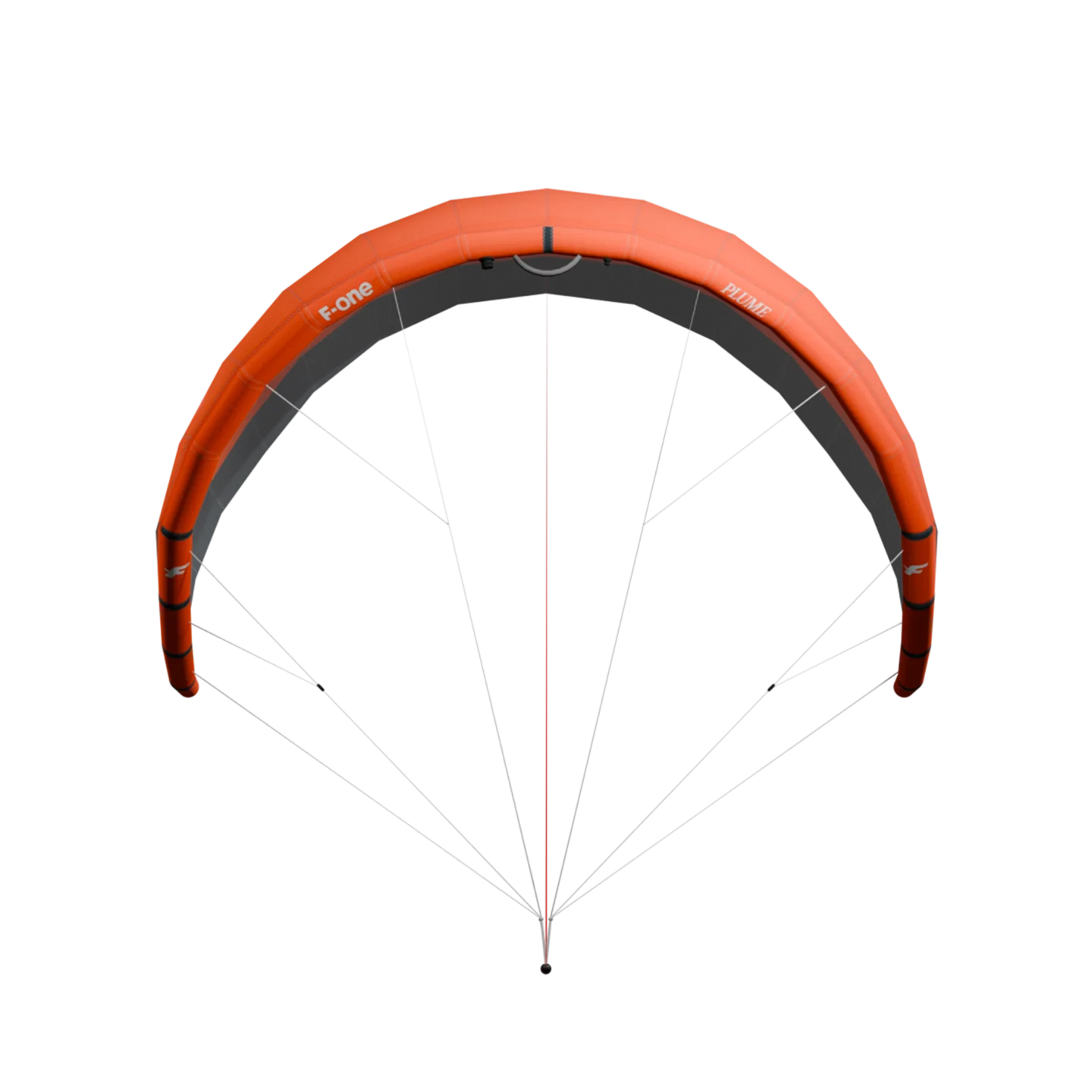
F-One Plume (K-Wing) in a cut-out render, front view: orange tube
The Plume, view 1 of the F-One page · © F-One
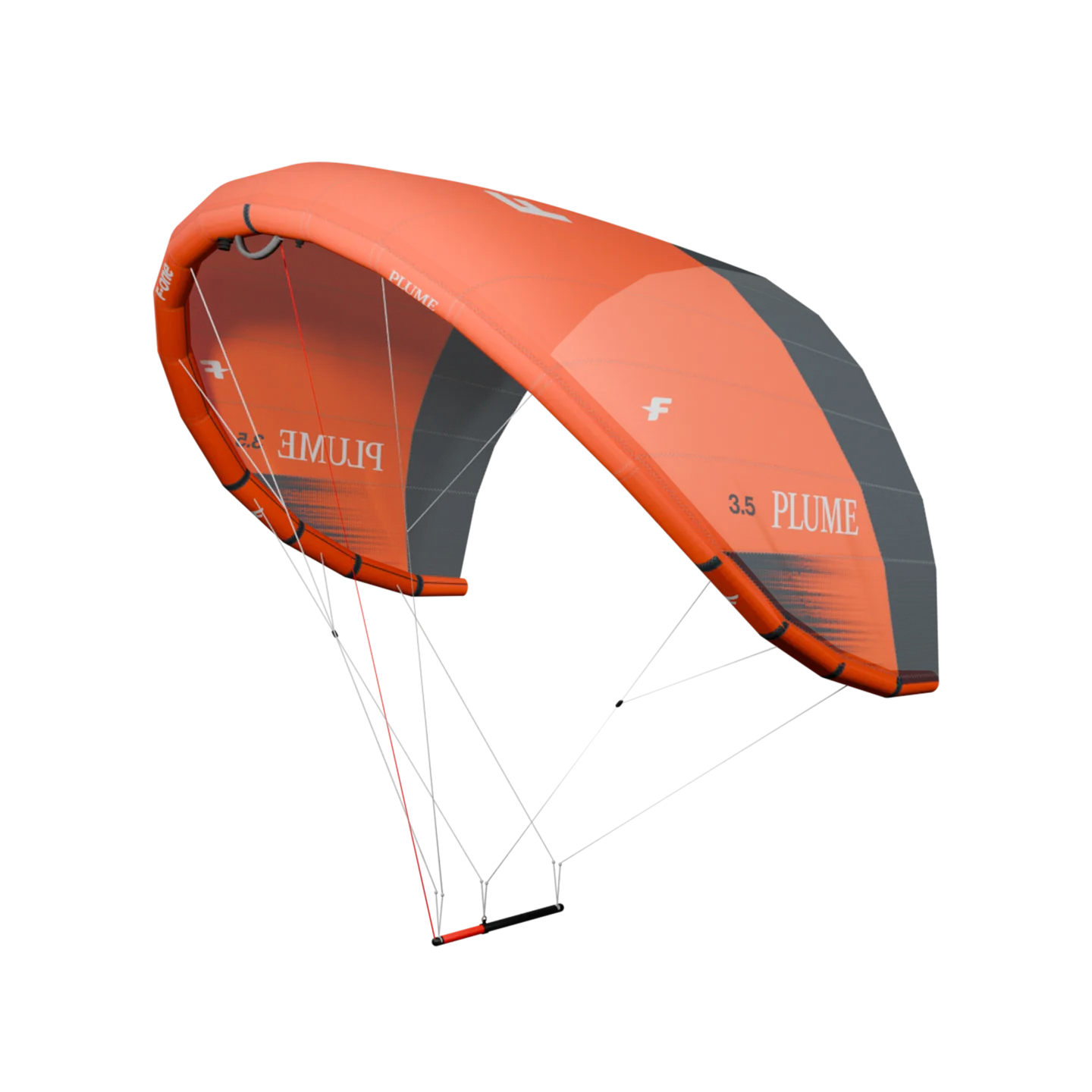
F-One Plume (K-Wing) 3.5 in a cut-out render, three-quarter view: orange canopy and charcoal gray panels
The Plume, view 2 of the F-One page · © F-One
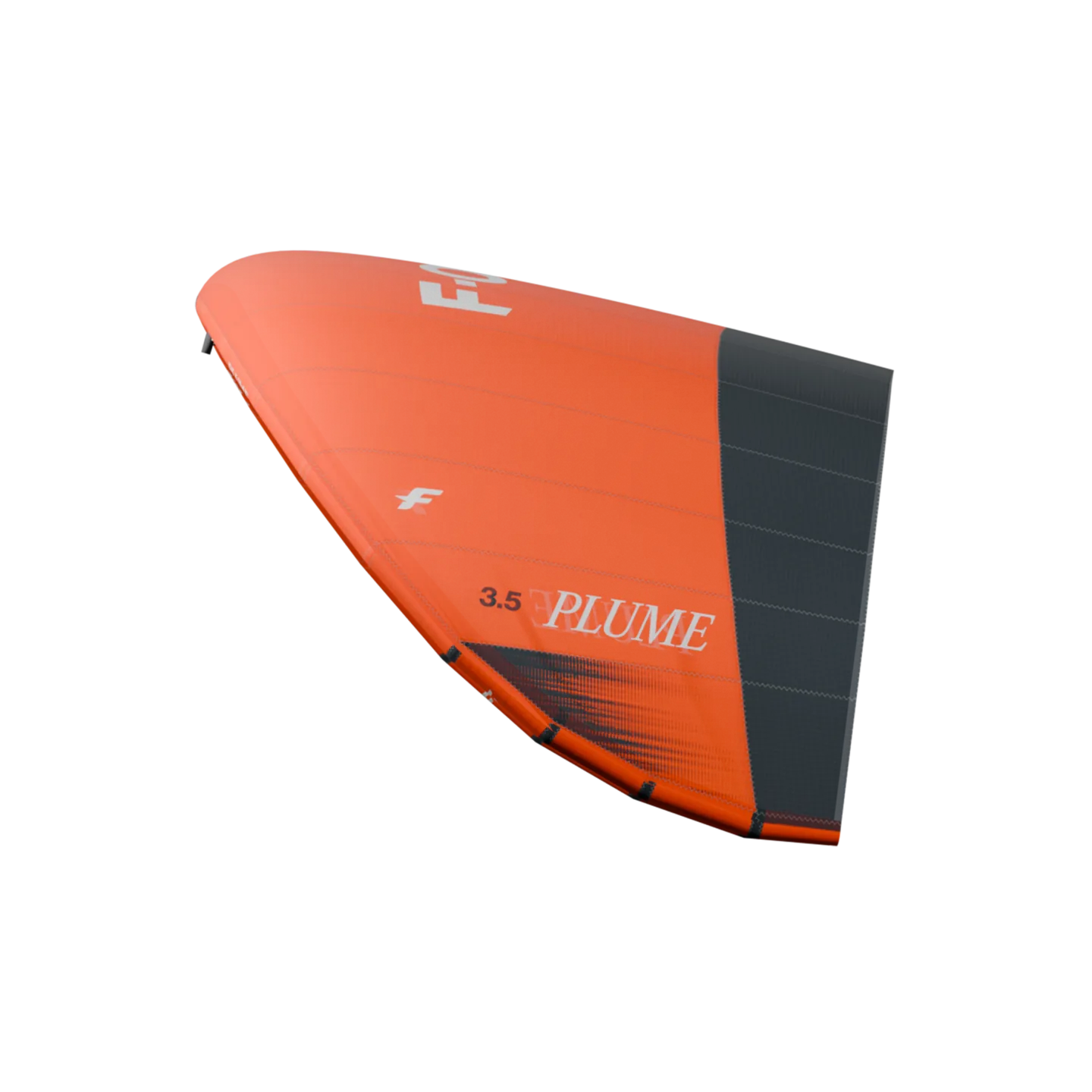
F-One Plume (K-Wing), third view of the manufacturer’s product render, on a cut-out background
The Plume, view 3 of the F-One page · © F-One
F-One

F-One Plume (K-Wing) test

  • Riding styleDownwind, freeride, wave
  • Sizes2.5 to 6 m²
  • Year2025
  • Wind12 to 40 knots

Verdict in brief

A small inflatable-tube kite on short lines, from 0.70 to 1.11 kg. The Inertia finds very reassuring stability, an almost limitless top end and upwind ability at least equal to that of most inflatable wings when the wing is well powered. It lacks low end and doesn’t pack down like a parawing. For me, it’s the wing to look at if you come from kitesurfing and parawings scare you.

Only one independent test (The Inertia, Plume 4.2 and 5 m²); the rest comes from F-One and shops. I did not try it myself.

For you if

  • You come from kitesurfing: The Inertia says the tube gives a “safety blanket”, easier to relaunch than a parawing, and MACkite talks about handling close to a parawing but simpler
  • You want a wide top end: The Inertia couldn’t overpower the 4.2 m² in nearly 30 knots
  • You head out on mini downwind runs, on swell or boat wake: the wing flags out behind you, lighter than an inflatable wing

Not for you if

  • You’re looking for low end: The Inertia advises going up a full size compared with your usual wing
  • You want to stow the wing mid-downwind: the tube doesn’t fold like a parawing, you have to deflate it (F-One plans for deflating the leading edge in flight and reinflating it at sea with a mini pump)
  • You’re looking for the lightest: 0.99 kg in 4.2 m², roughly double a true parawing according to The Inertia

Have you ridden this model? Leave the first review

What we know about this model

Our method
  • Specificationschecked early November 2026
  • 1 test publishedThe Inertia, F-One Plume K-Wing Review (July 2025): Plume 4.2 and 5 m², San Francisco Bay, up to nearly 30 knots, compared with inflatable wings and parawings
  • Rider reviewsgive yours, and it will appear here

Sizes, weight and wingspan

Your size on this model

Nothing stated for now.

Enter your weight and wind: your size is highlighted in the table.

what wing size to choose based on your weight and the windIndicative reference · rule 2026-10-31.1

To find your size, open the calculator: your weight, the wind, your level. wing size calculator

Sizes, weight, wingspan, wind range and pressure
SizeWing weightWind
2.5 m²0.7 kg30+ knots
3 m²0.73 kg30+ knots
3.5 m²0.86 kg25 – 40 knots
4.2 m²0.99 kg20 – 35 knots
5 m²1.11 kg15 – 30 knots
6 m²n/a12 – 23 knots

n/a: not disclosed. These values haven’t been published by the brand yet. We complete the page as soon as the brand publishes them.

Weight of the wing alone, n/a for the 6.0 m²; “30+” with no ceiling for the 2.5 and 3.0 m².

More details on these figures

The weight of the 6.0 m² is not published (“TBC” on the page, n/a). For the 2.5 and 3.0 m², F-One shows “30+”: only the minimum is given, the ceiling is not published (maximum wind n/a). F-One gives no reference rider weight; your weight, your foil and your board shift these reference points. The Inertia estimates the usable ceiling at 40+ knots in 2.5 m², 35+ in 3.0 and 3.5, 30+ in 4.2 and 25+ in 5.0: the tester’s estimate, not brand data. The wingspan is not published by F-One and neither is the inflation pressure (8 PSI cited by GlissEvolution, not carried into the table).

Strong points, weak points

Strong points

  • Stability and relaunch: the tube holds its shape and helps with relaunching, and the Plume doesn’t waterlog (MACkite, The Inertia)
  • Top end: The Inertia estimates the ceiling at more than 40 knots in 2.5 m², more than 30 in 4.2 m² and more than 25 in 5 m²
  • Upwind ability: at least equal to that of most inflatable wings and better than that of most parawings when the wing is well powered (The Inertia)
  • Light bar pressure: you can often do without a harness, and a harness helps when the wing is heavily powered (The Inertia)
  • Flagging in flight: a grab point on the leading edge and a leash act as a fifth line to cut the power (MACkite)

Weak points

  • Limited low end: The Inertia says so bluntly, and advises going up a size; F-One nonetheless shows 80% in “Low End” (brand rating, not a measurement)
  • Doesn’t pack down like a parawing: to stow it quickly on a downwind, the tube has to be deflated
  • Roughly double the weight of a true parawing (The Inertia), a little over a kilo in 4.2 m²
  • Only one independent test, on the 4.2 and 5 m² sizes; the 6.0 m² has a weight of “TBC” on the F-One page and has not been tried
  • The F-One page shows “Notify me when available” as of November 9, 2026: availability to be checked before choosing

The flaw to know about. My main complaint: the low end. F-One shows 80% in “Low End”, but The Inertia finds it limited and advises going up a full size compared with your usual wing. If you ride in little wind, aim for one size above what your instinct says, and read the size table before buying.

Specifications

9 specs, sources at the bottom of the page

Program (manufacturer)
“Freefly Downwind / Wave / Freeride” category; hybrid between a kite and a wing, the first wing of the “K-Wing” discipline
Construction
Small inflatable leading edge, no center strut, C-shaped profile (“Delta C Shape”), minimal bridle, Hitex canopy; the leading edge deflates in flight and reinflates at sea with a mini pump
Bar
41 cm vertical carbon bar on all sizes; automatic relaunch (“Auto relaunch”)
Line length
About 1.5 m according to The Inertia; F-One does not give it on the page
Sizes
2.5 · 3.0 · 3.5 · 4.2 · 5.0 · 6.0 m²
Weight
0.70 kg (2.5 m²), 0.73 (3.0), 0.86 (3.5), 0.99 (4.2), 1.11 (5.0); 6.0 m²: “TBC” on the F-One page. Weight of the wing alone according to the page table
Wind range (F-One)
30+ knots (2.5 and 3.0 m²), 25-40 (3.5), 20-35 (4.2), 15-30 (5.0), 12-23 (6.0). Reference rider: n/a
Brand ratings (not a measurement)
Low End 80%, High End 100%, Ease of Use 100%, Speed / Upwind 100%, Packing / Freefly 50%: ratings given by F-One on its page, not measurements
Inflation pressure
8 PSI according to GlissEvolution; F-One does not give it on the page

What the published tests say

1 test published, checked early November 2026

The Inertia, F-One Plume K-Wing Review (Bowen Dwelle)

Plume 4.2 and 5 m² tested in San Francisco Bay, as part of a parawing comparison. Strengths: a wing that is easy to fly and relaunch, an “almost unlimited” top end (the 4.2 m² isn’t overpowered in nearly 30 knots), upwind ability that matches most inflatable wings, light bar pressure, in-flight flagging better than a wing’s, a wing that doesn’t sink. Weaknesses: little low end (go up a full size), no stowing like a parawing, about twice the weight of a true parawing, not recommended in breaking waves unless you’re at a very advanced level. Estimates the usable ceiling at 40+ knots in 2.5 m² and 25+ in 5 m². Translated from English. Publication date not shown on the page: July 2025 according to the attached images and diagram.

Read the test
Articles from shops and schools (2), not counted as tests

These articles come from sites that sell or rent gear: they are cited for information and kept separate from published tests.

MACkite, 2025 F-One Plume K-Wing On-Water Review (Tucker Vantol)checked on 09/11/2026

Trial of a prototype by a shop rider. Small strutless kite with a handle attached to the bridles, close to a parawing but with an inflated leading edge. A good choice for moving to parawing without the hassle of bridles that flip. A 4 m² takes off from 20 knots and stays comfortable at 25-30 knots. Smooth top end even in uneven wind, immediate handling for an experienced wing and parawing rider. Packs smaller than a wing (no strut, a single bar), but doesn’t fold like a parawing. Translated from English.

GlissEvolution, Plume and Frigate comparison (Hadou’s trial)checked on 09/11/2026

Hadou’s trial, published by a shop that sells the Plume. Exceptional stability and course-holding, easy upwind ability, smooth handling even in gusts, an “almost unlimited” top end with no stalling when the wing is overpowered. A pull on the red line cuts the power, the wing floats without tangling and relaunches when you take the bar back. He judges it ideal for getting into parawing or progressing in freefly without the constraints of a pocket parawing. Translated from English.

Riders’ reviews

No reviews

No reviews yet.

Nobody has reviewed this gear yet. Do you use it? Help other riders of your weight — 2 minutes.

Leave your review (2 minutes)

Three screens: you, the gear, your review. Your email will never be published; it is only used to confirm that the review comes from a real person.

1/3 You

Only used to confirm your review and to let you know if it is rejected. Never displayed, never resold.

Your weight *

10 kg ranges only, so that other riders of your build can relate. No exact weight is recorded.

Your level *

Beginner: I’m still taking lessons. Intermediate: I ride on my own. Advanced: transitions and jumps. Expert: freestyle, wave or competition.

Your riding

Optional. If checked, your review stays published with the label “Gear received or tied to a brand” and doesn’t count toward the average rating.

You must be at least 15 to post a review (“Your data” article of the policy).

2/3 Your gear and how you use it
Wind range actually used (knots)
How long you’ve been using it *
Number of sessions (optional)
Rate each criterion (at least 3) *
Low-wind power
Stability / gusts
Maneuverability & weight in hand
Boom / handles
Finish & durability

1 = very poor, 5 = excellent. Leave blank any criterion you couldn’t judge.

Do you recommend it? *
3/3 Your review

140 characters minimum — Its low-end power, its stability in gusts, what disappointed you, who you’d recommend it to.

Rider reviews: confirmed email address, no compensation. “Brand-linked” and “loaned / received” reviews are labeled and excluded from the average. Each review shows its publication date, the date of the experience and, if it was edited, its update date. A review is published or rejected within 7 days at most; if it is rejected, you receive the reason by email and you can correct it. You can complete or delete your review at any time from the email address used to submit it. How do reviews work?

Alternatives to compare

F-One Frigate V2 2027

It packs down completely, which the Plume’s tube rules out. In its comparison with the 2025 Frigate (first generation), GlissEvolution describes the Frigate as more demanding and more technical, the Plume as simpler and more reassuring.

F-One Quest 2026

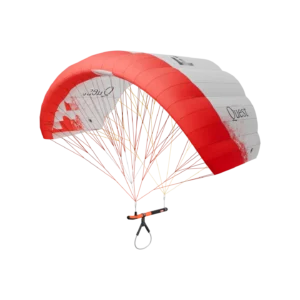
It folds like a parawing, but doesn’t have the tube that makes the Plume safer.

AFS Stow

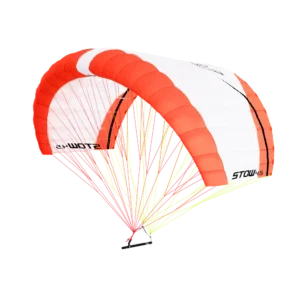
AFS parawing lighter and cheaper than the Plume, with only one published independent test and a wind range given for the 3.5 m² alone.

Frequently asked questions

What is the F-One Plume?

A hybrid between a kite and a wing, which F-One calls a K-Wing: small inflatable leading edge, no center strut, minimal bridle, 41 cm bar. F-One presents it as the first wing of this new discipline.

Is there a test of the F-One Plume?

Yes, one independent test: The Inertia tried the 4.2 and 5 m² in San Francisco Bay (July 2025) and came away with a stable wing, an almost unlimited top end and upwind ability at least equal to that of most inflatable wings when the wing is well powered, with little low end. MACkite and GlissEvolution, two shops, published equally positive trials.

Which F-One Plume size should you choose?

F-One offers 2.5 to 6.0 m². The page gives 20-35 knots for the 4.2 m² and 15-30 for the 5.0 m². The Inertia advises going up a full size compared with your usual wing, because of the limited low end, and starting with only one or two sizes.

Which sizes does the F-One Plume come in?

Sizes include 2.5, 4.2 and 6.0 m². For the price, see the “Where to buy” section of this page.

Method and limitations of this page

This page brings together the technical specs, tests from the press and blogs, and rider feedback found on the web, without rewriting any of it. When WindUnity has ridden the gear itself, the page says so with the “WindUnity test” badge.

Rider reviews are published as is, with their date. Reviews tied to a brand or based on loaned gear are labeled and excluded from the average.

What’s still missing

  • Weight of the 6.0 m²: “TBC” on the F-One page
  • Wind ceiling of the 2.5 and 3.0 m²: F-One shows “30+” with no maximum
  • Line length and inflation pressure: not given by F-One, taken from The Inertia (≈ 1.5 m) and GlissEvolution (8 PSI)
  • Exact date of the The Inertia test: not shown, July 2025 according to the images
  • Only one independent test, on the 4.2 and 5 m² sizes; the 6.0 m² has not been tried
  • Availability: the F-One page shows “Notify me when available” as of November 9, 2026
  • Reviews posted on WindUnity: none

Sources

Data collected early November 2026

F-One : product page

Shops : MACkite, GlissEvolution

Press and specialist sites : The Inertia

See the details of the 4 sources

F-One

Shops

  1. MACkite, Plume K-Wing test (EN, May 5, 2025)
  2. 27/01/2026

Press and specialist sites

  1. The Inertia, F-One Plume K-Wing test (EN, July 2025)