Skip to content
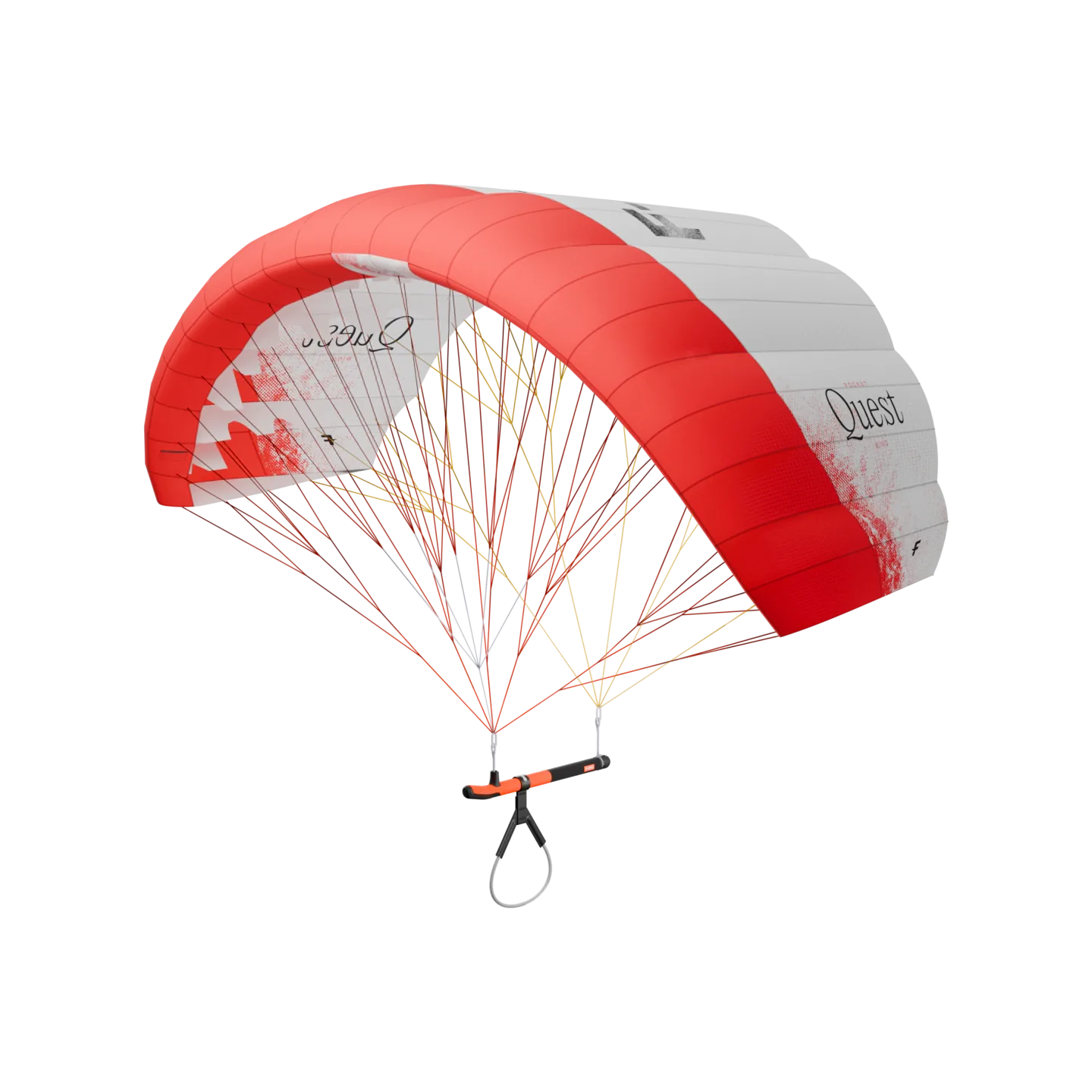
F-One Quest parawing in a studio render on a black background, red and white canopy, bridles and vertical bar in orange and black
The Quest in its red and white colorway, with its vertical bar · © F-One
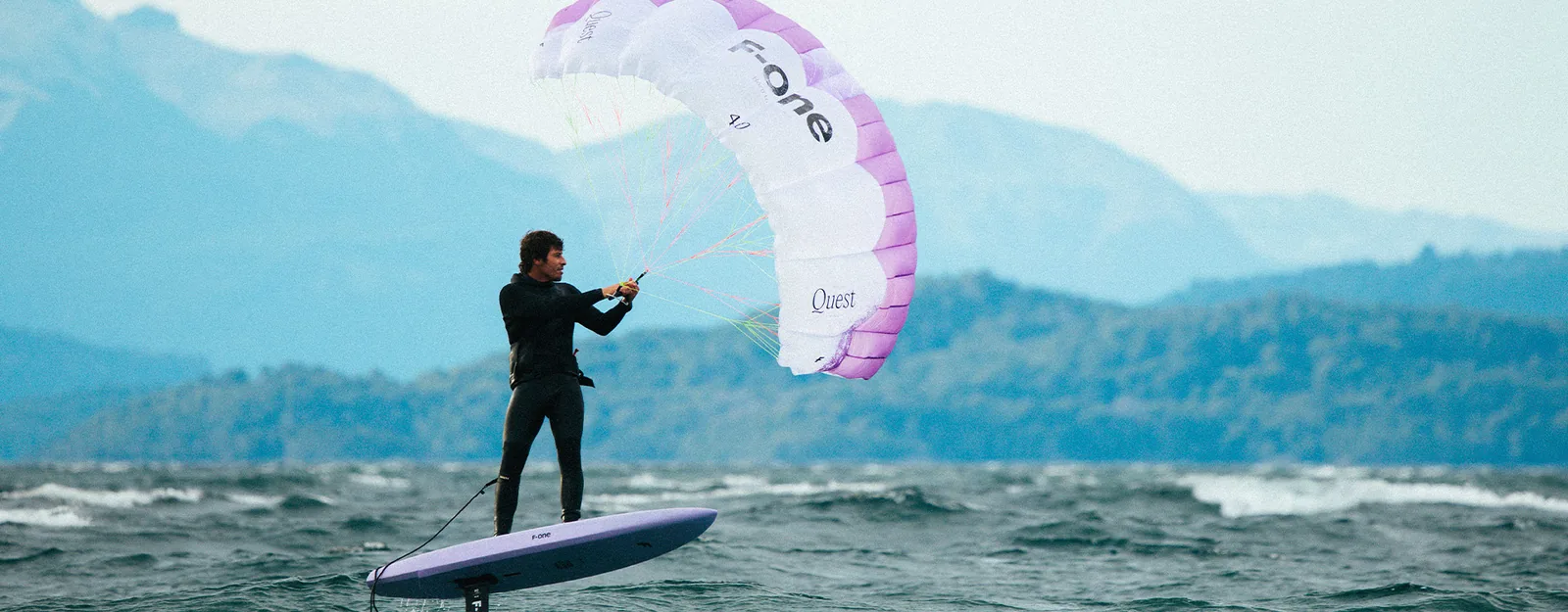
Rider in a black wetsuit standing on a foil, choppy lake and wooded hills, under a white and lilac F-One Quest parawing
The Quest in its lilac colorway, on a lake · © F-One
White and magenta F-One Quest parawing canopy seen backlit, ribs visible, blue sky and wooded hill behind
The Quest canopy backlit · © F-One
F-One

F-One Quest 2026 parawing test

  • Riding styleParawing, downwind, freeride
  • Sizes2 to 6 m²
  • Bar21 to 35 cm
  • Wind11 to 38 knots
  • Year2026

Verdict in brief

The parawing I would put in a beginner’s hands first: eight sizes from 2.0 to 6.0 m², wide wind range, 0.65 kg in 4.0 m² with the bar and harness line, very simple stowing and relaunch. The Inertia and a field test relayed by GlissEvolution say the same thing, and the same limit: it goes upwind well but less quickly than the Frigate V2, the Hatch V2 or the Afterburner.

A single independent outlet, The Inertia (two articles). Hydro Gav’s test, relayed by GlissEvolution, points the same way but is not counted; I haven’t done a test myself.

For you if

  • You are starting out in parawing: The Inertia makes it its beginner pick, because it gives lots of power at the low end of the wind range and is among the easiest wings to get up on the foil
  • You do downwind or surf: relaunch is quick, collapse is done by pulling a single A line, and the wing stays forward in the window
  • You ride in gusty conditions: Hydro Gav’s field test (3.6 m²) holds over 30 knots with no surge and no collapse on the front lines

Not for you if

  • You are aiming for VMG or racing: The Inertia and GlissEvolution find it slower and lower upwind than the Frigate V2, the Hatch V2 or the Afterburner
  • You want a very lively wing: steering is damped, on purpose, and you have to change your grip to fully release in downwind
  • You want a wide wind range on a single size: the top end of the range is narrower than that of the latest-generation wings

Have you ridden this model? Leave the first review

What we know about this model

Our method
  • Specificationschecked early November 2026
  • 1 test publishedThe Inertia (a single outlet, two articles by the same writer): “F-One Quest Review” (May 7, 2026, sizes tested: 3, 3.5, 4 and 5 m²) and “The Best Parawings” (October 29, 2026, Quest section): read in full on November 9, 2026
  • Rider reviewsgive yours, and it will appear here

Sizes, weight, wingspan and bar length

Sizes, weight, wingspan, wind range and bar length
SizeWing weightWindBar length
2 m²0.34 kg28+ knots21 cm
2.5 m²0.39 kg25 – 38 knots21 cm
3 m²0.43 kg21 – 35 knots25 cm
3.5 m²0.48 kg19 – 33 knots25 cm
4 m²0.52 kg17 – 28 knots25 cm
4.5 m²0.57 kg15 – 24 knots35 cm
5 m²0.61 kg13 – 21 knots35 cm
6 m²0.7 kg11 – 19 knots35 cm

Wind ranges in knots, with no reference rider: shift them according to your weight and your foil. The Inertia’s test finds that the ranges of the 3, 4 and 5 m² match those of an inflatable wing of the same size.

More details on these figures

Wind ranges in knots, weight of the wing alone, vertical bar length: table from the official F-One page as of November 9, 2026. The weight with bar and harness line is in the specs. The 2.0 m² is given as “28+”, with no precise upper limit. F-One does not state the reference rider weight. Wingspan not published.

Strong points, weak points

Strong points

  • Vertical carbon bar with harness line included, stiff enough to hook in with one hand; the bent section clears lines that snag
  • Double Dynamic bridles, with no pulley or spreader bar, with only two connection points: fewer tangles and more room for your hands on the bar
  • Pack Assist: you slide your hand a few centimeters along the white bridles and the wing goes neutral
  • Light: 0.34 kg (2.0 m²) to 0.70 kg (6.0 m²) for the wing alone, 0.65 kg in 4.0 m² with bar and harness line
  • Stable in the window and quiet across the whole range: The Inertia and Hydro Gav both stress this stability

Weak points

  • Less speed and upwind ability than the performance wings: The Inertia credits it with about 90% of the Frigate’s upwind ability, GlissEvolution talks about a good angle but a lagging VMG
  • Damped steering: pleasant for progressing, less so for technical freestyle
  • Lines a bit thin and abrasive on the hands at collapse, according to The Inertia and GlissEvolution

The flaw to know about. For me, its real flaw: it is no longer the best all-around parawing on the market. The Inertia had ranked it number one in its previous guide, then wrote that the competition has caught up with its level and that the Hatch V2 has become the best all-rounder of 2026. The Quest remains the wing it would hand to a beginner, but if you already know how to foil and you are after VMG, look at the Frigate V2, the Hatch V2 or the Afterburner.

Specifications

13 specs, sources at the bottom of the page

Program (manufacturer)
Pocket wing (parawing) “accessible and intuitive”, made for heading offshore, following the bumps and letting yourself go; opens up parawing and downwind to beginners and experienced riders alike. Softer canopy, shorter lines and a simplified panel layout compared with the Frigate
F-One profile
Low end 90%, top end 90%, ease of use 95%, speed / upwind ability 80%, stowing 100% (F-One’s in-house scale, not a measurement; F-One gives no unit or method)
Construction
Single-skin, medium aspect ratio, D-shaped ribs, Double Dynamic bridles (no pulley), only two connection points on the bar, Pack Assist system to neutralize the wing with one hand
Bar
Vertical carbon bar, upward-bent extension, molded protective parts; 21 cm (2.0 and 2.5 m²), 25 cm (3.0, 3.5 and 4.0 m²), 35 cm (4.5, 5.0 and 6.0 m²). Single-point harness line included, GlissEvolution gives an asymmetric bar of 35 cm maximum
Sizes
2.0, 2.5, 3.0, 3.5, 4.0, 4.5, 5.0 and 6.0 m²
Wind range (knots)
2.0 m²: 28+; 2.5: 25-38; 3.0: 21-35; 3.5: 19-33; 4.0: 17-28; 4.5: 15-24; 5.0: 13-21; 6.0: 11-19. F-One does not specify the reference rider weight
Weight of the wing alone (kg)
0.34 (2.0 m²), 0.39 (2.5), 0.43 (3.0), 0.48 (3.5), 0.52 (4.0), 0.57 (4.5), 0.61 (5.0), 0.70 (6.0)
Weight of bar + harness line + wing (kg)
0.46 (2.0 m²), 0.50 (2.5), 0.56 (3.0), 0.61 (3.5), 0.65 (4.0), 0.72 (4.5), 0.76 (5.0), 0.85 (6.0)
Line length
140 cm for the 4.0 m² (measurement reported by The Inertia, not published by F-One)
Colorways
Red and white (B- Red / White), lilac and white (A- Lilac / White); the F-One page offers two color references depending on the size
F-One reference
77261-2002A
Wingspan
n/a: F-One does not publish the wingspan by size
Model year
SS2026 range (F-One gallery visuals); the manual that can be downloaded on the F-One page is titled “2027 Pocket Wing UG”

What the published tests say

1 test published, checked early November 2026

The Inertia, “F-One Quest Review: Finally, a Parawing for Foiling That Does It All” (author not named in the text recorded; photos Will Sileo and Bowen Dwelle); same outlet, comparison guide “The Best Parawings: Tested and Ranked for Foiling Freedom” (October 29, 2026, https://www.theinertia.com/gear/best-parawings/)

Test done in San Francisco Bay with a quiver of 3, 4 and 5 m². The writer presents it as the first of the 2026 parawings to offer ease of use and a wind range close to an inflatable wing. Strengths: easy and predictable flying, collapse by a single A line (four colored A lines spliced into one), no tangles in testing, bar “one of the best tested”, careful finish, stiff harness line for hooking in with one hand. It pumps well and sits deeper in the window than the Frigate, so it is well suited to waves, downwind and freeride; the 4 m² flown in a 3 m wind stays flawless. Limits: about 90% of the Frigate’s upwind ability, lines a bit thinner than the Frigate’s, which can feel a bit sharp at collapse. Compared with Ozone’s Powerpack, he gives the edge to the Quest. Comparison guide from the same outlet (October 29, 2026): the Quest is “Best for Beginners” there, tested in 3, 3.5, 4 and 5 m². It gives lots of power at the low end, stays stable and intuitive, with excellent relaunch, a good bar, a color-coded line set; 140 cm lines in 4 m². Against: it doesn’t match the latest performance wings in speed, wind range or upwind ability. It is no longer the best all-around parawing, the Hatch V2 takes that spot and is barely less easy (translated from English).

Read the test
Articles from shops and schools (1), not counted as tests

These articles come from sites that sell or rent gear: they are cited for information and kept separate from published tests.

GlissEvolution (French retailer), “F-One Quest 2026 : test Hydro Gav” (page updated on March 25, 2026)checked on 09/11/2026

Report of Hydro Gav’s field test, in 3.6 m², from light wind to gusts of more than 30 knots. For him, the Quest is probably the easiest parawing to use to date, well finished, and its asymmetric bar is the best in its segment. The trade-off: steering is damped and VMG lags behind the Frigate, with a good angle but not the speed; he keeps the Frigate for 90% of his sessions. Report written by the retailer, original video (translated from English).

Rider feedback collected from the web (3)

Feedback found on the web, reworded. Never published as site reviews. Sample of 3 messages on the Progression Project forum (August and October 2026), all from owners of the wing; only one regrets the upwind ability.

Progression Project, forum, thread “Best size up Pocket Rocket from 3.5 F-one Quest?”2026-08-21

Member “pdubbs”, 72 kg, advanced-beginner parawing level, 84 L midlength board

He bought a 3.5 m² Quest to learn and says it has been very good. He added a used Pocket Rocket V2 to it for upwind speed.

Progression Project, forum, same thread2026-08-23

Member “LaPaloude”, 82 kg

He flies a 3 m² Quest with a 4.3 m² Pocket Rocket V2 and says he is happy with the overlap of the two ranges.

Progression Project, forum, thread “Best ~5m parawings”2026-10-01

Member “Velocicraptor”

He flies the 5 m² Quest and says it serves him very well, but he would like more upwind ability and is looking at the Frigate V2 and the Pocket Rocket V2.

Riders’ reviews

No reviews

No reviews yet.

Nobody has reviewed this gear yet. Do you use it? Help other riders of your weight — 2 minutes.

Leave your review (2 minutes)

Three screens: you, the gear, your review. Your email will never be published; it is only used to confirm that the review comes from a real person.

1/3 You

Only used to confirm your review and to let you know if it is rejected. Never displayed, never resold.

Your weight *

10 kg ranges only, so that other riders of your build can relate. No exact weight is recorded.

Your level *

Beginner: I’m still taking lessons. Intermediate: I ride on my own. Advanced: transitions and jumps. Expert: freestyle, wave or competition.

Your riding

Optional. If checked, your review stays published with the label “Gear received or tied to a brand” and doesn’t count toward the average rating.

You must be at least 15 to post a review (“Your data” article of the policy).

2/3 Your gear and how you use it
Wind range actually used (knots)
How long you’ve been using it *
Number of sessions (optional)
Rate each criterion (at least 3) *
Low-wind power
Stability / gusts
Steering & weight in hand
Handles & lines
Finish & durability

1 = very poor, 5 = excellent. Leave blank any criterion you couldn’t judge.

Do you recommend it? *
3/3 Your review

140 characters minimum — How it handles, its power and stability, what disappointed you, who you’d recommend it to.

Rider reviews: confirmed email address, no compensation. “Brand-linked” and “loaned / received” reviews are labeled and excluded from the average. Each review shows its publication date, the date of the experience and, if it was edited, its update date. A review is published or rejected within 7 days at most; if it is rejected, you receive the reason by email and you can correct it. You can complete or delete your review at any time from the email address used to submit it. How do reviews work?

Alternatives to compare

F-One Frigate V2 2027

The performance parawing from the same brand. The Inertia sees it as faster upwind, a bit heavier and more technical, with a less minimal relaunch than the Quest. The Quest is lighter, more forgiving and simpler to stow.

Naish Hatch V2 2026

The Inertia ranks it the best all-around parawing of 2026: a bit less simple to use than the Quest, but better VMG. J-bar and retractable harness line at Naish, nub at F-One.

Ozone Powerpack 2026

Ozone’s entry-level wing, lighter, lower-performing. For The Inertia, it is the closest competitor to the Quest: the Powerpack is an ultra-light wave tool, and the Quest seems to him more complete and better upwind.

Ozone Pocket Rocket V2

Forum riders pair a small-size Quest with a larger Pocket Rocket V2 to cover the whole range. The Pocket Rocket goes upwind faster but takes more hands-on input.

Frequently asked questions

Is the F-One Quest a good parawing for beginners?

Yes, that’s its role. The Inertia puts it in “Best for Beginners” in October 2026: lots of power at the low end, stable, intuitive, excellent relaunch. Hydro Gav, in the GlissEvolution test, sees it as the most accessible entry in its category. The hardest part of learning is getting out of the water onto the foil, and that is where it helps most.

Which Quest size should you choose?

Wind ranges in knots: 2.0 m² 28+; 2.5: 25-38; 3.0: 21-35; 3.5: 19-33; 4.0: 17-28; 4.5: 15-24; 5.0: 13-21; 6.0: 11-19, with no reference rider weight. A forum rider at 82 kg flies a 3 m² with a 4.3 m² from another brand; another, at 72 kg, started on a 3.5 m². The Inertia found the ranges of the 3, 4 and 5 m² close to those of an inflatable wing of the same size.

Quest or Frigate V2?

For me, the Quest for ease, learning, surf and downwind; the Frigate V2 for VMG and speed. The Inertia and GlissEvolution say the same thing: the Quest goes upwind well but less quickly, and the Frigate remains the wing for sessions where you are after performance.

How much does the Quest weigh?

The wing alone weighs 0.34 kg in 2.0 m², 0.52 kg in 4.0 m² and 0.70 kg in 6.0 m². With the bar and harness line, 0.65 kg in 4.0 m² and 0.85 kg in 6.0 m² (manufacturer’s page as of November 9, 2026).

Where can I check the current price?

See the current prices in the “Where to buy” section of this page.

Is there a test of the Quest?

Yes: The Inertia tested it in 3, 3.5, 4 and 5 m² (test of May 7, 2026, guide of October 29, 2026), and GlissEvolution reports Hydro Gav’s test in 3.6 m² (page updated on March 25, 2026). No review has been posted on WindUnity yet.

Method and limitations of this page

This page brings together the technical specs, tests from the press and blogs, and rider feedback found on the web, without rewriting any of it. When WindUnity has ridden the gear itself, the page says so with the “WindUnity test” badge.

Rider reviews are published as is, with their date. Reviews tied to a brand or based on loaned gear are labeled and excluded from the average.

What’s still missing

  • Prices of the sizes other than the 2.0 m² (F-One page) and the 5.0 m² (GlissEvolution): n/a
  • Wingspan by size: not published by F-One
  • Reference rider weight for the wind ranges: not specified
  • Exact release date: not given by F-One (GlissEvolution test of March 25, 2026 at the earliest)
  • Author of The Inertia article of May 7, 2026: not named in the text recorded
  • Rider reviews on WindUnity (N2): none

Sources

Data collected early November 2026

F-One : product page

Shops : GlissEvolution

Press and specialist sites : The Inertia

Forums and riders : Progression Project

See the details of the 7 sources

F-One

Shops

  1. GlissEvolution, F-One Quest 2026 : test Hydro Gav (EN)
  2. GlissEvolution, How to start parawing

Press and specialist sites

  1. The Inertia, F-One Quest Review
  2. The Inertia, The Best Parawings

Forums and riders

  1. Progression Project, Best size up Pocket Rocket from 3.5 F-one Quest?
  2. Progression Project, Best ~5m parawings