Skip to content
Burgundy and white Cabrinha Mantis 2027 wing, white circular logo, flat top view on white background
Mantis 2027, burgundy colorway · © Cabrinha
White Cabrinha Mantis 2027 wing with burgundy stripes fading to orange, black logo, top view on white background
Mantis 2027, white colorway · © Cabrinha
Two Cabrinha wings, one white with red patterns, the other magenta pink, held above a lagoon, mountains in the background
Mantis, two colorways on the water · © Cabrinha
Rider in the air with a white wing above him, turquoise board almost vertical, palm trees behind
Mantis in a jump · © Cabrinha
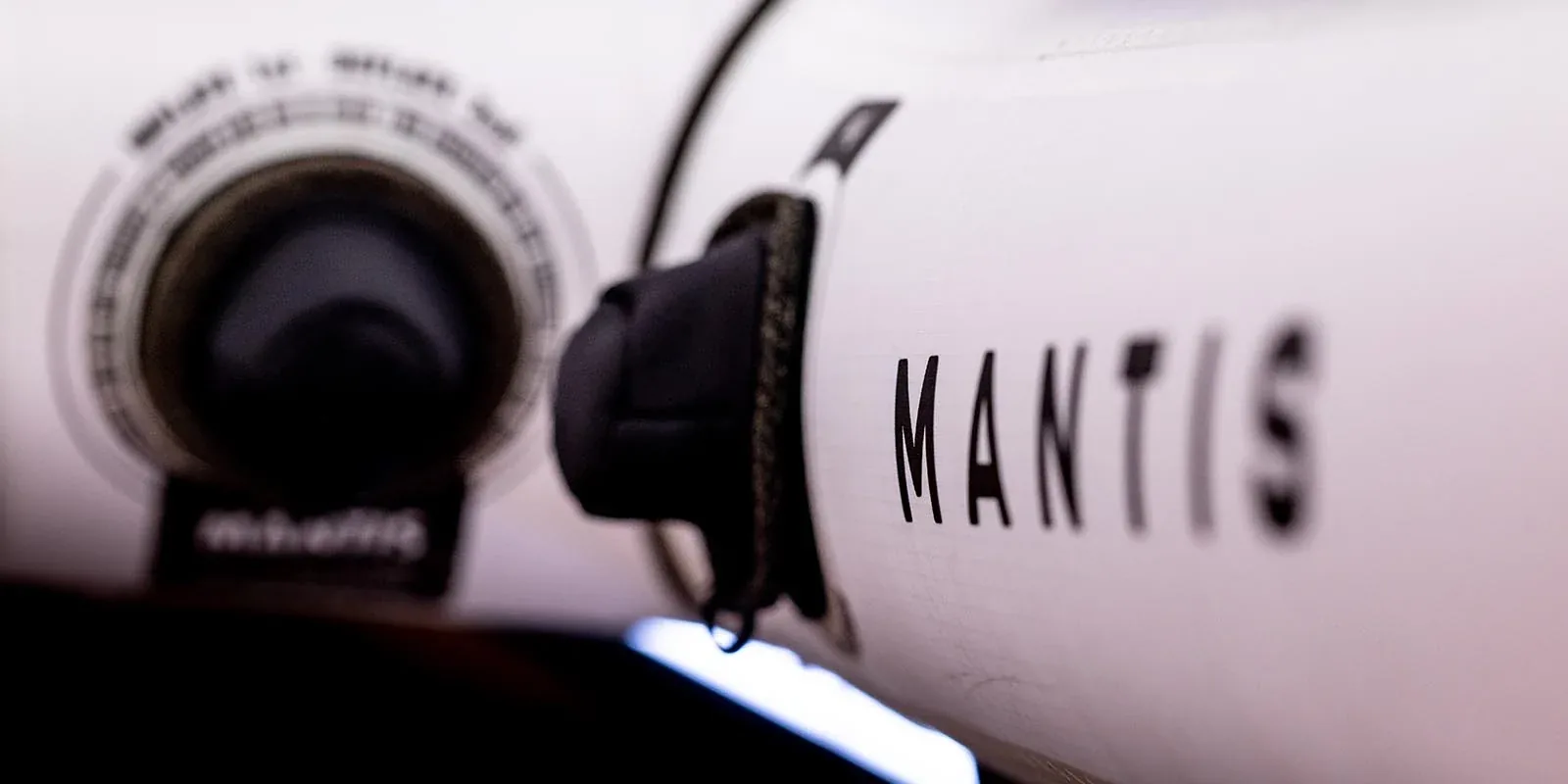
Close-up of the white tube of the Cabrinha Mantis: inflation valve with graduated ring, Mantis name in black, handle next to it
Mantis, detail of the inflation valve · © Cabrinha
Cabrinha

Cabrinha Mantis 2027 test

  • Riding styleFreeride, wave, big air
  • Sizes2 to 6 m²
  • YearModel 2027 · released Sep 2026
  • Wind7 to 45 knots

Verdict in brief

An all-round, powerful and balanced wing: tests of previous versions find it stable, with a good low end. Riders say it is more “grunty” than the Vision, and a bit demanding to get used to. The 2027 is too recent to have an independent test.

For you if

  • You want a powerful, stable and precise wing for freeride, wave and big air: that is its role in the Cabrinha range
  • You like a rigid boom and a rigid front handle for drifting in waves (Tonic Mag)
  • You want a good low end: Foiling Magazine and a Seabreeze rider (6 m) highlight it

Not for you if

  • You want a very forgiving wing in light wind: that is the Vision’s role, in the same range
  • You don’t want a wing that pulls hard: a Seabreeze rider (2023, on the V3) talks about a wing “with power, but a bit of a beast”
  • You want an independent opinion on the 2027: there is no test yet

Have you ridden this model? Leave the first review

What we know about this model

Our method

Sizes, weight and wingspan

Your size on this model

Nothing stated for now.

Enter your weight and wind: your size is highlighted in the table.

what wing size to choose based on your weight and the windIndicative reference · rule 2026-10-31.1

To find your size, open the calculator: your weight, the wind, your level. wing size calculator

Sizes, weight, wingspan, wind range and pressure
SizeWing weightWingspanWind
2 m²1.9 kg232 cm25 – 45 knots
2.5 m²2.05 kg257 cm20 – 40 knots
3 m²2.2 kg279 cm17 – 36 knots
3.5 m²2.4 kg296 cm16 – 34 knots
4 m²2.6 kg313 cm15 – 30 knots
4.5 m²2.75 kg328 cm13 – 27 knots
5 m²2.95 kg346 cm11 – 26 knots
5.5 m²3.1 kg359 cm9 – 24 knots
6 m²3.35 kg372 cm7 – 20 knots

Wind ranges for a 75 kg rider, weight without bag (tolerances vary): adjust them to your weight, board and level.

More details on these figures

Wind ranges published by Cabrinha for a 75 kg rider, wing weight without bag (tolerances vary according to Cabrinha) and wingspan read in the “Wind/Weight Chart” table of the Mantis 2027 page read on October 31, 2026; the 2 m² and 6 m² weights match Tonic Mag. Inflation pressure not published by Cabrinha on the Mantis 2027 page. Comparative benchmark: the actual choice depends on weight, foil, board, water conditions and level.

Strong points, weak points

Strong points

  • Stable, with accessible power and an excellent low end (Foiling Magazine, V3)
  • Goes upwind well and is not tiring when overpowered in the larger sizes (Foiling Magazine, V3)
  • Wide range of use: pumps up quickly when underpowered and takes gusts well (Tonic Mag, 2026)
Weak points

  • Flatter canopy than the Vision’s, so you have to pump more actively at the low end (Cabrinha via Tonic Mag, 2027)
  • The wingtip can dive when the wing is vertical and very powered up, notes a rider (Seabreeze, V4)
  • A 90 kg rider finds it powerful but “a beast” to handle, with thin handles (Seabreeze, V3 2023)

The flaw to know about. Riders describe a wing that pulls hard and needs micro-corrections at first. A 90 kg rider had to position himself much further downwind to power it up (V3, 2023), another notes that the wingtip can dive when vertical (V4, 2025). These reports concern previous versions.

Model evolution

  • Previous version Cabrinha Mantis 2026 (“Handlebar” boom-type handle replacing the two handles)

What changes vs the Mantis 2026 (announced by Cabrinha)

  • New aerodynamic profiles (better front hand pressure and balance)
  • Optimized canopy tension (early glide, consistent power)
  • Panel cut with radial load distribution
  • Teijin D2 canopy and new Teijin 75 trailing edge panels
  • 3-step hybrid leading edge: 160 g/m² in the center, 140 g/m² toward the wingtips
  • Redesigned drop strut, rigid boom, TruView visibility panel

Specifications

9 specs, sources at the bottom of the page

Program (manufacturer)
All Around Freeride, Wave and Big Air
Sizes
9 sizes: 2, 2.5, 3, 3.5, 4, 4.5, 5, 5.5 and 6 m²
Weight (without bag)
1.90 kg (2 m²) to 3.35 kg (6 m²)
Wingspan
2.32 m (2 m²) to 3.72 m (6 m²)
Canopy
Teijin D2 double ripstop; Teijin 75 trailing edge
Leading edge
3-step hybrid Dacron: 160 g/m² in the center, 140 g/m² toward the wingtips; reinforced double center section
Control
Single rigid boom with angled Keylock fittings; rigid front handle; drop strut
Visibility and valve
TruView mesh panel; high-capacity one-way valve, twist locking
Foiling Magazine measurement (V3, 2023)
4 m²: 2.22 kg

What the published tests say

2 tests published, checked late October 2026

The Foiling Magazine (Mantis V3, 2023)

V3 test: “a balance between stability and accessible power”, excellent low end, good crossover between disciplines; doesn’t stall even when sheeted in aggressively, goes upwind well and is not tiring when overpowered in the larger sizes. New semi-rigid molded handles, stiffer frame, reworked inflation, stiffer leading edge. V3 version, not the 2027.

Read the test
Tonic Mag (Mantis 3.5 m 2026, by Rou Chater)

2026 version: the “Handlebar” boom is presented as the major improvement, lighter and more direct; rigid front handle stabilizing in drift; excellent low end without being too “grunty”; pumps up quickly when underpowered and handles big gusts; clean turns. 2026 version, not the 2027.

Read the test
Rider feedback collected from the web (5)

5 pieces of feedback (V3 and V4 versions, never the 2027), never published as site reviews. Sources in English and German, translated by WindUnity.

Seabreeze (forum, EN)2025-05-27

Rider from Neusiedler See (Austria), Mantis V4 5 m for a year, 12 to 20 knots, compares with a Vision V3 4 m

He uses it by default from 12 to about 20 knots: very stable, good upwind, gust-resistant; “great” handles and a comfortable rigid front handle. He switches to the Vision V3 when the wind picks up.

Seabreeze (forum, EN)2025-05-27

Rider with the 6 m (Mantis V4), weight not specified; knows friends of 95 and over 100 kg with 4 m ones and two 5 m ones

The 6 m is his light-wind weapon: very good low end, pumps up easily, comfortable rigid handles, good float with the rigid front handle, turns well. Flaws: wingtip that can dive when vertical, adaptation needed for sharp gusts.

Seabreeze (forum, EN)2023-06-11

90 kg, Armstrong HA1125 foil and 80 L board; demoed the Mantis V3 4.0 m² in 20 knots; rides North Nova V2 and Mode

Disappointed: thin, fragile handles (coating coming off), powerful wing but “a beast”, lots of micro-adjustments, has to be positioned further downwind to power it up, flipped over by the side wind after falls. He judges it a generation behind. Another rider in the thread prefers the Mantis V3 to the Mode and the Nova V3 4 m (“too much raw power, tiring”).

Oaseforum (German forum)2024-02-20

Rider who has had Mantis and Vision; foils and mast not specified

Good wings with an “absolutely top” finish, but not to his taste: lots of baseline pull, like Cabrinha’s Crossbow and Switchblade kites.

Oaseforum (German forum)2024-02-21

Mantis user since the Mk1; bought a Mantis MK3 the year before for his partner

His partner, who rode a Duotone Unit, finds the Mantis much more pleasant (the Unit “way too restless”). He rides the Vision in 8 m: less balanced than the Mantis, but with more baseline pull to get going early.

Riders’ reviews

No reviews

No reviews yet.

Nobody has reviewed this gear yet. Do you use it? Help other riders of your weight — 2 minutes.

Leave your review (2 minutes)

Three screens: you, the gear, your review. Your email will never be published; it is only used to confirm that the review comes from a real person.

1/3 You

Only used to confirm your review and to let you know if it is rejected. Never displayed, never resold.

Your weight *

10 kg ranges only, so that other riders of your build can relate. No exact weight is recorded.

Your level *

Beginner: I’m still taking lessons. Intermediate: I ride on my own. Advanced: transitions and jumps. Expert: freestyle, wave or competition.

Your riding

Optional. If checked, your review stays published with the label “Gear received or tied to a brand” and doesn’t count toward the average rating.

You must be at least 15 to post a review (“Your data” article of the policy).

2/3 Your gear and how you use it
Wind range actually used (knots)
How long you’ve been using it *
Number of sessions (optional)
Rate each criterion (at least 3) *
Low-wind power
Stability / gusts
Maneuverability & weight in hand
Boom / handles
Finish & durability

1 = very poor, 5 = excellent. Leave blank any criterion you couldn’t judge.

Do you recommend it? *
3/3 Your review

140 characters minimum — Its low-end power, its stability in gusts, what disappointed you, who you’d recommend it to.

Rider reviews: confirmed email address, no compensation. “Brand-linked” and “loaned / received” reviews are labeled and excluded from the average. Each review shows its publication date, the date of the experience and, if it was edited, its update date. A review is published or rejected within 7 days at most; if it is rejected, you receive the reason by email and you can correct it. You can complete or delete your review at any time from the email address used to submit it. How do reviews work?

Alternatives to compare

Duotone Unit 2026

Duotone: 10 sizes from 2.0 to 6.5 m², boom or handles as a paid option. Cabrinha: 9 sizes from 2 to 6 m², rigid boom as standard. An Oaseforum rider says his partner, coming from the Unit, finds the Mantis much more pleasant (2024).

Cabrinha Vision 2026

Same brand: the Vision has a fuller canopy and more dihedral. It is announced as the very-light-wind choice, while the Mantis aims for a wider range and more active handling (Tonic Mag). Classed “Freeride / Freestyle” at Cabrinha.

F-One Strike V6

Same range of 9 sizes from 2 to 6 m². Wind ranges are given for 75 kg on both sides, but F-One shows no ceiling on its two smallest sizes (2 m²: “35+” knots, 2.5 m²: “30+”), whereas Cabrinha shows 25 to 45 knots for the Mantis 2 m². The two brands do not show their prices in the same currency.

Other versions of this model

Cabrinha Mantis

Frequently asked questions

Is there a test of the Cabrinha Mantis?

Not on the 2027, released in September 2026. The Foiling Magazine tested the V3 (2023) and Tonic Mag the 2026 version: both are summarized and linked above.

What do riders say about the Cabrinha Mantis?

The feedback found (Seabreeze, Oaseforum) describes a stable wing, with a good low end and good upwind ability, but a lot of baseline pull. Opinions are divided on the V3 and V4; none concerns the 2027.

Which sizes and wind ranges for the Mantis 2027?

9 sizes from 2 to 6 m². Ranges for a 75 kg rider: 2 m 25-45 knots, 2.5 m 20-40, 3 m 17-36, 3.5 m 16-34, 4 m 15-30, 4.5 m 13-27, 5 m 11-26, 5.5 m 9-24, 6 m 7-20.

What is the difference between the Mantis V3, V4, 2026 and 2027?

The V3 (2023) brings semi-rigid molded handles, the 2026 moves to the rigid boom, the 2027 reworks the profiles, canopy tension and radial panel cut. For the V4, we don’t know whether it corresponds to the 2025: Cabrinha does not confirm it in our readings.

Mantis or Vision?

In the Cabrinha range, the Vision is announced as the most forgiving in very light wind (fuller canopy, more pronounced dihedral); the Mantis is more versatile and more active. One rider switches to the Vision when the wind picks up (Seabreeze, V4/V3).

Method and limitations of this page

This page brings together the technical specs, tests from the press and blogs, and rider feedback found on the web, without rewriting any of it. When WindUnity has ridden the gear itself, the page says so with the “WindUnity test” badge.

Rider reviews are published as is, with their date. Reviews tied to a brand or based on loaned gear are labeled and excluded from the average.

What’s still missing

  • Retail price of the Mantis 2027 (the official shop shows 1,089 to 1,369 with no explicit currency in the data read): not published here
  • Weight by size (only the 2 m² and 6 m² values are published in the source read)
  • Independent test of the Mantis 2027: none
  • Publication date of the Foiling Magazine and Tonic Mag tests
  • V4 / 2025 name correspondence: not confirmed
  • WindUnity trial (N3) and WindUnity review: none

Sources

Data collected late October 2026

Cabrinha : 2 product pages

Press and specialist sites : Tonic Mag, The Foiling Magazine

Forums and riders : Seabreeze, Forum Oase

See the details of the 8 sources

Cabrinha

  1. Shop catalog for the Mantis 2027

Press and specialist sites

  1. Tonic Mag, Mantis 3.5 m 2026
  2. The Foiling Magazine, Mantis V3

Forums and riders

  1. Seabreeze, Mantis V4
  2. Seabreeze, Mantis V3
  3. Oaseforum, Cabrinha