Skip to content
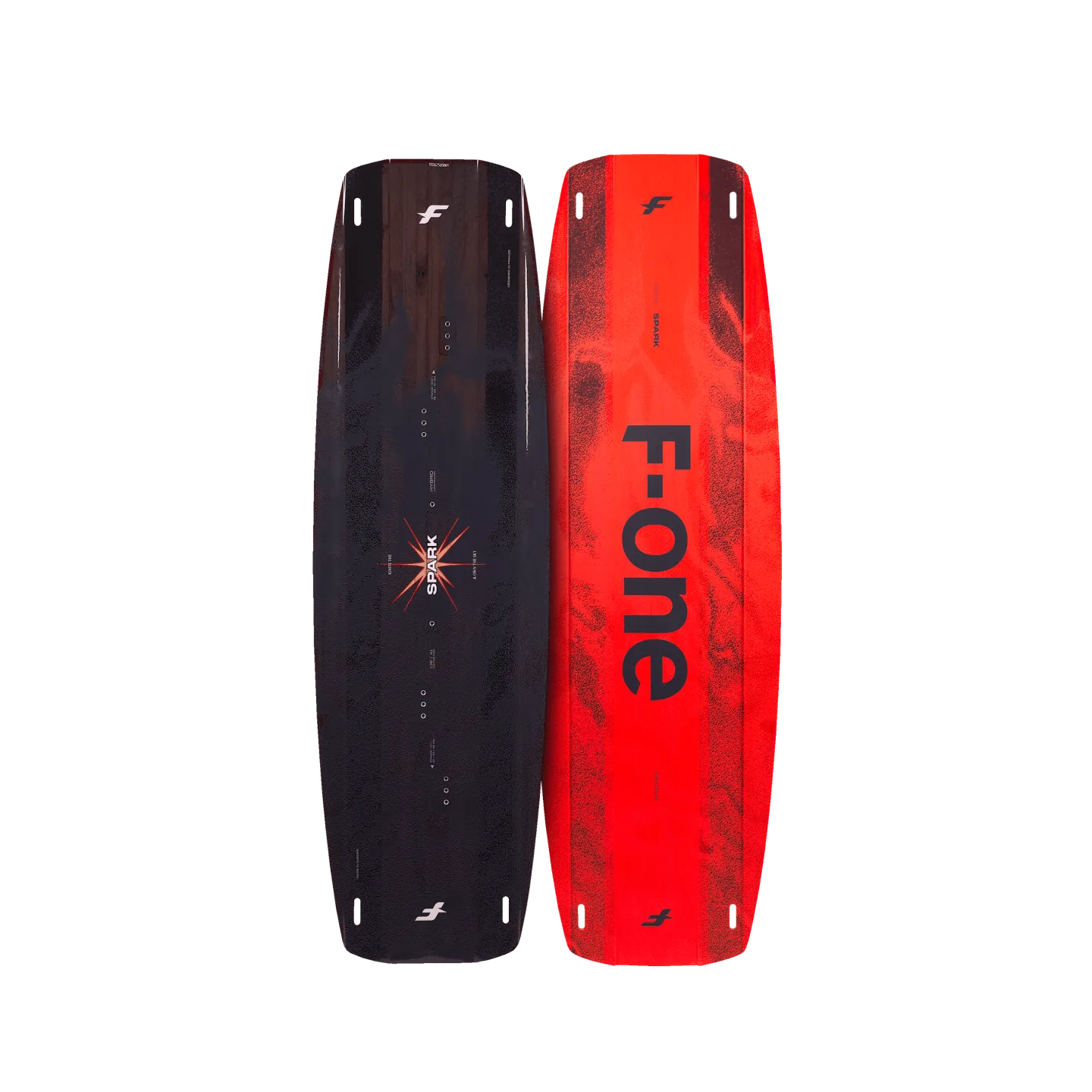
F-One Spark twin-tip kiteboard: dark wood-look deck and red-orange bottom, top and bottom view
Spark, deck and bottom · © F-One
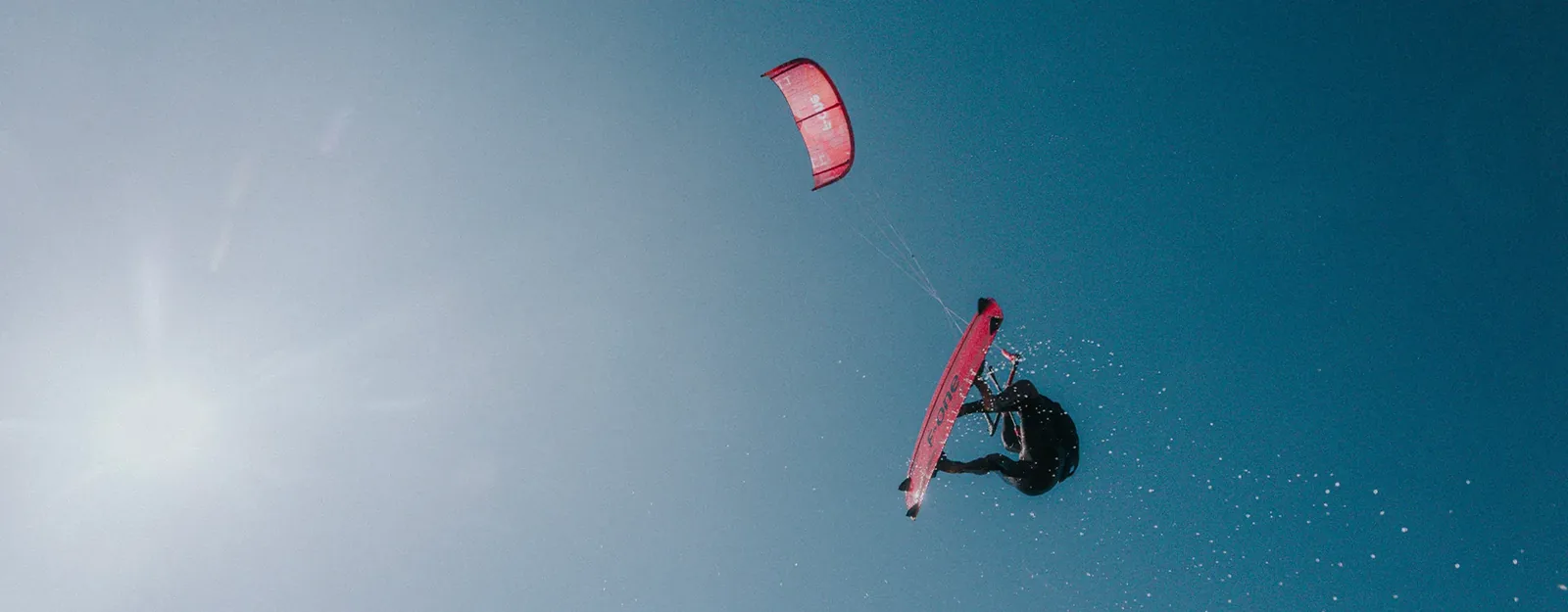
Kitesurfer mid-jump against the light, red kite and board, water droplets around him, F-One Spark
Backlit jump, photo from F-One’s Spark gallery · © F-One
Kitesurfer almost upside down, board raised, above choppy water in front of wooded hills, F-One Spark
Inverted jump in front of wooded hills, photo from F-One’s Spark gallery · © F-One
F-ONE

F-One Spark 2026 test

  • Riding styleBig air, strong-wind freeride; hybrid construction
  • Sizes134×39,5 to 140×43 cm
  • YearModel 2026 · released Sep 2025

Verdict in brief

The Spark is F-One’s big air twin-tip in hybrid construction (carbon strips on a paulownia core): four sizes from 134×39.5 to 140×43 cm, 2.3 to 2.6 kg Unibox fins included. Only one test found, Ridersguide’s: very good grip and control, even in the chop, with a bit more cushioning and forgiveness than the Carbon. No rider weight published.

Only one published test (Ridersguide, together with the Carbon), checked on November 7, 2026.

For you if

  • You want to jump higher without paying for the carbon version: Ridersguide finds it more forgiving than the Carbon, with a bit more cushioning
  • You ride in strong wind and in the chop: Ridersguide notes very good control on both Sparks, including in solid chop
  • You’re coming from a freeride twin-tip like the Trax and want to move up to big air: Kitemana (retailer) finds it a notch above in grip and pop, with more channels and a double concave

Not for you if

  • You’re looking for an easygoing board to learn or cruise on: that is the Trax’s role, the Spark is made for big air and strong wind
  • You want the stiffest, most nervous board at takeoff: take the Spark Carbon, with a more aggressive pop according to Ridersguide
  • You choose your size by your weight: F-One publishes no rider weight range for the Spark

Have you ridden this model? Leave the first review

What we know about this model

Our method
  • Specificationschecked early November 2026
  • 1 test publishedRidersguide, expert review of the Spark Hybrid and Carbon (page published on November 13, 2025), read in full on November 7, 2026
  • Rider reviewsgive yours, and it will appear here

Sizes, volume and weight

Sizes, volume, weight and recommended rider
SizeLength × widthBoard weightRecommended riderFins
134×39,5134 × 39.5 cm2.3 kgn.c.4 Unibox 50 mm fins
136×41136 × 41 cm2.3 kgn.c.4 Unibox 50 mm fins
138×42138 × 42 cm2.5 kgn.c.4 Unibox 50 mm fins
140×43140 × 43 cm2.6 kgn.c.4 Unibox 50 mm fins

Indicative lengths, widths and weights from F-One (page of November 7, 2026). No rider weight range published.

More details on these figures

Lengths, widths and weights: “Find my size” table on the F-One page (indicative weights, “subject to slight variations due to the manufacturing process”). Windance, GlissEvolution and Surfshop.fr copy the same weights, MACkite the same lengths and widths; the “recommended” column reuses Windance’s (retailer) size descriptions, not F-One advice. F-One publishes neither a rider weight range nor a wind range: n/a. Strap insert spacing and type are not published either.

Strong points, weak points

Strong points

  • Four sizes from 134×39.5 to 140×43 cm, from 2.3 to 2.6 kg, four 50 mm Unibox fins in the package
  • Softer takeoff and more cushioned landing than the Carbon (Ridersguide)
  • Very good control on both Sparks, right into solid chop (Ridersguide)

Weak points

  • No rider weight or wind range by size
  • Only one test, bundled with the Carbon, with no measurements or comparison with another board
  • Unibox fins that aren’t the stiffest, even if the grip is enough (Ridersguide)
  • Handle and bindings to buy separately at F-One Pro Shop, whereas Ridersguide talks of a handle included: check with your retailer

The flaw to know about. Only one test, shared with the Carbon, and no recommended rider weight. The table on the official page gives 2.3 / 2.3 / 2.5 / 2.6 kg for the Spark and 2.5 / 2.53 / 2.55 / 2.6 kg for the Carbon: the hybrid version is thus as light or lighter than the carbon one, whereas Ridersguide writes that the Carbon is a bit lighter and that, on F-One’s house scale, lightness is 90 for the Spark and 100 for the Carbon. The weights are indicative values, with slight manufacturing variations.

Specifications

12 specs, sources at the bottom of the page

Program (manufacturer)
Big air: explosive takeoffs, precise grip and control, at ease in strong wind, with a forgiving, accessible side thanks to the hybrid construction
Construction
Hybrid: unidirectional carbon strips placed where needed on a paulownia core; flat deck under the bindings
Shape
Compact outline, thin straight rails, balanced tips, flat sides, moderate rocker; Double Concave Step Design, channel along the whole length and double channel at the tips
Sizes
134×39.5, 136×41, 138×42 and 140×43 cm
Board weight
2.3 kg (134 and 136), 2.5 kg (138), 2.6 kg (140); indicative values, slight variations are possible
Recommended rider weight
n/a: F-One publishes no rider weight range (checked on November 7, 2026)
F-One in-house scale (in %)
Planing start 80, grip 80, landing 90, pop 80, comfort 90, lightness 90, speed 90
Fins
4 Unibox fins of 50 mm included; F-One patented Unibox system, thin asymmetric profile
Delivered with
Board and four 50 mm Unibox fins (MACkite). F-One Pro Shop: handle and bindings to order separately. Ridersguide mentions a hard plastic handle included as standard, which the two shops don’t mention
Colorways
Red and black (MACkite): dark deck, red-orange bottom on the F-One visual
Reference
77263-0602
Release date
September 2025 (F-One launch film of September 4, 2025)

What the published tests say

1 test published, checked early November 2026

Ridersguide, expert review F-One Spark Hybrid and Carbon (product page published on November 13, 2025, updated on April 19, 2026)

The testers rode both Sparks, with Platinum 3 bindings (old and new version), no size specified. Same compact, fairly squared shape, sharp rails, double channels at the tips: grip is at its maximum, which lets you raise line tension to jump high and far. The Carbon has a slightly more aggressive pop and demands more skill; the Hybrid breaks away more gently and is more forgiving. The double concave and the channel along the whole length clear the water even after a hard landing: stable exit from the water, tricks strung together without a hitch. The Hybrid absorbs a little more; the Carbon suffers a little less from “reverse flex” on very hard landings. The flat sides make it unstick from the water quickly; the Carbon responds slightly faster under the feet and demands more active riding, the Hybrid is more relaxed. Medium rocker: both accelerate fast and reach a very high top speed. Very good control on both, even in sturdy chop; the Carbon calls for slightly sharper edging. Boards made in Europe, 5 cm Unibox fins with an asymmetric profile, color-coded; not the stiffest, but enough grip. The tester writes that the hard plastic handle is supplied as standard; a 7 cm big air handle is sold separately (translated from Dutch). No measurements, no comparison with another board.

Read the test

Riders’ reviews

No reviews

No reviews yet.

Nobody has reviewed this gear yet. Do you use it? Help other riders of your weight — 2 minutes.

Leave your review (2 minutes)

Three screens: you, the gear, your review. Your email will never be published; it is only used to confirm that the review comes from a real person.

1/3 You

Only used to confirm your review and to let you know if it is rejected. Never displayed, never resold.

Your weight *

10 kg ranges only, so that other riders of your build can relate. No exact weight is recorded.

Your level *

Beginner: I’m still taking lessons. Intermediate: I ride on my own. Advanced: transitions and jumps. Expert: freestyle, wave or competition.

Your riding

Optional. If checked, your review stays published with the label “Gear received or tied to a brand” and doesn’t count toward the average rating.

You must be at least 15 to post a review (“Your data” article of the policy).

2/3 Your gear and how you use it
Wind range actually used (knots)
How long you’ve been using it *
Number of sessions (optional)
Rate each criterion (at least 3) *
Comfort / cushioning
Pop & jump
Grip / upwind ability
Maneuverability
Finish & durability

1 = very poor, 5 = excellent. Leave blank any criterion you couldn’t judge.

Do you recommend it? *
3/3 Your review

140 characters minimum — How it behaves in chop and on landing, what disappointed you, who you’d recommend it to.

Rider reviews: confirmed email address, no compensation. “Brand-linked” and “loaned / received” reviews are labeled and excluded from the average. Each review shows its publication date, the date of the experience and, if it was edited, its update date. A review is published or rejected within 7 days at most; if it is rejected, you receive the reason by email and you can correct it. You can complete or delete your review at any time from the email address used to submit it. How do reviews work?

Alternatives to compare

F-One Spark Carbon 2026

Same shape, but in full carbon: stiffer, more aggressive pop and more demanding (Ridersguide). The F-One table nevertheless gives it as heavy or heavier: 2.5 / 2.53 / 2.55 / 2.6 kg against 2.3 / 2.3 / 2.5 / 2.6 kg.

F-One Trax 2027

Same brand, opposite role: the Trax is the freeride twin-tip, forgiving and easy. On F-One’s house scale, it has the planing start at 90 (80 for the Spark) but landing and pop at 70 (90 and 80 for the Spark).

Duotone TS Big Air SLS 2027

Another brand, a competition big air board: carbon and Innegra, three sizes from 133×39 to 139×41 cm, 2.3 to 2.7 kg. It targets the high level where the Spark aims to be more accessible.

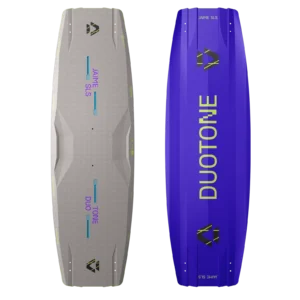
Duotone Jaime SLS 2027

Another brand, a freestyle and big air board: four sizes from 133×40 to 142×43 cm, 2.37 to 2.92 kg. It also serves freestyle, where the Spark concentrates on big air.

Other versions of this model

F-ONE Spark

Frequently asked questions

Which F-One Spark size should you choose?

F-One gives no rider weight range for the Spark. It comes in 134×39.5 (2.3 kg), 136×41 (2.3 kg), 138×42 (2.5 kg) and 140×43 cm (2.6 kg). Windance describes the 134 as the most compact and lively, the 136 as the most balanced, and the 140 as the one that offers the most planing and support on landing. The safest route: ask your retailer for advice with your weight, your kite and your spot.

Spark or Spark Carbon: which one should you choose?

Same shape, two constructions. The Spark is hybrid: softer takeoff, more cushioning, more forgiveness. The Carbon is full carbon: stiffer, more aggressive pop, more demanding (Ridersguide). Watch the weights: the official table gives the Spark as light or lighter (2.3 to 2.6 kg against 2.5 to 2.6 kg), whereas Ridersguide and Kitemana write the Carbon as lighter. If you jump a lot and string tricks together, the Carbon. Otherwise, the Spark is enough.

Is there a test of the F-One Spark?

Only one: Ridersguide rode the Spark Hybrid and the Spark Carbon (page of November 13, 2025). Very good grip and control, even in the chop; the Hybrid is softer at takeoff and cushions a bit more. No test at Gleiten.tv, TheKiteMag or IKSURFMAG as of November 7, 2026.

Is the F-One Spark a big air or freeride board?

Big air first: F-One classes it as “Big Air”, with a compact shape, thin rails and channels in the tips. It stays forgiving thanks to the hybrid construction, and its flat sides help it release from the water quickly. For easygoing freeride, the Trax is more forgiving.

What comes in the F-One Spark package?

The four 50 mm Unibox fins are included (MACkite). At F-One Pro Shop, handle and bindings are ordered separately. Ridersguide, for its part, talks of a hard plastic handle delivered as standard: ask your retailer what is in the box.

How many sizes does the F-One Spark 2026 come in?

The F-One Spark 2026 comes in four sizes. A Spark Carbon version also exists. For the price, see the “Where to buy” section of this page.

Method and limitations of this page

This page brings together the technical specs, tests from the press and blogs, and rider feedback found on the web, without rewriting any of it. When WindUnity has ridden the gear itself, the page says so with the “WindUnity test” badge.

Rider reviews are published as is, with their date. Reviews tied to a brand or based on loaned gear are labeled and excluded from the average.

What’s still missing

  • Only one test, bundled with the Carbon and with no date of its own; no rider feedback found
  • No rider weight range or wind range by size at F-One; stance width and type of strap inserts not published
  • Weight: the F-One table gives the Carbon as heavy or heavier than the Spark, whereas its own scale rates the Carbon lighter (100 against 90) and Ridersguide writes it lighter
  • Package contents unclear: MACkite lists only the fins, F-One Pro Shop supplies neither handle nor bindings, Ridersguide mentions a handle included
  • F-One page undated: the “2027 TT UG” guide is linked from the page, but no 2027 Spark exists.
  • F-One doesn’t distinguish retail price from reseller price

Sources

Data collected early November 2026

F-ONE : 3 product pages, brand video

Shops : F-ONE Pro Shop, MACkite, Windance, GlissEvolution

Press and specialist sites : Ridersguide

See the details of the 9 sources

F-ONE

  1. Official Spark Carbon page
  2. Spark and Spark Carbon film
  3. Official Trax page

Shops

  1. F-One Pro Shop, Spark Hybrid 2026
  2. Windance, Spark 2026 page
  3. GlissEvolution, Spark 2026 page

Press and specialist sites

  1. Ridersguide, Spark Hybrid and Carbon test