Skip to content
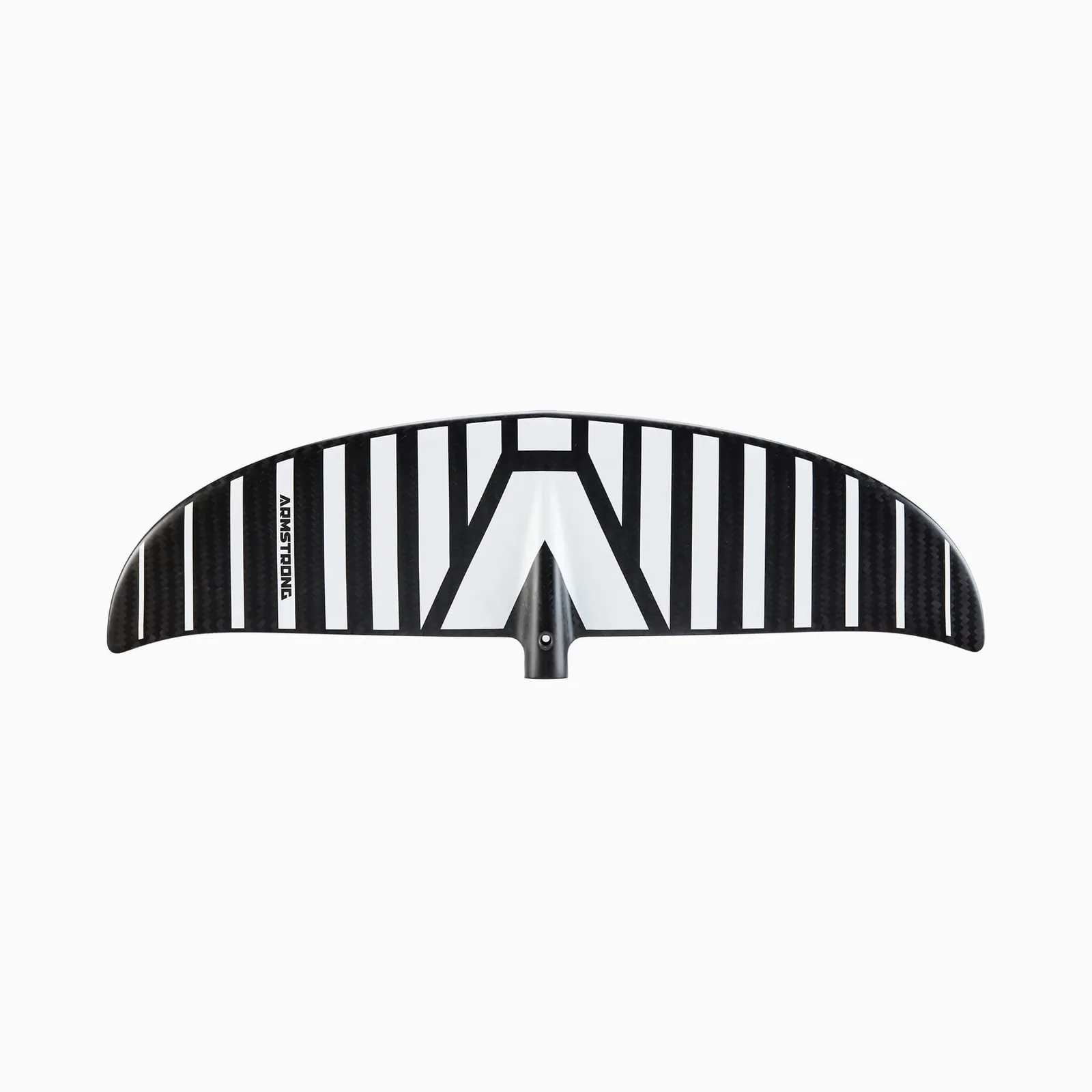
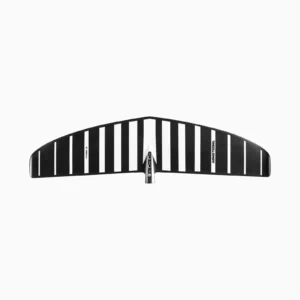
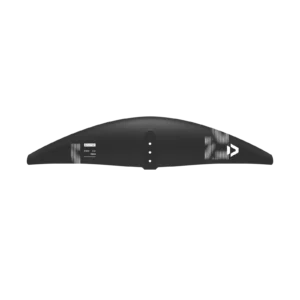
Armstrong CF V2 1200 front wing, short and wide, in black carbon with vertical white stripes and a central white A pattern
CF V2 front wing, 1200 cm² size · © Armstrong
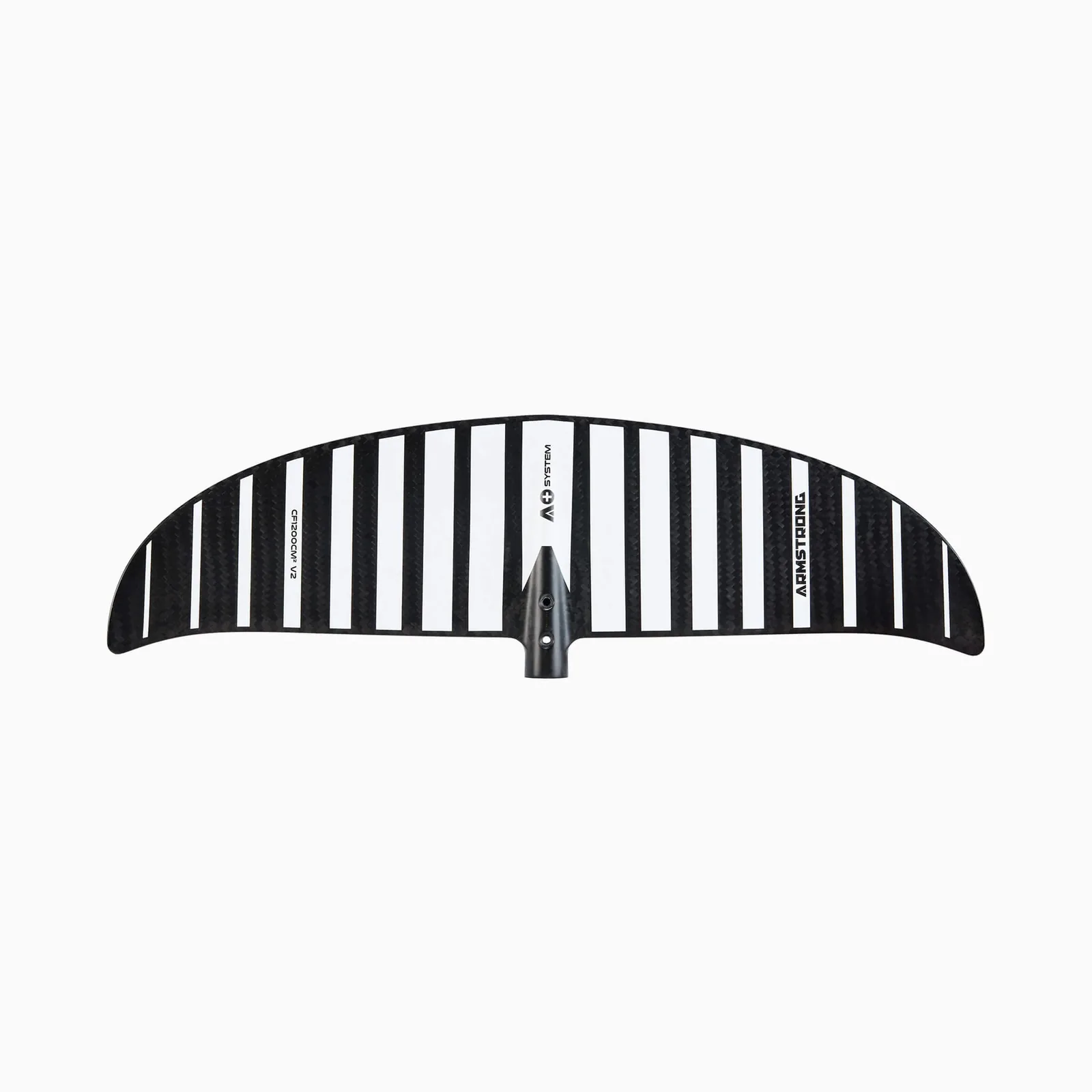
Armstrong CF V2 1200 front wing, black with vertical white stripes, second view of the packshot on a white background
The CF V2 front wing, second view · © Armstrong
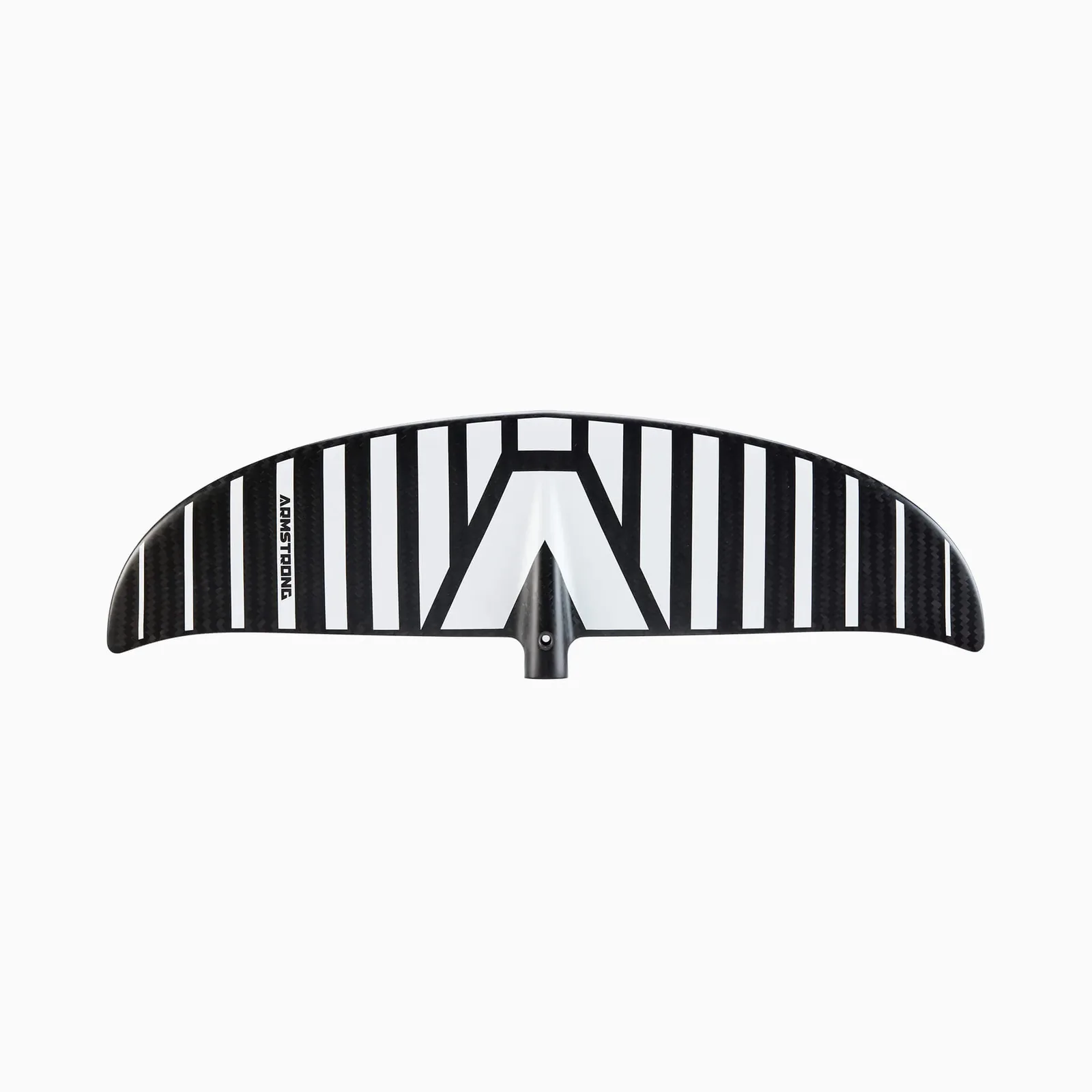
Detail of the Armstrong CF V2 1200 front wing: black and white chevron stripes around the black mounting base
The CF V2 front wing, cropped on the center and the mounting base (from the first view) · © Armstrong
Armstrong

Armstrong CF V2 Front Foil test

  • Riding styleLearning and progression: wing, kite foil, surf foil, wake foil
  • Front wings950 to 1200 cm²
  • Wingspan67 to 74.6 cm
  • Year2022

Verdict in brief

A front wing with a low to medium aspect ratio (4.9 to 5.0), in 950 and 1200 cm² on the Armstrong page, made for learning and then progressing in wing, kite foil and surf foil. The three tests I read (Tonic Mag in wing, TheKiteMag and IKSURFMAG in kite) find it stable, maneuverable and forgiving. I recommend it for kite foil, or for wing if you’re light (the 1200, up to 64 kg according to Armstrong) or already advanced (the 950). I wouldn’t take it for pumping or gliding for a long time: Tonic Mag finds that the 1200 pumps well, but less than a high aspect ratio wing.

For you if

  • You’re learning kite foil: TheKiteMag makes the 1200 the starting size, with soft lift and progressive stall
  • You’re light and learning wing: Armstrong intends the 1200 for riders up to 64 kg, and Tonic Mag finds its stall very slow
  • You’re working on your jibes and tacks: Tonic Mag writes that the 1200 turns fast while staying stable when it glides

Not for you if

  • You want to pump far: Tonic Mag finds that the 1200 pumps well, but not as much as a high aspect ratio wing like the HA 1125
  • You want a very low stall on the 950: IKSURFMAG notes a stall point at a slightly higher speed than on a high aspect ratio wing
  • You weigh more than 65 kg and you’re learning wing: Armstrong only offers the 1200 for wing up to 64 kg, you would have needed the 1600 or the 2050, which are missing from the current page

Have you ridden this model? Leave the first review

What we know about this model

Our method
  • Specificationschecked early November 2026
  • 3 tests publishedTonic Mag (CF 950 and 1200, August 4, 2022), TheKiteMag (CF V2 1200 and 950, November 18, 2022), IKSURFMAG (CF 950 V2, 2022)
  • Rider reviewsgive yours, and it will appear here

Front wings: sizes and mounting

Front wings: area, span, aspect ratio, stabilizer and mounting
SizeWingspanAspect ratioRecommended stabilizerWing attachmentWing weight
950 cm²67 cm5CF300 (beginners); HS232 or HA195 (intermediate and advanced), Armstrong advice from 2022A+: 2 M6 screws of 28.5 mm, 1 M6 barrel nut of 8 mm950 g
1200 cm²74,6 cm4,9CF300 (beginners); HS232 or HA195 (intermediate and advanced), Armstrong advice from 2022A+: 2 M6 screws of 28.5 mm, 1 M6 barrel nut of 8 mm1020 g

Span, aspect ratio and weight: Armstrong’s 2022 press release.

More details on these figures

Wingspan, aspect ratio and weight: Armstrong’s launch press release of June 25, 2022, picked up by Sail-World. November 10, 2026, the 950 is not listed there. The published aspect ratios (5.0 and 4.9) don’t match the spans given (4.7 and 4.6 by calculation): values kept as they are. The press release’s CF V2 1600 cm² (856 mm, 1,250 g) and 2050 cm² (972 mm, 1,620 g) no longer appear on the Armstrong page: they are not included in the table.

Components and compatibility

Checked on 10/11/2026

Masts

Performance-X Carbon Mast

ultra-high-modulus carbon

Performance-X Carbon Mast
Longueur
72.5 cm
79.5 cm
86.5 cm
93.5 cm

Performance Mk II Carbon Mast

carbon · thickness 13.8 mm

Performance Mk II Carbon Mast
Longueur
72.5 cm
79.5 cm
86.5 cm
93.5 cm

Mk II Carbon Mast

carbon · thickness 15.8 mm

Mk II Carbon Mast
Longueur
65.5 cm
72.5 cm
79.5 cm
86.5 cm

Alloy Mast

aluminum

Alloy Mast
Longueur
58 cm
72 cm
85 cm

Fuselage

Titanium Core Fuselage (A+); also exists in Alloy, 65 and 75 cm · titanium core sheathed in carbon

Titanium Core Fuselage (A+); also exists in Alloy, 65 and 75 cm
Longueur
50 cm
60 cm
70 cm

Stabilisateurs

Surf Mk II

Surf Mk II
Surface
130 cm²
170 cm²
200 cm²

Dart 120

Dart 120
Surface
120 cm²

Dart 140

Dart 140
Surface
140 cm²

Speed 180

Speed 180
Surface
180 cm²

Glide 220

Glide 220
Surface
220 cm²

Flow 235

Flow 235
Surface
235 cm²

Pump 202

Pump 202
Surface
202 cm²

S1 300

S1 300
Surface
300 cm²

Masts, fuselages and stabilizers: lengths, weights not noted. The catalog doesn’t say which are recommended for this front wing, apart from what the cited tests say.

Compatibility

Wing attachment
Armstrong’s A+ system, which assembles mast, fuselage, front wing and stabilizer. Screws supplied with the front wing: 2 M6 screws of 28.5 mm in 316 stainless steel with a titanium coating and one M6 barrel nut of 8 mm in titanium, plus a protective cover. Tightening torque not published.
Stabilisateurs
Armstrong advice (2022 press release picked up by Sail-World): CF300 stabilizer for beginners, HS232 or HA195 for intermediate and advanced riders. These three references no longer appear in the stabilizer list noted on armstrongfoils.com on November 8, 2026; SurfShop sells a CF 300 Tail Wing V2. Tonic Mag rode the CF300, TheKiteMag too, and IKSURFMAG the HS 252 V2 on the 950.
Fuselage
Armstrong advice (2022 press release): TC70 fuselage for beginners, TC60 for intermediate and advanced riders. Tonic Mag rode a 70 cm, TheKiteMag a 700 mm fuselage supplied with the set and preferred a 600 mm on the 950 for advanced riders. Current A+ catalog: Titanium Core in 50, 60 and 70 cm, Alloy in 65 and 75 cm.
Masts
Armstrong advises a 72 cm mast for beginners (Tonic Mag); TheKiteMag recommends 85 cm for kite and IKSURFMAG rode the 950 on 85 cm. Current A+ catalog: Alloy in 58, 72 and 85 cm, Mk II, Performance Mk II and Performance-X in carbon.

Stated riding styles

Front wing
Armstrong page: fun, ease and versatility across all disciplines (wing, surf, wake, kite). Tonic Mag: wing, with prone, wake, downwind and kite in sight. TheKiteMag and IKSURFMAG: kite foil, and surf foil for the 950.
Summary
wing · kite foil · surf foil · wake foil · learning and progression

Strong points, weak points

Strong points

  • Two sizes on the Armstrong page, 950 and 1200 cm² (670 and 746 mm span, 950 and 1,020 g)
  • Stable even at speed: with the 950, Tonic Mag is confident maneuvering and lifting off the water
  • Soft jump landings: Tonic Mag found that the wing drops into the water without a jolt, with no lift rebound as on a high aspect ratio wing
  • Careful build: all carbon, titanium hardware according to Tonic Mag, rounded edges that are not very dangerous according to TheKiteMag
Weak points

  • Limited pumping and glide compared with a high aspect ratio wing (Tonic Mag, CF 1200)
  • IKSURFMAG: stall point of the 950 at a slightly higher speed than what he knows on his high aspect ratio wings
  • The Armstrong page publishes no span, no weight and no aspect ratio: the figures come from the brand’s 2022 press release
  • Three tests from 2022, two in kite and one in wing: nothing on the larger sizes or on the recent period

The flaw to know about. For me, its real flaw is the choice of sizes: only two are left on the Armstrong page, and in wing the brand reserves the 1200 for riders up to 64 kg and the 950 for advanced riders. If you’re heavier and learning wing, you would have needed the 1600 or the 2050, which are no longer on the page. Also worth knowing: the page publishes no span, no weight and no aspect ratio, and the 1200’s aspect ratio of 4.9 doesn’t match its 746 mm span (4.6 by calculation); I couldn’t settle it.

Specifications

8 specs, sources at the bottom of the page

Program (manufacturer)
Fun, ease and versatility: wing, surf, wake, kite
Sizes (area)
950 and 1200 cm² on the Armstrong page of November 10, 2026 (1600 and 2050 cm² existed at the 2022 launch)
Wingspan
67.0 cm (950), 74.6 cm (1200)
Aspect ratio
5.0 (950) and 4.9 (1200); the span² / area calculation gives 4.7 and 4.6
Weight
950 g (950), 1,020 g (1200)
Construction
All carbon, high-density foam core, high-modulus and intermediate-modulus carbon; titanium hardware (Tonic Mag)
Mounting system
A+: 2 M6 screws of 28.5 mm (316 stainless steel, rainbow titanium coating), 1 M6 barrel nut of 8 mm in titanium; protective cover included
Armstrong availability
All sizes shown as “Sold out” on November 10, 2026

What the published tests say

3 tests published, checked early November 2026

Tonic Mag, “Armstrong Foils CF V2 950 & 1200 2022”

The tester finds himself riding the 950 more and more: even at speed, the CF V2 stays very stable and lets you maneuver. He keeps jumping on it and reports landings of an unprecedented softness: the wing drops without a jolt and the board takes the impact. The 1200 is his light-wind wing: very slow stall, you get up fast and stay in the air in the lulls. It pumps well, not as much as a high aspect ratio wing like the HA 1125, but he likes its turns in waves and its jibes and tacks, fast and stable. He only rode in wing. Conclusion: the all-round wing par excellence, for starting out as well as for jumping high.

Read the test
TheKiteMag, “Armstrong CF V2 1200 and 950”

To learn kite foil, the 1200 is the starting size: soft lift, progressive stall, a board that goes onto the plane without porpoising. The longer fuselage and the well-behaved stabilizer bring stability on all axes, especially in pitch, which forgives poor foot placement. The 950 is more playful and faster: clearly superior maneuverability, very tight turns with the kite’s support, good in waves, with a low weight for jumping. For advanced riders, he prefers it with an HS232 or HA195 and a 600 mm fuselage. He also notes a quiet, light set with rounded edges, and cross-compatibility across the whole range.

Read the test
IKSURFMAG, “Armstrong Foils CF 950 V2 2022”

The tester, used to high aspect ratio wings, is delighted to find a well-balanced medium aspect ratio wing. Easy first start in the water, a wing that is stable underfoot. He notes a stall point at a slightly higher speed than what he knows, quickly forgotten after a few sessions. He struggled to pump in prone in a small surf after so many years on high aspect ratio. No wing tried. Conclusion: predictable, playful and very easy, for anyone who wants a surf feel with stability.

Read the test

Riders’ reviews

No reviews

No reviews yet.

Nobody has reviewed this gear yet. Do you use it? Help other riders of your weight — 2 minutes.

Leave your review (2 minutes)

Three screens: you, the gear, your review. Your email will never be published; it is only used to confirm that the review comes from a real person.

1/3 You

Only used to confirm your review and to let you know if it is rejected. Never displayed, never resold.

Your weight *

10 kg ranges only, so that other riders of your build can relate. No exact weight is recorded.

Your level *

Beginner: I’m still taking lessons. Intermediate: I ride on my own. Advanced: transitions and jumps. Expert: freestyle, wave or competition.

Your riding

Optional. If checked, your review stays published with the label “Gear received or tied to a brand” and doesn’t count toward the average rating.

You must be at least 15 to post a review (“Your data” article of the policy).

2/3 Your gear and how you use it
Wind range actually used (knots)
How long you’ve been using it *
Number of sessions (optional)
Rate each criterion (at least 3) *
Low-end takeoff
Speed & glide
Maneuverability (turns)
Pump
Finish & durability

1 = very poor, 5 = excellent. Leave blank any criterion you couldn’t judge.

Do you recommend it? *
3/3 Your review

140 characters minimum — Takeoff, glide, pump, what disappointed you, who you’d recommend it to.

Rider reviews: confirmed email address, no compensation. “Brand-linked” and “loaned / received” reviews are labeled and excluded from the average. Each review shows its publication date, the date of the experience and, if it was edited, its update date. A review is published or rejected within 7 days at most; if it is rejected, you receive the reason by email and you can correct it. You can complete or delete your review at any time from the email address used to submit it. How do reviews work?

Alternatives to compare

Armstrong S1

Armstrong’s learning wing, from 1250 to 2450 cm², aspect ratio 4.8 to 5.7. Larger, so more stable at low speed; the CF V2 stays smaller and livelier. No test compares them.

Duotone Free 2026

Progression wing in 1300, 1600 and 1900 cm², aspect ratio 6.8 to 7.2. No test compares them.

AFS Evo

Progression wing in four sizes from 950 to 1650, aspect ratio 7.5 to 8.1 so more pumping. No test compares them.

Frequently asked questions

Where can I check the current price?

See the current prices in the “Where to buy” section of this page.

What does the Armstrong CF V2 include?

The front wing alone, in two sizes: 950 and 1200. For the price, see the “Where to buy” section of this page.

Which CF V2 size should you choose?

Armstrong’s recommendations (2022 press release): the 1200 in wing for riders up to 64 kg in light to moderate wind, in prone for all weights in small to medium waves, in kite from 78 kg, in wake from 65 to 89 kg; the 950 in wing and surf for advanced riders of all weights, in kite from 65 to 89 kg. For heavier riders in wing, the brand offered the 1600 (beginners from 65 to 77 kg) and the 2050 (beginners from 78 kg and up), which are missing from its current page. These are general guidelines, not an official grid.

Which stabilizer and mast with the CF V2?

The 2022 launch press release advises beginners a 70 cm fuselage with a CF300 stabilizer and, according to Tonic Mag, a 72 cm mast; for intermediate and advanced riders, a 60 cm fuselage with an HS232 or an HA195. For kite, TheKiteMag recommends an 85 cm mast and IKSURFMAG rode the 950 on 85 cm.

Is the CF V2 good for a beginner? What level?

Yes, that’s its purpose: Armstrong designs it for beginners who want a base for progression as well as for experienced riders. In kite foil, TheKiteMag makes the 1200 the starting size. In wing, the brand reserves the 1200 for riders up to 64 kg and the 950 for advanced riders; if you’re heavier, you would have needed the 1600 or the 2050. I recommend it for learning kite foil. If you want a larger learning wing, look at Armstrong’s S1.

What about used?

I haven’t found any reliable used price, so I’m not giving one. What to check: leading and trailing edge (impacts, cracks, delamination), play in the fuselage assembly, threads and A+ screws (M6) in good condition, stabilizer included. Don’t confuse the CF V2 with the original CF, which is older, or with the pre-A+ mount.

Method and limitations of this page

This page brings together the technical specs, tests from the press and blogs, and rider feedback found on the web, without rewriting any of it. When WindUnity has ridden the gear itself, the page says so with the “WindUnity test” badge.

Rider reviews are published as is, with their date. Reviews tied to a brand or based on loaned gear are labeled and excluded from the average.

What’s still missing

  • Armstrong page with no span, aspect ratio or weight: taken from the 2022 launch press release (Sail-World)
  • Weight recommendations per size: those of the 2022 press release; shops publish a different version for the 1200, I couldn’t settle it
  • Published aspect ratios (5.0 and 4.9) at odds with the spans (4.7 and 4.6 by calculation)
  • Three tests from 2022 (one in wing, two in kite): nothing on the 1600 and 2050 sizes or on the recent period
  • Both sizes are sold out at Armstrong on November 10, 2026
  • Exact date of the IKSURFMAG test not recorded
  • Photos: the Armstrong page publishes only two for the CF V2; the third is a cropped detail of the first
  • Reviews posted on WindUnity: none

Sources

Data collected early November 2026

Shops : Surfshop.fr

Press and specialist sites : Tonic Mag, TheKiteMag, IKSURFMAG, Sail-World

Others : Armstrong

See the details of the 6 sources

Shops

  1. SurfShop, Armstrong (prices)

Press and specialist sites

  1. Tonic Mag, Armstrong CF V2 950 and 1200 test
  2. TheKiteMag, Armstrong CF V2 1200 and 950 test
  3. IKSURFMAG, Armstrong CF 950 V2 test

Others