Skip to content
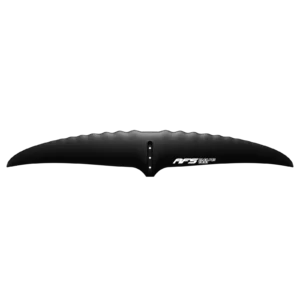
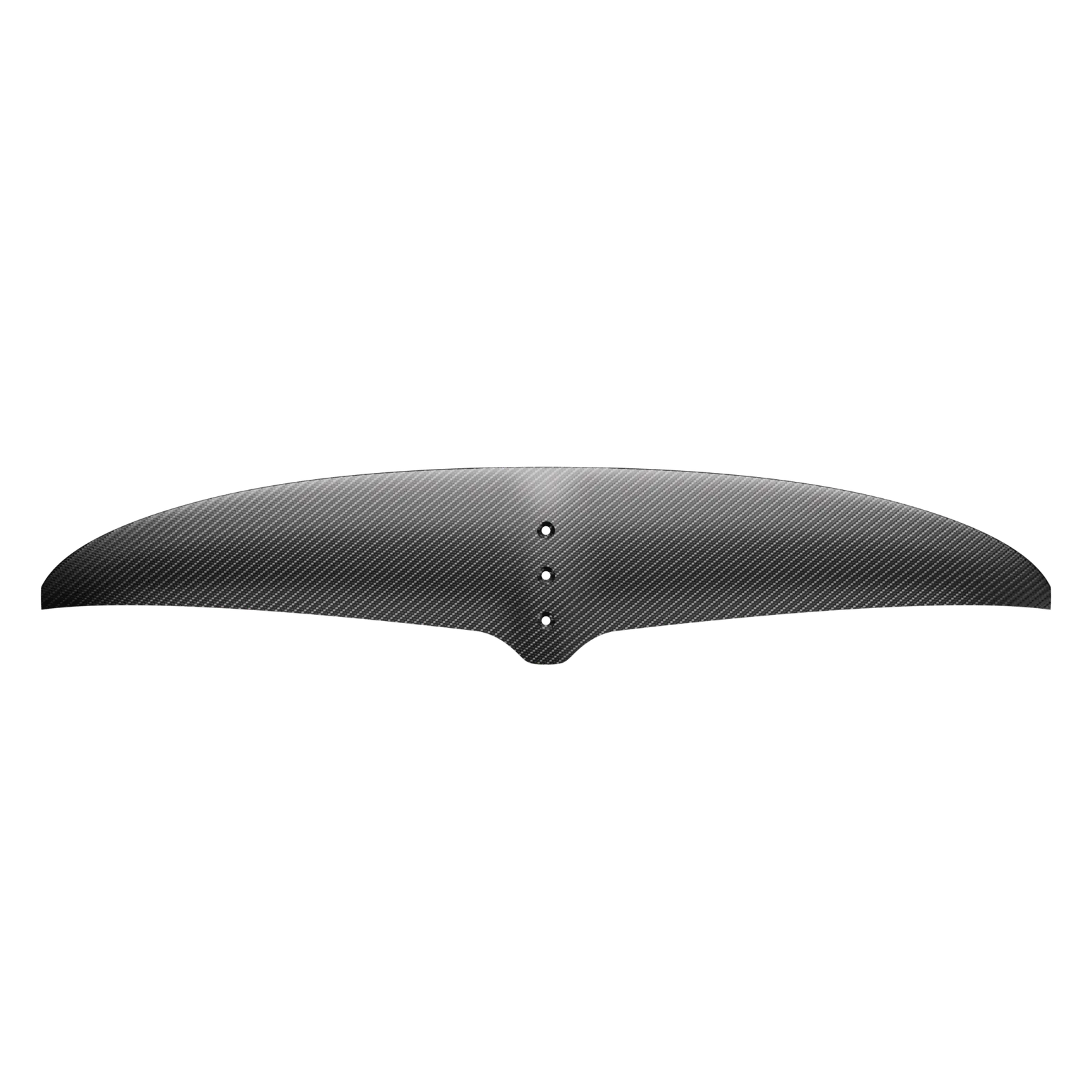
Black AFS Evo 950 front wing, thin and elongated, flat view on transparent background
The Evo 950, the smallest front wing in the range · © AFS
Assembled black AFS Evo 1450 foil: vertical mast, fuselage, Cruiser L stabilizer and front wing, on transparent background
An Evo 1450 assembled on an 80 cm HM mast with a Cruiser L · © AFS
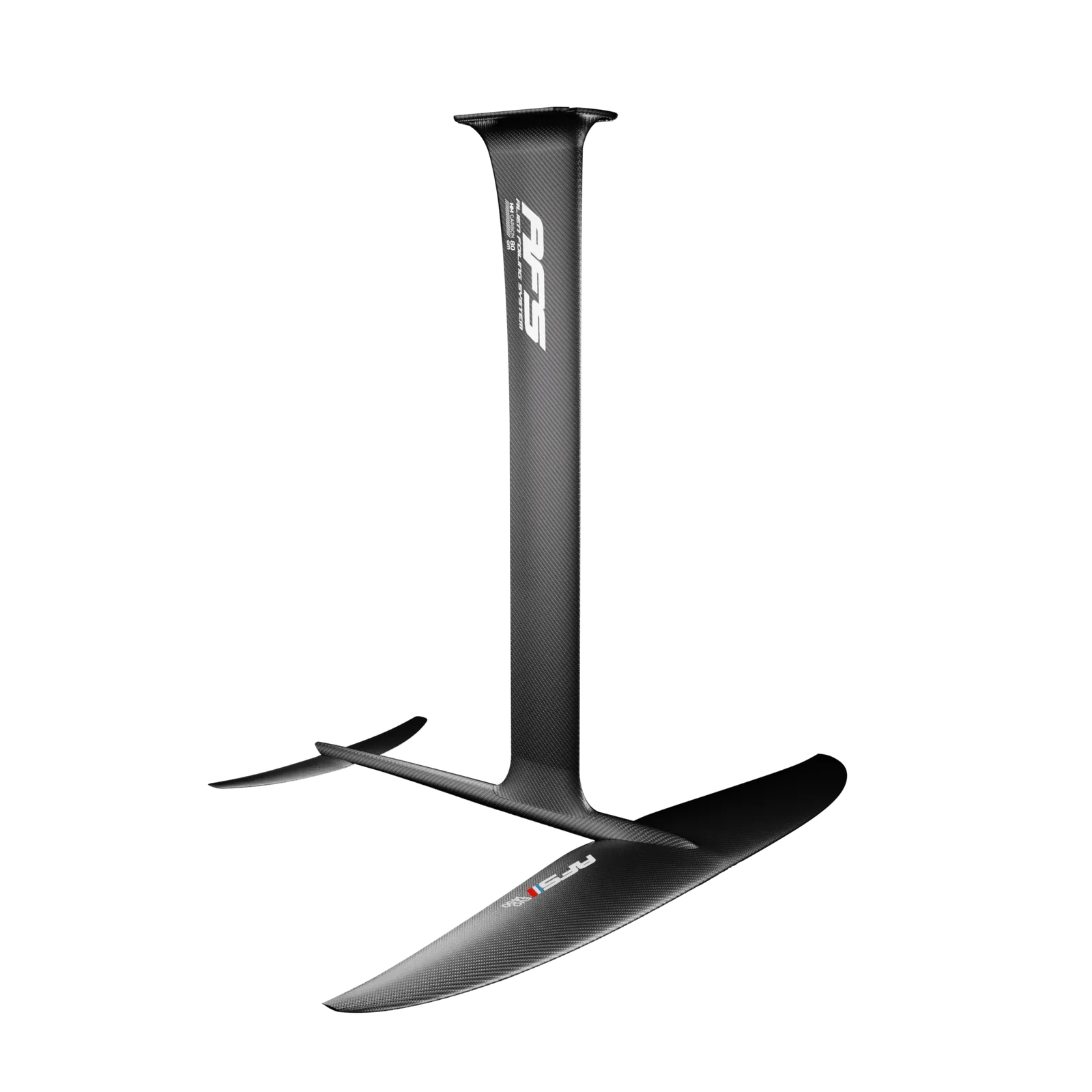
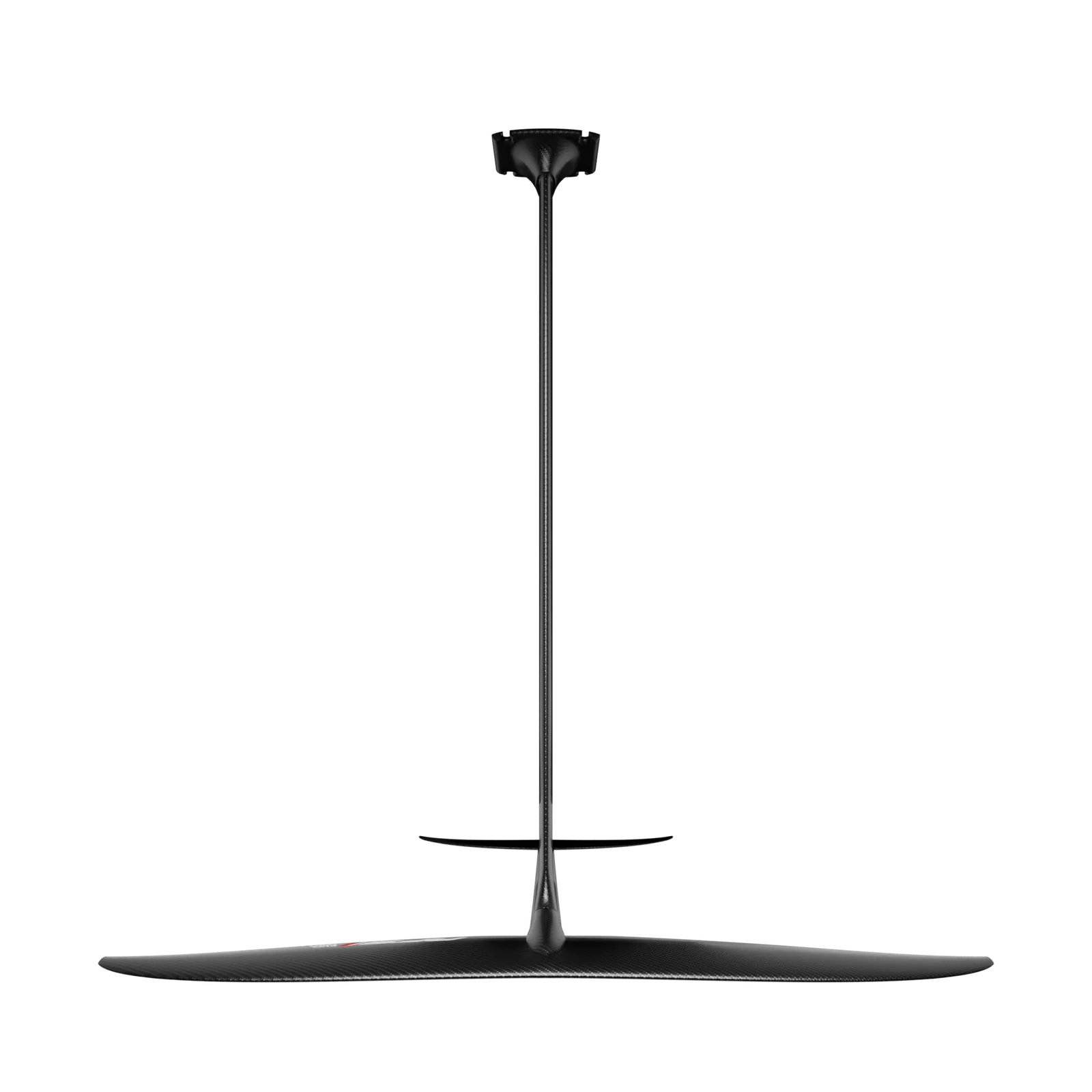
Black AFS Evo 1250 foil seen from the front: vertical mast, small stabilizer and front wing at the bottom, on transparent background
An Evo 1250 seen from the front, 80 cm HR mast and Cruiser S · © AFS
AFS Foil

AFS Evo test

  • Riding styleFreeride, progression, wing foiling, surf foil and downwind
  • Front wings950 to 1650 cm²
  • Wingspan88 to 111 cm
  • YearModel 2026 · released Feb 2024

Verdict in brief

A progression front wing in four sizes, 950, 1250, 1450 and 1650. Foiling Magazine rode the Evo 1250: it takes off very early without being abrupt, glides well and turns rail to rail without nervousness. No test of the other three sizes.

Only one independent test (Evo 1250, July 2024, 80 cm UHM mast). Sizes, weights and prices come from the AFS pages of November 7, 2026.

For you if

  • You’re learning wing foiling: the brand puts it first for beginners, with one size per weight bracket, from the 1250 under 60 kg to the 1650 from 75 kg in light wind
  • You want a front wing that takes off early without surprising you: Foiling Magazine finds the Evo 1250 very early but progressive, with great pumping power at low speed
  • You want a single front wing for wing foiling, surf foil and downwind: Foiling Magazine finds that the Evo 1250 does everything very well, especially in small to medium open waves, with a stabilizer you can move forward or back

Not for you if

  • You’re after pure speed or big waves: Foiling Magazine writes that you probably won’t reach 30 knots or waves over two meters with the Evo 1250
  • You want a very high aspect ratio for downwind: the Evo tops out at 8.1, the Evo HA goes up to 12.1 and 13.3, the Enduro to 11
  • You want a light foil: from 700 g to 1.1 kg for the front wing, and the set’s mast, fuselage and stabilizer add 2.28 to 2.36 kg (mast 1.6 kg, fuselage 0.56 kg, stabilizer 120 to 200 g)

Have you ridden this model? Leave the first review

What we know about this model

Our method

Front wings: sizes and mounting

Front wings: area, span, aspect ratio, stabilizer and mounting
SizeWingspanAspect ratioRecommended stabilizerWing attachmentWing weight
950 cm² (147,3 in²)88 cm (34,6 in)8,1U-Cruise 190M8x20 Torx 40 screws700 g
1250 cm² (192,2 in²)97 cm (38,2 in)7,6U-Cruise 220M8x20 Torx 40 screws800 g
1450 cm² (223,2 in²)104 cm (40,9 in)7,6U-Cruise 220M8x20 Torx 40 screws1000 g
1650 cm² (254,2 in²)111 cm (43,7 in)7,5U-Cruise 245M8x20 Torx 40 screws1100 g

Read on November 7, 2026.

More details on these figures

The size name is not the area: 1250 = 1,240 cm², 1450 = 1,440 cm², 1650 = 1,640 cm². 1450 aspect ratio: 7.6 on the AFS page (7.5 if recalculated). The areas in in² and the wingspans in inches are WindUnity conversions. Tightening torque not published.

Components and compatibility

Checked on 07/11/2026

Masts

HM Carbon 85 cm mast (included in the set)

HM carbon, Corecell core · cord 120 mm · thickness 15 mm

HM Carbon 85 cm mast (included in the set)
LongueurWeight
85 cm1.6 kg

Fuselage

Fuselink fuselage · one-piece HR carbon · 3 M8x45 screws, mast / fuselage

Fuselink fuselage
Longueur
65 cm
68 cm

Stabilisateurs

U-Cruise

one-piece HR carbon · 3 M6x12 screws, Torx 30

U-Cruise
Surface
190 cm²
220 cm²
250 cm²

Complete sets

Complete sets
SizeSet contents
950 cm²Evo 950 / HM 85 cm mast, standard fuselage, U-Cruise 190
1250 cm²Evo 1250 / HM 85 cm mast, standard fuselage, U-Cruise 220
1450 cm²Evo 1450 / HM 85 cm mast, standard fuselage, U-Cruise 220
1650 cm²Evo 1650 / HM 85 cm mast, standard fuselage, U-Cruise 245

Published weights: front wing from 700 g to 1.1 kg depending on size, HM 85 cm mast 1,600 g, standard fuselage 560 g, U-Cruise stabilizer 120, 150 or 200 g. No published weight for the complete set.

Compatibility

Wing attachment
Stainless steel M8x20 screws, Torx 40, supplied with the front wing; torque not published. The page mentions three M8 screws for the attachment, the box ships four.
Stabilisateurs
In the set: U-Cruise 190 with the 950, 220 with the 1250 and 1450, 245 with the 1650. The Silk, Pure and Cruiser stabilizers all fit the Evo.
Fuselage
Standard Fuselink fuselage (68 cm, 560 g) in the set; the short one (65 cm) is sold separately.
Masts
HM Carbon 85 cm mast in the set. AFS carbon Fuselink masts fit the Evo: HR, HM and UHM.

Stated riding styles

Front wing
AFS page: “ultra-versatile” front wing for learning and practicing all disciplines, from wing foiling to prone and SUP, in freeride, freestyle, freerace, surf and downwind. 950: speed, glide and maneuverability, takes off early despite its size; 1250: “must-have” size, wing foiling, downwind or prone; 1450: fast takeoff and efficient pumping; 1650: effortless glide, for heavier riders.
Summary
wing foiling (progression) · prone · SUP foil · surf foil · downwind

Strong points, weak points

Strong points

  • Early but progressive takeoff on the 1250: the Foiling Magazine tester talks about lift very early, a stall and an “insane” low end
  • Four sizes from 950 to 1650, with a size recommendation per weight bracket for light wind and strong wind
  • Stabilizer adjustable to two positions on the fuselage: forward to turn, back to stabilize at high speed
  • HR carbon and Corecell core, made in France, 2-year warranty, 14-day return

Weak points

  • No test of the 950, 1450 and 1650: the Foiling Magazine test covers the 1250 only
  • No front wing for big hollow waves or 30 knots, by the tester’s own admission
  • The names are not the areas: the 1250 is 1,240 cm², the 1450 1,440 cm², the 1650 1,640 cm²
  • The complete set ships with a U-Cruise 220 with the 1450, while the AFS guide recommends a 245 for that size
  • 1450 aspect ratio listed at 7.6 on its page, while its area and wingspan give 7.5

The flaw to know about. No series defect recorded. To watch: the size names are not the areas (1250 = 1,240 cm²) and the complete 1450 set comes with a U-Cruise 220 where AFS recommends the 245. A visitor to the Pimpyourride forum found the Evos very well finished (April 2024).

Model evolution

Checked on 07/11/2026

  • Previous version AFS Performer

What changes vs the Performer range

  • The Evo builds on the success of the Performer range: same spirit of smoothness and stability, with a slightly higher aspect ratio (from 7.5 to 8.1) for more glide and a slight bell-shaped profile
  • New front wing / fuselage connection, lighter and stiffer, fixed with M8 screws
  • Three stabilizers at launch, Cruiser S, M and L, compatible with those of the Silk and Pure ranges; today’s catalog offers the U-Cruise 190, 220 and 245

Specifications

16 specs, sources at the bottom of the page

Riding style
Progression and versatility: wing foiling, prone, SUP, surf foil, downwind; freeride, freestyle, freerace
Sizes (name)
950, 1250, 1450 and 1650
Actual area
950, 1,240, 1,440 and 1,640 cm²
Wingspan
880, 970, 1,040 and 1,110 mm
Aspect ratio
8.1, 7.6, 7.6 and 7.5
Max chord
150, 185, 195 and 195 mm
Max thickness
13.5, 16.5, 17.5 and 17.5 mm
Weight
700, 800, 1,000 and 1,100 g
Construction
HR carbon, Corecell core
Attachment
Stainless steel M8x20 screws, Torx 40; torque not published
Comes with
Front wing bag and 4 screws; no fuselage, mast or stabilizer
Complete foil
Front wing + HM carbon 85 cm mast + standard fuselage + U-Cruise stabilizer (190, 220, 220 or 245); bags, case, screws and screwdriver included
Size recommendation (beginner, light wind of 10 to 20 knots)
Under 60 kg: 1250; 60 to 74 kg: 1450; 75 to 90 kg: 1650; over 90 kg: 1650
Size recommendation (beginner, strong wind above 20 knots)
60 to 74 kg: 1250; 75 to 90 kg: 1450
Warranty and returns
2 years; 14-day return
Evo HA (separate product)
HA750 (750 cm², 1,000 mm, aspect ratio 13.3, 700 g) and HA1000 (1,000 cm², 1,100 mm, aspect ratio 12.1, 1,100 g), Evo attachment

What the published tests say

1 test published, checked early November 2026

Foiling Magazine, “AFS Evo 1250”

Tested in wing foiling in light wind, in surf foil and in downwind SUP foil. For a 1250, takeoff is very early but progressive; the thin profile gives a good mix of glide and lift; wide speed range (over 17 knots in surf foil); convincing pumping, with a stall and an “insane” low end according to the tester; rail-to-rail carving, stable in pitch and roll; small to medium open waves, no hollow waves. The stabilizer has two positions: forward for maneuverability in prone, back for stability in wing foiling. The tester writes that the Evo doesn’t fit in a box and does everything very well; he adds that you probably won’t reach 30 knots or waves over two meters.

Read the test
Rider feedback collected from the web (3)

No usable rider feedback found as of November 7, 2026.

Reddit r/wingfoil, thread “Foil brand”2025-01-21

User calebsurfs; has ridden the Evo since Christmas 2024, level not specified

He likes the Evo’s low-speed glide and acceleration, and the simplicity of the range.

Reddit r/wingfoil, thread “AFS Evo 950 vs Enduro 900”2025-07-15

User calebsurfs; describes himself as beginner to intermediate

He likes his 950 but has not tried the Enduro. In the next reply, he says he rides it wing foiling when the wind isn’t light, in flat water and small waves, with a Cruiser M stabilizer in the back position (message n3bxe8v).

Pimpyourride, thread “AFS Flyer 1800 / 1500”2024-04-28

User Hikkaduwa; saw the Flyer in a shop

He judges the Flyer’s finish inferior to that of the Evo range, whose front wings look very well finished to him, but finds this expensive.

Riders’ reviews

No reviews

No reviews yet.

Nobody has reviewed this gear yet. Do you use it? Help other riders of your weight — 2 minutes.

Leave your review (2 minutes)

Three screens: you, the gear, your review. Your email will never be published; it is only used to confirm that the review comes from a real person.

1/3 You

Only used to confirm your review and to let you know if it is rejected. Never displayed, never resold.

Your weight *

10 kg ranges only, so that other riders of your build can relate. No exact weight is recorded.

Your level *

Beginner: I’m still taking lessons. Intermediate: I ride on my own. Advanced: transitions and jumps. Expert: freestyle, wave or competition.

Your riding

Optional. If checked, your review stays published with the label “Gear received or tied to a brand” and doesn’t count toward the average rating.

You must be at least 15 to post a review (“Your data” article of the policy).

2/3 Your gear and how you use it
Wind range actually used (knots)
How long you’ve been using it *
Number of sessions (optional)
Rate each criterion (at least 3) *
Low-end takeoff
Speed & glide
Maneuverability (turns)
Pump
Finish & durability

1 = very poor, 5 = excellent. Leave blank any criterion you couldn’t judge.

Do you recommend it? *
3/3 Your review

140 characters minimum — Takeoff, glide, pump, what disappointed you, who you’d recommend it to.

Rider reviews: confirmed email address, no compensation. “Brand-linked” and “loaned / received” reviews are labeled and excluded from the average. Each review shows its publication date, the date of the experience and, if it was edited, its update date. A review is published or rejected within 7 days at most; if it is rejected, you receive the reason by email and you can correct it. You can complete or delete your review at any time from the email address used to submit it. How do reviews work?

Alternatives to compare

Duotone Free 2.0 2026

Duotone’s progression front wing, in 1300, 1600 and 1900 cm², wingspan 97 to 114 cm, aspect ratio from 6.8 to 7.2. Against the Evo 1250 (1,240 cm², 970 mm, aspect ratio 7.6), the Free 2.0 in 1300 is a bit larger, with a slightly lower aspect ratio (7.2) and cheaper.

AFS Flyer

AFS’s Flyer, in two sizes, 1500 and 1800 (1,430 and 1,735 cm², aspect ratio 6.3) is the brand’s entry-level front wing, thicker (20 and 22 mm versus 13.5 to 17.5 mm) and with a lower aspect ratio.

AFS Enduro

AFS’s Enduro, in seven sizes from 600 to 1300 cm², aspect ratio 11 is the next step after the Evo: AFS asks riders to stay on the Evo as long as they are new to freeride. More glide, less forgiveness.

AFS Evo HA

AFS’s Evo HA keeps the Evo attachment with an aspect ratio of 12.1 (HA1000, 1,000 cm²) and 13.3 (HA750, 750 cm²), for long glide. For intermediate to expert riders, with a stated speed range of 10 to 25 knots for the HA1000.

Frequently asked questions

AFS Evo: which sizes and what weight?

Four sizes, 950, 1250, 1450 and 1650, which measure 950, 1,240, 1,440 and 1,640 cm² and 880 to 1,110 mm of wingspan. Aspect ratio from 7.5 to 8.1, weight from 700 g to 1.1 kg, for the front wing alone. For the price, see the “Where to buy” section of this page.

Which Evo size should you choose for your weight?

To start in light wind (10 to 20 knots), AFS gives 1250 under 60 kg, 1450 from 60 to 74 kg and 1650 from 75 kg. In strong wind, 1250 from 60 to 74 kg and 1450 from 75 to 90 kg. For surf foil or downwind, the front wing page gives the 1450 from 60 to 90 kg in small waves (under 50 cm) and the 1250 in waves from 50 cm to 1 m.

What do the tests of the AFS Evo say?

Foiling Magazine tested the Evo 1250 (July 2, 2024): very early but progressive takeoff, wide speed range (over 17 knots in surf foil), convincing pumping and low end, stable rail-to-rail carving. Not a front wing for hollow waves or 30 knots. No test of the 950, 1450 or 1650 was found.

What does the complete AFS Evo foil include?

Evo front wing of your choice, HM carbon 85 cm mast, standard Fuselink fuselage, U-Cruise stabilizer (190 with the 950, 220 with the 1250 and 1450, 245 with the 1650), bags, case, screws and screwdriver. AFS recommends a U-Cruise 245 for the 1450, the set ships with a 220. For the price, see the “Where to buy” section of this page.

AFS Evo or Flyer for beginners?

AFS puts the Evo first for beginners. The Flyer (1500 and 1800, i.e. 1,430 and 1,735 cm², aspect ratio 6.3) is its entry-level front wing. The Evo has a higher aspect ratio and takes you further.

Does the AFS Evo succeed the Performer?

AFS writes “Building on the success of our Performer foil range”: the Evo takes up the spirit of the Performer, with a slightly higher aspect ratio, a new front wing / fuselage connection and three Cruiser stabilizers at launch. The page does not announce the end of the Performer.

Method and limitations of this page

This page brings together the technical specs, tests from the press and blogs, and rider feedback found on the web, without rewriting any of it. When WindUnity has ridden the gear itself, the page says so with the “WindUnity test” badge.

Rider reviews are published as is, with their date. Reviews tied to a brand or based on loaned gear are labeled and excluded from the average.

What’s still missing

  • Tightening torque of the front wing screws: not published; the page mentions three M8 screws, the box ships four
  • Test of the 950, 1450 and 1650: none published; 1250 test done in July 2024 with an 80 cm UHM mast
  • Complete set weight: not published
  • 1450 aspect ratio: 7.6 on the AFS page, 7.5 if recalculated from the area and wingspan
  • Release date: AFS does not show one, only the creation of the page (February 23, 2024) is dated
  • Rider reviews on WindUnity (N2): none

Sources

Data collected early November 2026

Press and specialist sites : The Foiling Magazine

Others : AFS, Boardsport SOURCE

See the details of the 7 sources

Press and specialist sites

  1. Foiling Magazine, Evo 1250 test

Others

  1. AFS, official Evo Front Wing page (EN)
  2. AFS, Evo HA Front Wing page (EN)
  3. AFS, Flyer Front Wing page (EN)
  4. Boardsport SOURCE, AFS S/S 2027 preview