Skip to content
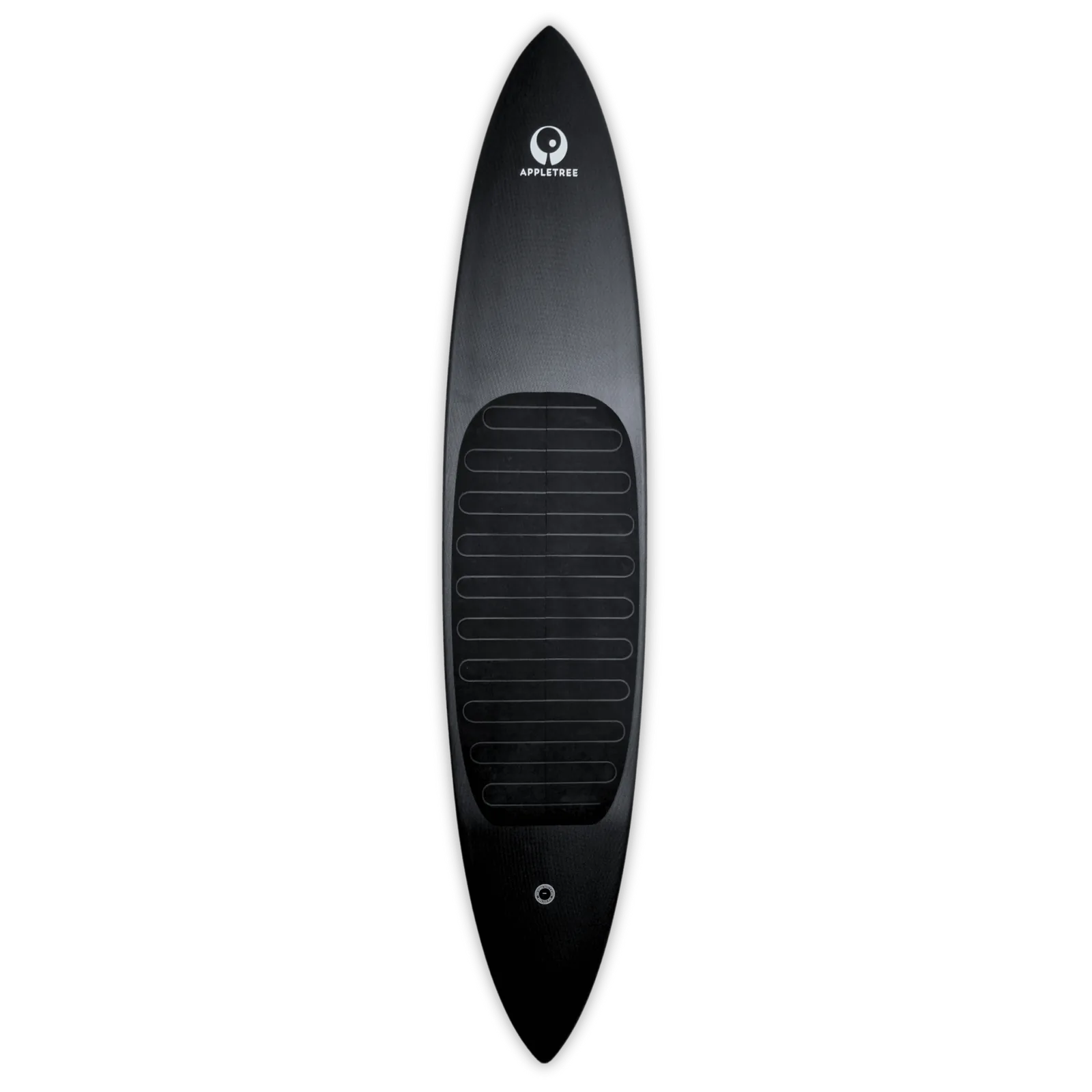
Deck of the Appletree Skipper Downwind V2 seen from above on a black background: black carbon board, large grooved pad, logo
The Skipper Downwind V2 deck · © Appletree
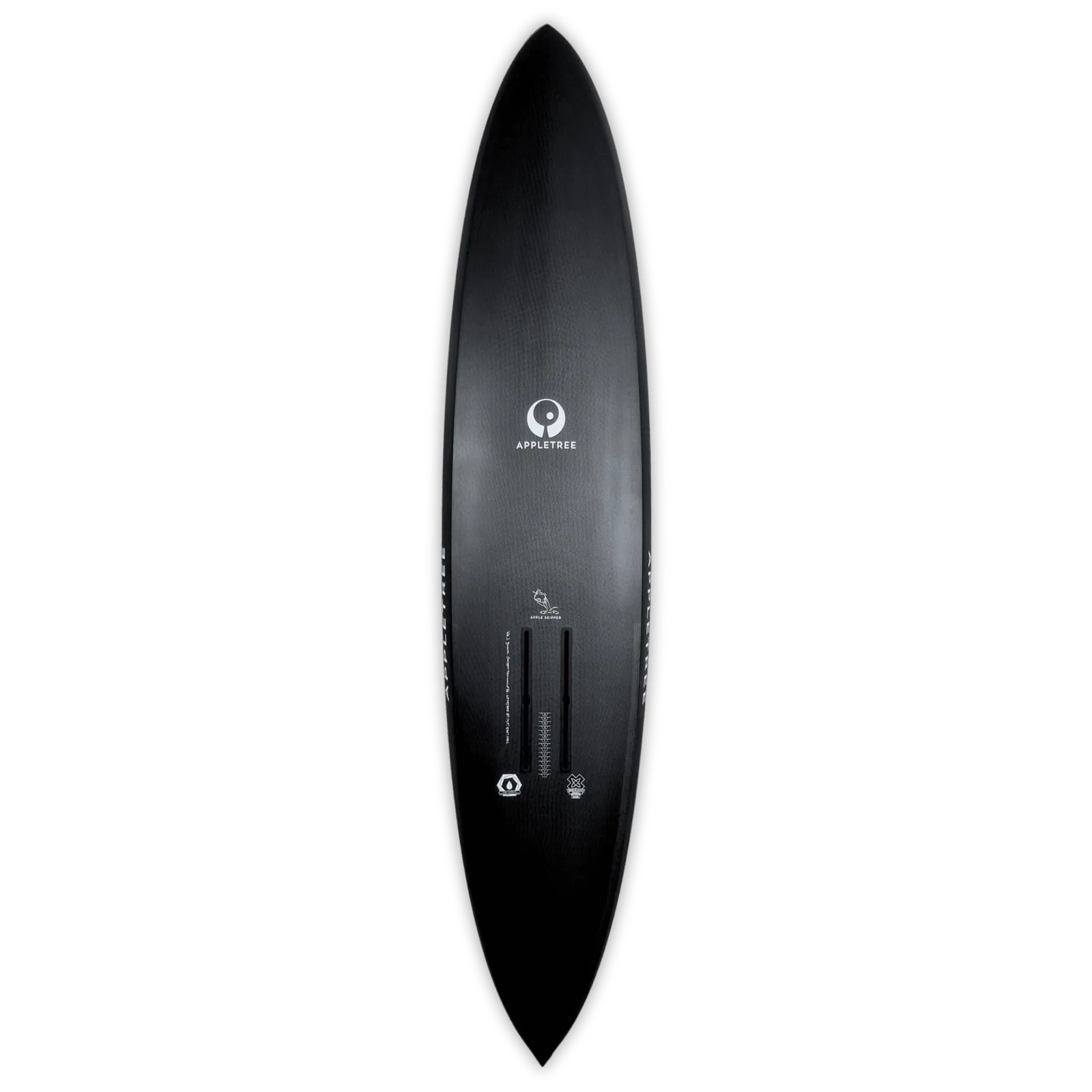
Hull of the Appletree Skipper Downwind V2 on a black background: black carbon board, two foil tracks near the tail
The Skipper Downwind V2 hull and its foil tracks · © Appletree
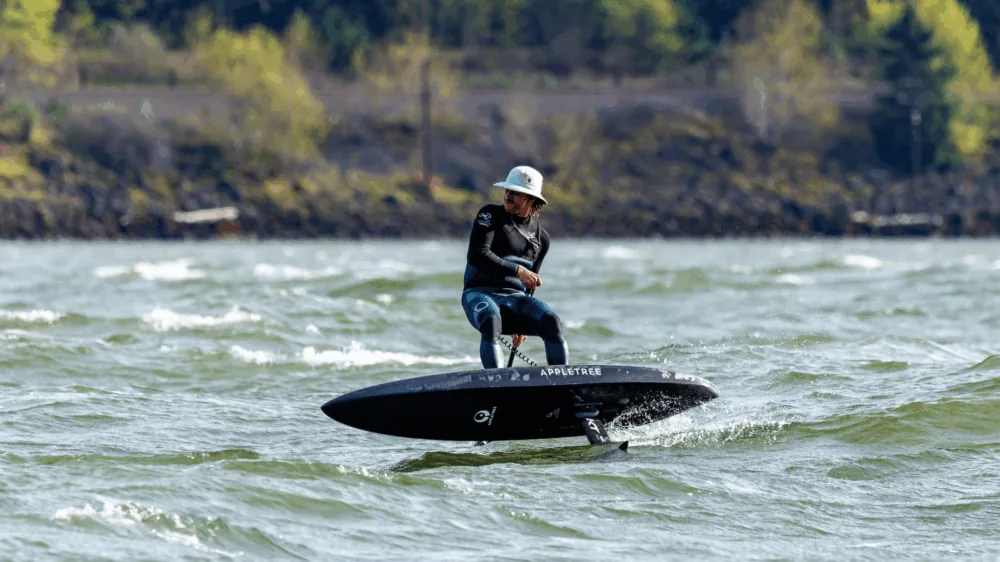
Rider foiling on a black Appletree board above choppy water, white bucket hat, green bank in the background
A black Appletree in flight · © Appletree
Appletree

Appletree Skipper Downwind V2 test

  • Riding styleDownwind, parawing
  • Sizes213,4 to 243,8 cm
  • YearModel 2025 · released May 2025

Verdict in brief

Carbon downwind board, from 94 to 118 l and from 7'0'' to 8'0'', with an adjustable width at no extra cost. The V2 is more stable, has more rocker and is lighter than the V1. Foiling Magazine finds it more stable and quicker to take off, with a “best in class” foil feel.

A single test (Foiling Magazine, September 11, 2025), with no size tried and no tester weight, and two rider reports on a forum. Weight and price are not published by Appletree (checked on November 6, 2026).

For you if

  • You do downwind on a SUP foil or parawing and the V1 felt unstable: Foiling Magazine finds the V2 clearly more stable on the roll axis, with a better heading when paddling
  • You want to choose your width: from 17.5 to 20 in at no extra cost, from 92 to 121 l depending on length
  • You’re looking for a board that is very direct underfoot: Foiling Magazine rates the foil transmission “best in class” and credits the reinforced deck

Not for you if

  • You’re new to downwind or foil: GlissEvolution reserves it for intermediate to expert riders and points beginners to the AppleSlice V4
  • You want the easiest board to paddle: Eriefoiler gives the edge to his Armstrong DW, which is slimmer, longer and has more volume
  • You’re looking for a wing board to progress on: Appletree classes it as downwind; for wing, look at the Midlength V2 or the AppleSlice V4

Have you ridden this model? Leave the first review

What we know about this model

Our method
  • Specificationschecked early November 2026
  • 1 test publishedFoiling Magazine, Appletree Apple Skipper DW V2 test (page published on September 11, 2025)
  • Rider reviewsgive yours, and it will appear here

Sizes, volume, weight and foil box

Sizes, volume, weight and recommended rider
SizeLength × widthVolumeFoil box
7'0’’213.4 × 45.7 cm94 LBoîtiers FUTURES oneshot
7'4’’223.5 × 47 cm102 LBoîtiers FUTURES oneshot
7'8’’233.7 × 48.3 cm110 LBoîtiers FUTURES oneshot
8'0’’243.8 × 49.5 cm118 LBoîtiers FUTURES oneshot

Lengths and widths converted from feet and inches by WindUnity; volumes published by Appletree.

More details on these figures

“Apple Skipper DW Stock” table from the Appletree page (length, width and volume), read on November 6, 2026. Length is published in feet and inches, and width in inches; the centimeters are converted by WindUnity (1 inch = 2.54 cm) and rounded to the tenth. Appletree publishes neither the board weight nor a recommended rider weight, and the thickness is written 5’43”, 5’44”, 5’45” and 5’46”: unreadable value, not carried over. Custom widths from 17.5 to 20 in are possible at no extra cost (92 to 121 l), with a lead time of about eight weeks for sizes not in stock.

Strong points, weak points

Strong points

  • Four sizes from 94 to 118 l, custom width from 17.5 to 20 in at no extra cost
  • Deck reinforced with a hex-skin plate in the pumping area, which Foiling Magazine rates “best in class” for foil feel
  • Lighter than the V1 at comparable volume, according to Foiling Magazine, with 50K closed-cell foam
  • Rail tape, an extra layer under the hull and a tapered edge near the box: protection against paddle knocks
  • A presentation video published by Appletree on May 16, 2025

Weak points

  • No published weight, either on Appletree’s page or at GlissEvolution
  • A single test, with no size or tester weight
  • The stock pad slips with booties, according to noripplez (Progression Project, June 23, 2025)
  • Thickness written 5’43” on the page, so it cannot be carried over into the table

The flaw to know about. The only flaw on record comes from a rider on the Progression Project forum, noripplez (75 kg, June 23, 2025): with the more pronounced rocker and the volume concentrated under the feet, his V2 7'8'' × 18'' 105 l tends to pivot more at the start than his V1; he thinks a volume in the high 90s l would have suited him better. He also finds the stock pad very slippery with Solite booties, excellent barefoot. No test noted a flaw.

Model evolution

Checked on 06/11/2026

  • Previous version Apple Skipper Downwind V1

What changes vs Skipper Downwind V1

  • Entirely redesigned hull: double rocker, with a curved rail rocker for the foil angle and a straighter, longer centerline for planing
  • Harder, sharper rails: they catch a little more but release the water much better, especially on touchdowns; rail curve that rises more sharply toward the tail
  • Sharper nose for lift, which allowed the board to be made slimmer and longer
  • Deck reinforced with a hex-skin plate in the pumping area, “spoiler” shape toward the tail for water drainage, front concave in the stance area
  • Lighter construction despite a slightly heavier 50K foam, rail tape and an extra carbon layer under the hull, tapered edge from the box toward the tail
  • Standard range from 7'0'' (94 l) to 8'0'' (118 l); custom width from 17.5 to 20 in at no extra cost

Specifications

11 specs, sources at the bottom of the page

Program (manufacturer)
Downwind board for advanced downwind riders, with an opening toward parawing
Sizes and volumes
7'0'' (94 l), 7'4'' (102 l), 7'8'' (110 l) and 8'0'' (118 l)
Dimensions (length × width)
213.4 × 45.7 cm (94 l) to 243.8 × 49.5 cm (118 l), converted from Appletree’s feet and inches
Custom width
17.5 to 20.0 in (44.5 to 50.8 cm) at no extra cost: 92 to 105 l in 7'0'', 96 to 110 l in 7'4'', 102 to 116 l in 7'8'' and 106 to 121 l in 8'0''
Weight
n/a: Appletree does not publish the board weight
Construction
Full carbon on 50K closed-cell foam, vacuum-injected epoxy resin, rail tape and an extra layer under the hull
Foil box
CNC-cut FUTURES oneshot boxes, in a PET honeycomb panel between two layers of carbon
Shape
Double rocker, hard rails, sharper nose, freer tail, “spoiler” shape toward the tail, front concave in the stance area, volume concentrated under the feet
Deck
Pad supplied, hex-skin plate in the pumping area
Release date
May 2025: Appletree post and video of May 16, 2025; Appletree shows no release date on the page
Official video
“Introducing the Apple Skipper Down Wind V2!”, Appletree Surfboards, May 16, 2025

What the published tests say

1 test published, checked early November 2026

Foiling Magazine (Appletree Apple Skipper DW V2 test, page published on September 11, 2025)

Test of the Skipper DW V2, with no size tried and no tester weight. Four stock sizes from 94 l in 7'0'' to 118 l in 8'0'', custom width from 17.5 to 20 in up to 121 l. Revised laminate: board clearly lighter than the V1 at a similar volume, to be handled with a little more care in the van. Hull narrower and more pointed at both ends, and much squarer: clearly better stability on the roll axis, cleaner heading under the paddle, cleaner release. Much more pronounced two-stage rocker at the nose and tail: stance area sitting deeper, board planted and stable when stopped, more grip when pumping on takeoff, tail less likely to catch. Sharp rails all the way to the nose, V bow. Deck: slight concave, kick and drainage channels at the rear, hex glass under the pad for high stiffness, pad smoother than the usual diamond pattern, volume spread under the feet. The test sees a natural step toward parawing and K-wing, the stability helping first sessions or rougher seas before moving down to a mid-length. Conclusion: an entirely positive redesign, lighter, more stable, quicker to take off, more at ease in hard carves; foil transmission “best in class”.

Read the test
Rider feedback collected from the web (2)

Feedback found on the web, reworded. Never published as site reviews. Sample of two messages from two people on the Progression Project forum (posts 318 and 328 of the thread), read on November 6, 2026. The first says he is not sponsored but received his board early at a discount.

Progression Project, thread “Production Downwind Boards”2025-05-29

Eriefoiler, 85 kg, freshwater, downwind SUP foil and wing; he writes that he received an early copy at a discount

He finds the V2 much better than his V1 7'3'' 100 l after eight 13-mile downwind SUP sessions and several wing sessions. At 85 kg, 100 l seems small to him in freshwater, but he no longer needed his Armstrong DW 8'11'' 108 l, easier to paddle, because the Appletree’s dimensions are more fun on the foil. It takes off even when the timing on the wave is poor.

Progression Project, thread “Production Downwind Boards”2025-06-23

noripplez, 75 kg, downwind sessions at Hood River

For him, this V2 is more of a V3: more rocker, hard and reinforced rails, lighter board, slightly scooped deck, foil tracks set further forward. Two days of strong wind, with bumps of 25 to 30 knots: touchdowns and momentum to his liking, the width did not bother him in carves. Reservations: very slippery pad with Solite booties, more tendency to pivot at the start, and a 105 l volume he finds a bit high for 75 kg. He likes the closed-cell foam, which allows repairs later.

Riders’ reviews

No reviews

No reviews yet.

Nobody has reviewed this gear yet. Do you use it? Help other riders of your weight — 2 minutes.

Leave your review (2 minutes)

Three screens: you, the gear, your review. Your email will never be published; it is only used to confirm that the review comes from a real person.

1/3 You

Only used to confirm your review and to let you know if it is rejected. Never displayed, never resold.

Your weight *

10 kg ranges only, so that other riders of your build can relate. No exact weight is recorded.

Your level *

Beginner: I’m still taking lessons. Intermediate: I ride on my own. Advanced: transitions and jumps. Expert: freestyle, wave or competition.

Your riding

Optional. If checked, your review stays published with the label “Gear received or tied to a brand” and doesn’t count toward the average rating.

You must be at least 15 to post a review (“Your data” article of the policy).

2/3 Your gear and how you use it
Wind range actually used (knots)
How long you’ve been using it *
Number of sessions (optional)
Rate each criterion (at least 3) *
Takeoff / low-speed stability
Weight & maneuverability
Stiffness
Foot comfort
Finish & durability

1 = very poor, 5 = excellent. Leave blank any criterion you couldn’t judge.

Do you recommend it? *
3/3 Your review

140 characters minimum — Takeoff, low-speed stability, what disappointed you, who you’d recommend it to.

Rider reviews: confirmed email address, no compensation. “Brand-linked” and “loaned / received” reviews are labeled and excluded from the average. Each review shows its publication date, the date of the experience and, if it was edited, its update date. A review is published or rejected within 7 days at most; if it is rejected, you receive the reason by email and you can correct it. You can complete or delete your review at any time from the email address used to submit it. How do reviews work?

Alternatives to compare

Naish Chimera 2027

Naish mid-length for wing, parawing and downwind, from 40 to 130 l, from 142 to 203 cm. Its large sizes, 110 l (6'4'', 193 × 56.9 cm, 5.87 kg) and 130 l (6'8'', 203.2 × 59.7 cm, 6.7 kg), remain much shorter and wider than the Skipper DW V2, 213 to 244 cm long by 45.7 to 49.5 cm wide, with no published weight.

Duotone Skybrid SLS 2027

Duotone narrow board for freeride and parawing: five sizes from 60 to 100 l, 165 to 185 cm, 49.5 to 56 cm wide, from 4.7 to 6.0 kg. The Skipper DW V2 is longer, at 213 to 244 cm, for 94 to 118 l, and has no published weight.

Appletree Midlength V2

Appletree board for parawing and wing in light wind, an evolution of the Skipper Midlength: eight sizes from 37 l (5'2'') to 107 l (7'1''), 17.9 to 20 in wide. The Skipper DW V2 targets paddle downwind: longer, from 7'0'' to 8'0'', and narrower, from 18 to 19.5 in.

Frequently asked questions

Skipper Downwind V2 or V1: what changes?

The hull is entirely redesigned: double rocker, harder and sharper rails, sharper nose, freer tail. The deck gains a hex-skin plate in the pumping area, and the construction makes the board lighter despite a slightly heavier 50K foam. The standard range now runs from 7'0'' to 8'0'' (94 to 118 l). Foiling Magazine finds it lighter, more stable and quicker to take off.

Which size and width of Skipper DW V2 should you choose?

Appletree gives no recommended rider weight. The four stock sizes are 94, 102, 110 and 118 l, from 18 to 19.5 in wide, and the width is adjustable from 17.5 to 20 in at no extra cost. A 75 kg rider from the Progression Project forum, who took 105 l, thinks a volume in the high 90s l would have suited him better: choose the volume with care.

What sizes does the Appletree Skipper Downwind V2 come in, and what is not included?

It comes in 94, 102, 110 and 118 l, without foil, paddle or leash. For the price, see the “Where to buy” section of this page.

Skipper Downwind V2 or Skipper Midlength: which one should you choose?

The Skipper DW V2 is a paddle downwind board: 7'0'' to 8'0'', 94 to 118 l. The Skipper Midlength, which is no longer produced (stock only on Appletree’s page), targeted prone, wing and parawing; its successor, the Midlength V2, targets parawing and wing in light wind, from 5'2'' (37 l) to 7'1'' (107 l). For wing, look at the Midlength V2 or the AppleSlice V4.

Is there a test of the Skipper Downwind V2?

Yes, one test from Foiling Magazine, published on September 11, 2025: a lighter, more stable board that is quicker to take off, with foil transmission rated “best in class”. It states neither the size tried nor the tester’s weight. Two riders from the Progression Project forum also give their opinion, in May and June 2025.

Can you use the Skipper Downwind V2 for wing?

Appletree and GlissEvolution present it as a downwind board. Foiling Magazine sees a natural step toward parawing and K-wing, and a rider from the Progression Project forum used it for wing. It is narrow, at 18 to 19.5 in: it is not a board for learning wing.

Method and limitations of this page

This page brings together the technical specs, tests from the press and blogs, and rider feedback found on the web, without rewriting any of it. When WindUnity has ridden the gear itself, the page says so with the “WindUnity test” badge.

Rider reviews are published as is, with their date. Reviews tied to a brand or based on loaned gear are labeled and excluded from the average.

What’s still missing

  • Board weight: Appletree does not publish it
  • Price at Appletree: the page shows none, only the GlissEvolution shop is cited
  • Thickness: written 5’43” on the page, unreadable value
  • Recommended rider weight: not published
  • Size tried by Foiling Magazine: not specified
  • Exact release date: Appletree shows none, only the May 16, 2025 presentation is dated
  • Rider reviews on WindUnity (N2): none

Sources

Data collected early November 2026

Shops : GlissEvolution

Press and specialist sites : The Foiling Magazine

Forums and riders : Progression Project

Others : Appletree, Foilriders, Naish, Duotone

See the details of the 9 sources

Shops

  1. GlissEvolution, Appletree Skipper Downwind V2

Press and specialist sites

  1. Foiling Magazine, Appletree Apple Skipper DW V2 test

Forums and riders

  1. Progression Project, Production Downwind Boards

Others

  1. Foilriders, Appletree boards
  2. Appletree, Midlength V2 page
  3. Naish, official Chimera 2027 page
  4. Duotone, Skybrid SLS 2027