Skip to content
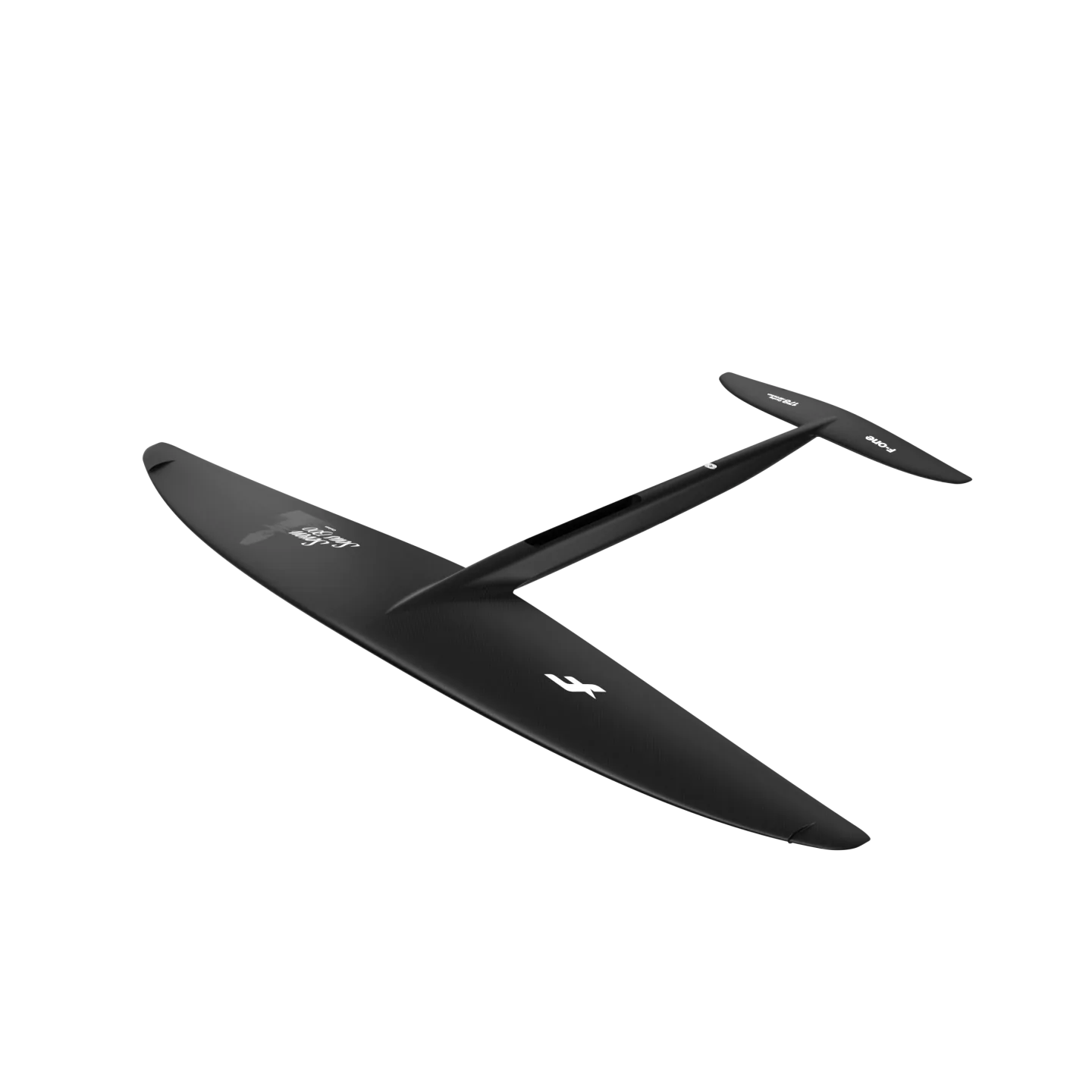
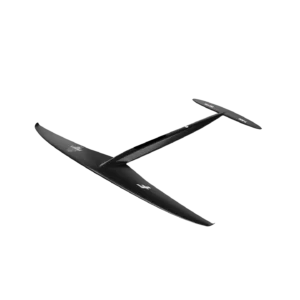
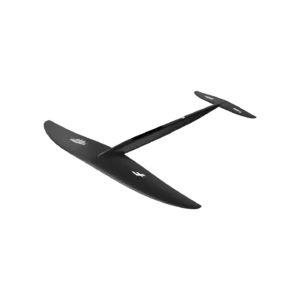
Black F-One Seven Seas foil seen in three-quarter view: large tapered front wing, thin fuselage and small stabilizer, black background
The assembled Seven Seas, front wing and stabilizer · © F-One
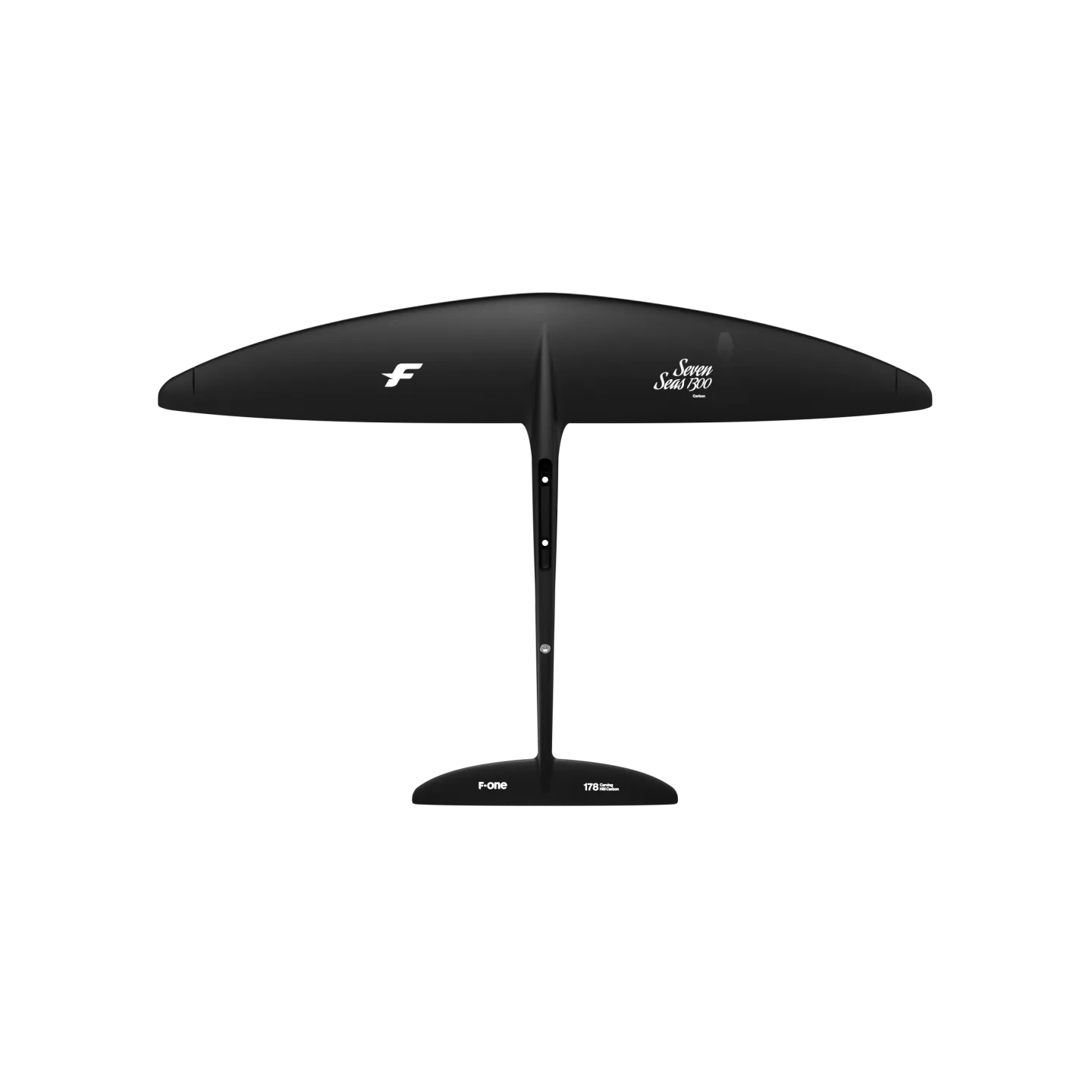
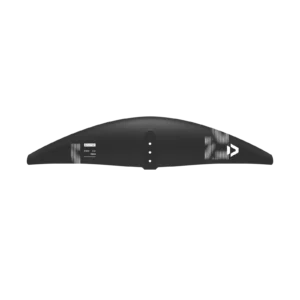
Black F-One Seven Seas foil seen from above: crescent front wing, white F logo on the left, Seven Seas marking on the right
The Seven Seas front wing seen from above, with its marking · © F-One
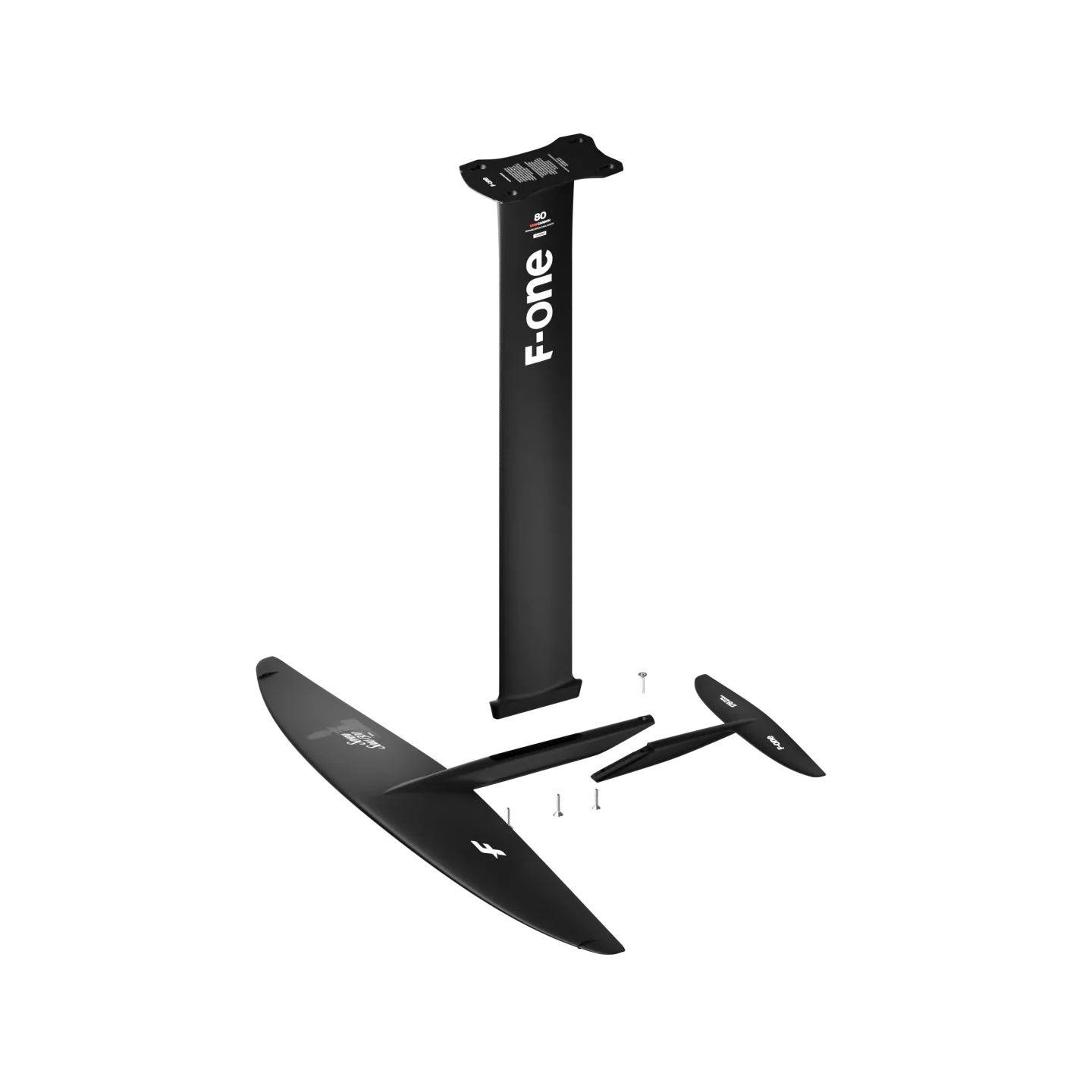
Black F-One foil in separate parts on a black background: mast, fuselage, Seven Seas front wing, stabilizer and four screws
The foil parts before assembly: mast, fuselage, front wing, stabilizer and screws · © F-One
F-One

F-One Seven Seas 2026 test

  • Riding styleFreeride and downwind (wing, K-wing, pocket wing, SUP foil), learning
  • Front wings1100 to 1600 cm²
  • Wingspan94 to 113 cm
  • YearModel 2026 · released Mar 2026

Verdict in brief

F-One’s all-round front wing: six sizes (1100 to 1600 cm²), aspect ratio of 8.0, built to take off early and glide easily. The brand makes it the stepping stone for riders leaving compact front wings; some riders recommend it for learning, others find it slow or heavy in large sizes. No independent test of the Titan 2 version.

For you if

  • You are learning wing foiling and want a front wing that takes off on its own: Reddit riders cite it as F-One’s best beginner foil (March 24, 2026) and another suggests a 1100 for a 45 kg child who is learning (August 8, 2026)
  • You are leaving a compact progression front wing: the glide and stability make jibes and tacks easier
  • You want a single front wing for freeride and a bit of downwind: MACkite ranks it among the front wings of a one-foil quiver for intermediate riders

Not for you if

  • You are looking for speed and maneuverability: a Reddit rider finds the large sizes “dragy and sluggish” next to an SK8 650 (November 6, 2025), and prefers the Eagle 890
  • You want serious downwind: the Seven Seas stays downwind-oriented, but a Reddit rider outgrew his 1100, too slow to keep up with the waves over long distances (October 26, 2025); the Eagle and the Eagle X are there for that
  • You want a light front wing or plan to jump: 1.91 kg in the 1500 and 2.11 kg in the 1600, and the manual prohibits jumping beyond 1,000 cm² or 90 cm of span, so across the whole range

Have you ridden this model? Leave the first review

What we know about this model

Our method

Front wings: sizes and mounting

Front wings: area, span, aspect ratio, stabilizer and mounting
SizeWingspanAspect ratioRecommended stabilizerWing attachmentWing weight
1100 cm²94 cm8Carving 178 XXS2 M8x25 screws · 25 Nm1470 g
1200 cm²98 cm8Carving 178 XXS2 M8x25 screws · 25 Nm1530 g
1300 cm²102 cm8Carving 178 XXS2 M8x25 screws · 25 Nm1670 g
1400 cm²105,5 cm8Carving 198 XXS2 M8x25 screws · 25 Nm1750 g
1500 cm²109,5 cm8Carving 198 XXS2 M8x25 screws · 25 Nm1910 g
1600 cm²113 cm8Carving 198 XXS2 M8x25 screws · 25 Nm2110 g

F-One data read on November 7, 2026.

More details on these figures

Stabilizer: the Monobloc Tail Carving that F-One recommends first; the second choice (DW) is under compatibility. Attachment: F-One 2026 manual. Area in square inches and profile thickness are not published.

Components and compatibility

Checked on 07/11/2026

The weight of each front wing is published by F-One (1.47 to 2.11 kg). Mast, stabilizer and mast base are sold separately.

Compatibility

Wing attachment
Titan 2 mast base: 2 M8x25 mm screws at 25 N.m. Front wing and stabilizer are assembled with 2 M6x25 mm screws at 12 N.m.
Stabilisateurs
Monobloc Tail, F-One’s first choice: Carving 178 XXS for the 1100, 1200 and 1300, Carving 198 XXS for the 1400, 1500 and 1600. Second choice depending on level and discipline: DW 136 XS or DW 156 XS (1100, 1200), DW 156 XS (1300), DW 176 XXS (1400 to 1600).
Fuselage
Fuselage molded in one piece with the front wing (monobloc): there is no fuselage to choose, only the stabilizer is mounted at the rear.
Masts
F-One aluminum mast with Titan 2 mast base, or F-One carbon mast compatible with Titan 2. Titan 2 front wings do not fit Titan 1 carbon masts, and there is no Titan 1 to Titan 2 adapter.

Stated riding styles

Front wing
F-One page: “Downwind / Freeride” program. Text: under a wing, a K-Wing or a pocket wing, progressive takeoff then glide upwind and in the bumps, easier jibes and tacks; the brand keeps the front wing downwind-oriented and calls it “of choice” for advanced riders in light wind; surfing small chop possible. The word prone does not appear in the text.
Summary
freeride, learning · downwind · wing, K-wing, pocket wing; small chop surfing; prone not mentioned.

Strong points, weak points

Strong points

  • Six sizes from 1100 to 1600 cm², aspect ratio of 8.0 on all, published weight from 1.47 to 2.11 kg
  • F-One ranks it among the most popular front wings in its range, with a very wide speed range and a very efficient low end
  • Wingtips shaped for carving, with a natural roll that lets you surf small chop
  • Titan 2 connection with two M8 screws (25 N.m) and revised carbon layup; front wing alone priced among the lowest in the range

Weak points

  • No independent test of the Titan 2 version: everything you read comes from F-One, shops and riders (previous generation)
  • Heavy in the large sizes: 1.91 kg in the 1500 and 2.11 kg in the 1600, versus 1.47 kg for the 1100
  • Mixed opinions among riders: “lame” for one, who preferred an SK8 (March 23, 2026); “dragy and sluggish” in a large size for another (November 6, 2025)
  • Profile thickness and stabilizer area not published; stabilizer to buy separately

The flaw to know about. No serial defect recorded. Riders rather describe a trade-off: on the previous generation, one rider notes lower pitch stability than a more forgiving front wing, which makes the jibe harder (Reddit, March 24, 2026), and another finds the large sizes heavy to maneuver (November 6, 2025). No independent test settles it for the Titan 2.

Model evolution

What changes vs the previous generation

  • Titan 2 connection: two M8 screws instead of three M6 screws, for more structural efficiency, better glide and a more direct feel
  • Revised carbon layup (Dynamic Structural Design): more overall control and stability
  • Extended size range to cover more disciplines and conditions: six sizes from 1100 to 1600 cm²
  • Aspect ratio of 8.0, unchanged: the previous generation already had it at 8.0 (Wing and Kite, MACkite)

Specifications

12 specs, sources at the bottom of the page

Program (manufacturer)
Downwind / Freeride; wing, K-wing, pocket wing, SUP foil; beginner to expert riders
Sizes (area)
1100, 1200, 1300, 1400, 1500 and 1600 cm²
Wingspan
94 cm (1100), 98 (1200), 102 (1300), 105.5 (1400), 109.5 (1500), 113 (1600)
Aspect ratio
8.0 for all sizes
Weight
1.47 kg (1100), 1.53 (1200), 1.67 (1300), 1.75 (1400), 1.91 (1500), 2.11 (1600)
Profile
Refined profile, reworked wingtips for maneuverability; thickness not published
Construction
Carbon (Toray T700 fiber), Dynamic Structural Design structure, wing and fuselage molded as a single piece (one-piece)
Connection
Titan 2: 2 M8x25 mm screws, 25 N.m; front wing and stabilizer: 2 M6x25 mm screws, 12 N.m
Recommended stabilizer
Monobloc Tail Carving 178 XXS (1100 to 1300), Carving 198 XXS (1400 to 1600)
Jumps
Prohibited with a front wing of more than 1,000 cm² or more than 90 cm of span (F-One manual): all sizes are affected
Brand ratings (F-One’s in-house scale)
Roll 90 · pivot 70 · pitch 80 · min speed 70 · glide 75 · max speed 85 · overpower 30 · breaching 95 · carving 100
Official film
“F-ONE / SEVEN SEAS - Explained” (March 29, 2026), F-ONE channel

Riders’ reviews

No reviews

No reviews yet.

Nobody has reviewed this gear yet. Do you use it? Help other riders of your weight — 2 minutes.

Leave your review (2 minutes)

Three screens: you, the gear, your review. Your email will never be published; it is only used to confirm that the review comes from a real person.

1/3 You

Only used to confirm your review and to let you know if it is rejected. Never displayed, never resold.

Your weight *

10 kg ranges only, so that other riders of your build can relate. No exact weight is recorded.

Your level *

Beginner: I’m still taking lessons. Intermediate: I ride on my own. Advanced: transitions and jumps. Expert: freestyle, wave or competition.

Your riding

Optional. If checked, your review stays published with the label “Gear received or tied to a brand” and doesn’t count toward the average rating.

You must be at least 15 to post a review (“Your data” article of the policy).

2/3 Your gear and how you use it
Wind range actually used (knots)
How long you’ve been using it *
Number of sessions (optional)
Rate each criterion (at least 3) *
Low-end takeoff
Speed & glide
Maneuverability (turns)
Pump
Finish & durability

1 = very poor, 5 = excellent. Leave blank any criterion you couldn’t judge.

Do you recommend it? *
3/3 Your review

140 characters minimum — Takeoff, glide, pump, what disappointed you, who you’d recommend it to.

Rider reviews: confirmed email address, no compensation. “Brand-linked” and “loaned / received” reviews are labeled and excluded from the average. Each review shows its publication date, the date of the experience and, if it was edited, its update date. A review is published or rejected within 7 days at most; if it is rejected, you receive the reason by email and you can correct it. You can complete or delete your review at any time from the email address used to submit it. How do reviews work?

Alternatives to compare

AFS Evo

AFS’s Evo plays the same progression front wing role with an aspect ratio of 7.5 to 8.1. The Evo remains the front wing AFS recommends for learning.

Duotone Free 2.0 2026

Duotone’s progression front wing, in 1300, 1600 and 1900 cm², aspect ratio of 6.8 to 7.2. Lower aspect ratio and cheaper than the Seven Seas, it is more forgiving; a Reddit rider cites the Free 2.0 as an alternative, harder to get going in light wind.

F-One Eagle X

F-One’s front wing with the highest aspect ratio: 12, six sizes from 500 to 1,000 cm². For anyone who has outgrown the Seven Seas in downwind (and the Eagle in between), but it needs momentum. Don’t confuse it with the Eagle, which is another front wing from the brand.

F-One Sushi

F-One’s surf front wing: aspect ratio of 7.7, 620 to 1020 cm², less speed and more roll. It is for those who want to turn in the wave, not glide.

Frequently asked questions

F-One Seven Seas: which sizes and what weight?

Six sizes, all with an aspect ratio of 8.0: 1100 cm² (94 cm span, 1.47 kg), 1200 (98 cm, 1.53 kg), 1300 (102 cm, 1.67 kg), 1400 (105.5 cm, 1.75 kg), 1500 (109.5 cm, 1.91 kg) and 1600 (113 cm, 2.11 kg), front wing alone. Wing and fuselage are molded in one piece. For the price, see the “Where to buy” section of this page.

Seven Seas: which size should you choose?

On Reddit, an 83 kg rider finds the 1300 a bit big in strong wind and thinks a 1100 is enough at 75 kg (previous generation, March 24, 2026). For a 45 kg child who is learning, one rider recommends a 1100 and another aims for around 1000 cm² or less (August 8, 2026). A 66 kg rider outgrew his 1100 for downwind (October 26, 2025).

Seven Seas or SK8: which one for learning?

A Reddit rider recommends the Seven Seas until jibes, tacks and foot changes are mastered, then the SK8 (March 24, 2026); another found it disappointing after Phantoms (March 23, 2026). A third finds the large Seven Seas draggy next to a small SK8 650 (November 6, 2025). No test puts them side by side.

Which stabilizer with the F-One Seven Seas?

The recommended Monobloc Tail: Carving 178 XXS for the 1100, 1200 and 1300, Carving 198 XXS for the 1400, 1500 and 1600. Second choice: DW 136 XS or 156 XS (1100, 1200), DW 156 XS (1300), DW 176 XXS (1400 to 1600). One rider recommends a surf 275 stabilizer rather than a Carving 200 for a child who is learning.

Does the current Seven Seas fit my F-One mast?

It uses the Titan 2 connection: 2 M8 screws instead of the 3 M6 screws of the Titan 1. On an aluminum mast, you need the Titan 2 mast base; on a carbon mast, the mast must be Titan 2 too, as there is no Titan 1 to Titan 2 adapter. Seven Seas with the Titan 1 connection are older and do not fit a Titan 2 carbon mast.

Method and limitations of this page

This page brings together the technical specs, tests from the press and blogs, and rider feedback found on the web, without rewriting any of it. When WindUnity has ridden the gear itself, the page says so with the “WindUnity test” badge.

Rider reviews are published as is, with their date. Reviews tied to a brand or based on loaned gear are labeled and excluded from the average.

What’s still missing

  • No independent test of the Titan 2 version as of November 7, 2026; the feedback comes from Reddit and concerns the previous generation
  • Profile thickness, area in square inches and stabilizer weight: not published by F-One
  • Recommended rider level: the F-One page shows it with a gauge (beginner, intermediate, expert) with no readable value
  • Recommended rider weight by size: F-One does not publish it; only riders give their size and weight
  • Exact years of the previous generations: foil.guide gives 2022 for the first Seven Seas, MACkite presents the 8.0 aspect ratio on April 12, 2024; F-One dates nothing
  • Reviews posted on WindUnity: none

Sources

Data collected early November 2026

F-One : 3 product pages

Shops : MACkite, GlissEvolution

Press and specialist sites : foil.guide

Forums and riders : Reddit

Others : Wing and Kite

See the details of the 9 sources

F-One

  1. Official Seven Seas page (EN)
  2. Titan 2 connection (EN)

Shops

  1. MACkite, Eagle X and Seven Seas updates
  2. GlissEvolution, F-One Titan 2

Press and specialist sites

  1. foil.guide, F-One Seven Seas 1500

Forums and riders

  1. Reddit r/wingfoil, F-One Foil Dilemma
  2. Reddit r/wingfoil, What size f one Eagle wing?

Others

  1. Wing and Kite, F-One Seven Seas page