Skip to content
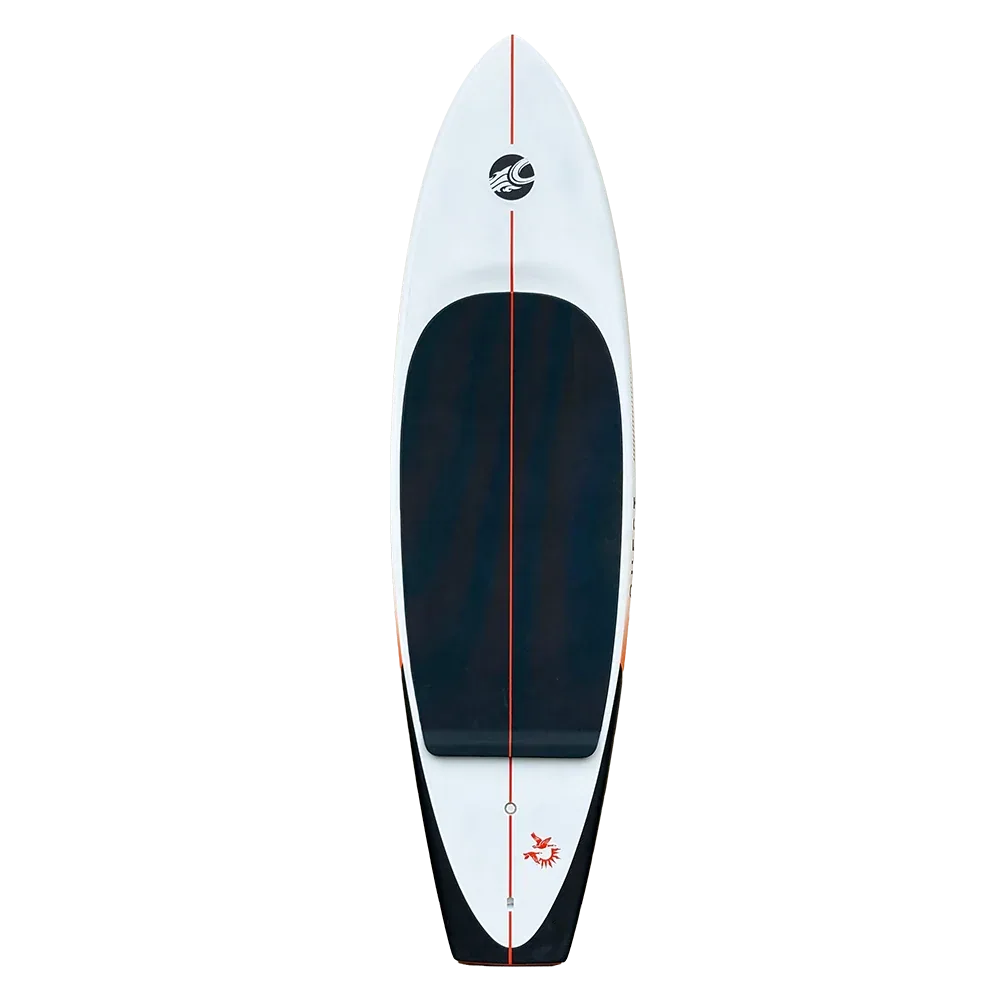
Cabrinha Quest V2, top view: glossy white deck with a thin red-orange line down the center, large black pad
The Quest V2, top view · © Cabrinha
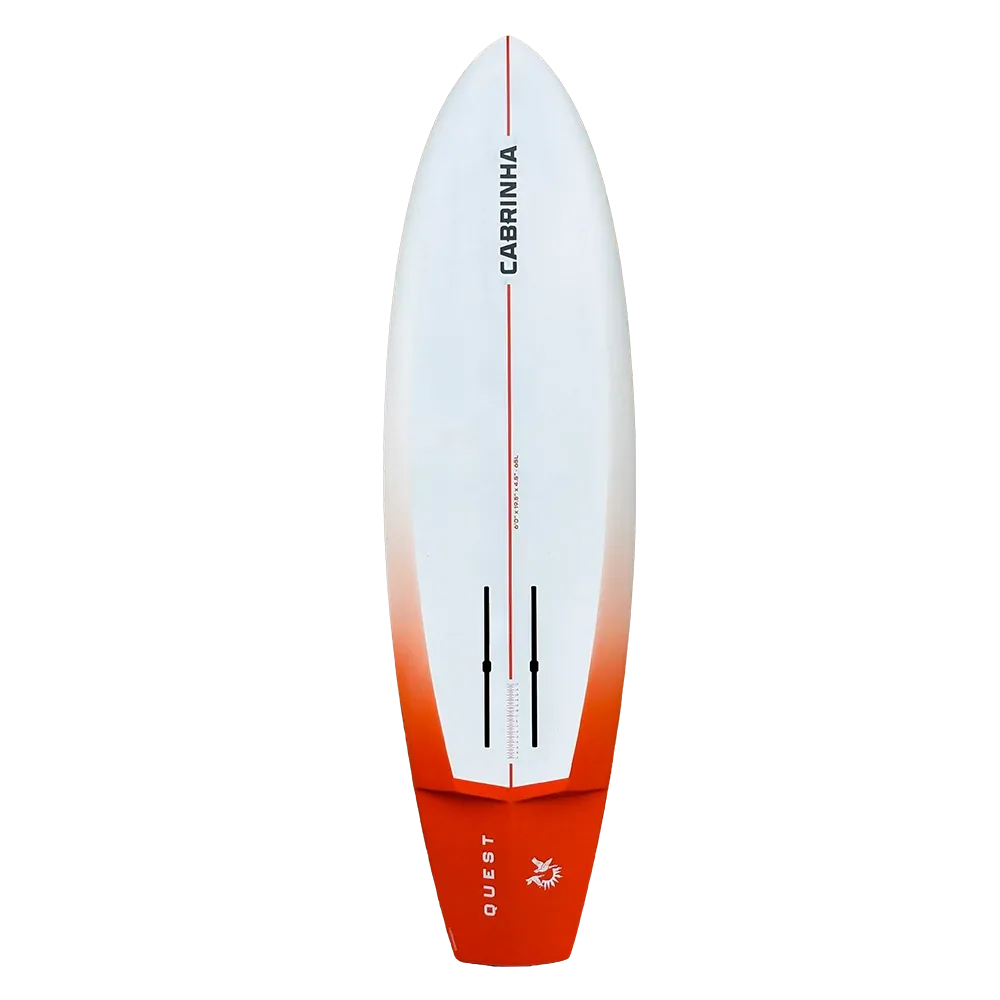
Cabrinha Quest V2, bottom view: white turning to orange-red toward the tail, two black box rails with graduated markings
The Quest V2, bottom view · © Cabrinha
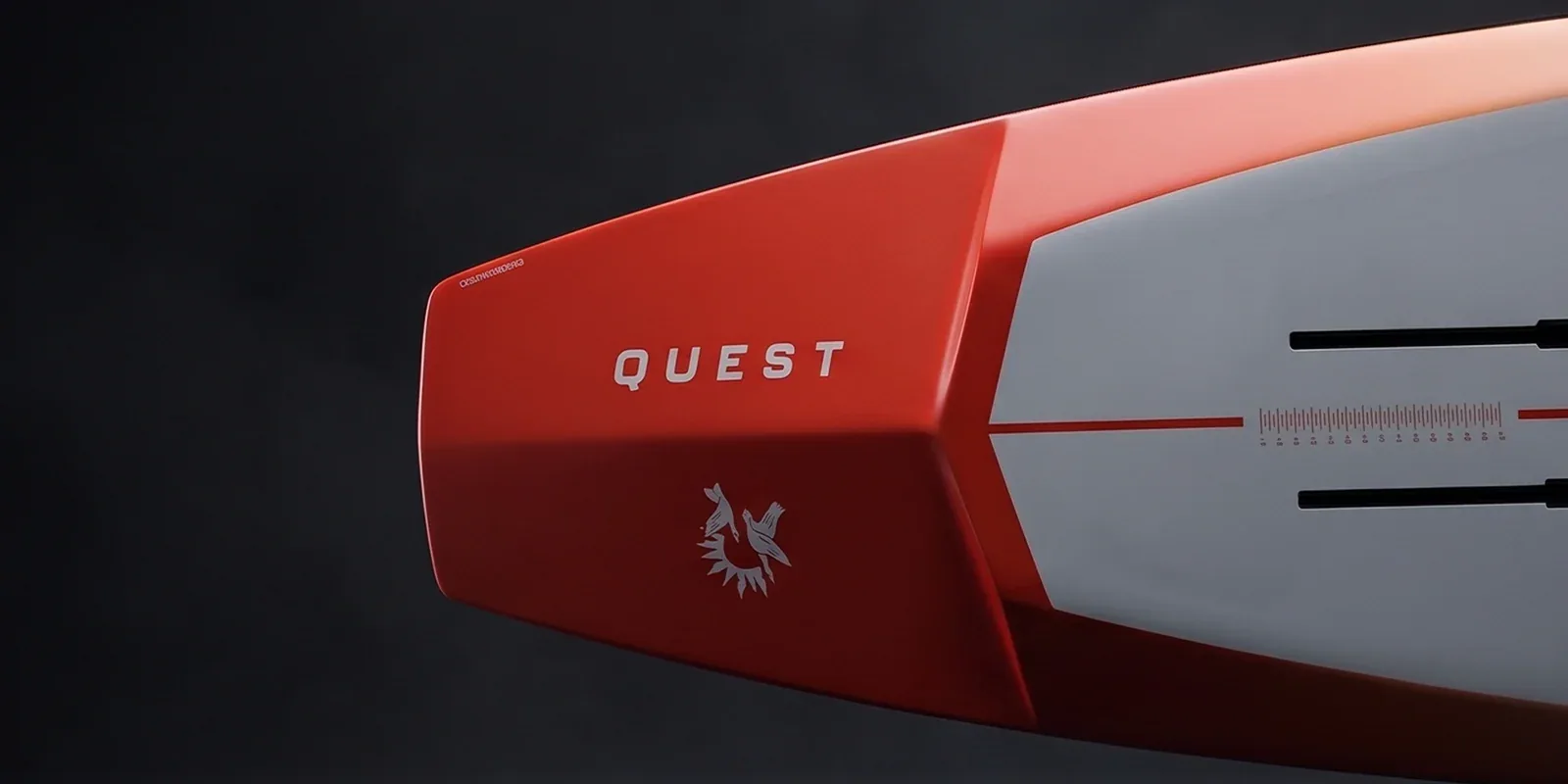
Close-up of the red-orange end of a Quest V2: glossy faceted face with the word QUEST in white
Detail of the Quest V2 · © Cabrinha
Cabrinha

Cabrinha Quest V2 test

  • Riding styleDownwind, parawing, light wind
  • Sizes182,9 to 243,8 cm
  • YearModel 2027 · released Sep 2026

Verdict in brief

A downwind and parawing board, 183 to 244 cm long and 65 to 112 l. Cabrinha makes it for paddle downwind or parawing, and for parawing freeride; it says it is better than the Swift in light wind, with the Swift keeping the advantage in strong wind and in wing foiling. I recommend it if your program is parawing or downwind. No independent test, no published weight: my opinion rests on the brand’s page.

No independent test of the Quest V2 found as of November 11, 2026; Cabrinha publishes no board weight, no rider weight and no wind range.

For you if

  • You do parawing: the new tail is said to pop up more easily when there are no waves, and the 65 to 85 l sizes are dedicated to this use
  • You do paddle downwind or parawing downwind: hull and volume built for glide and holding course
  • You want to choose your volume precisely: six sizes from 65 to 112 l, with dimensions published for each

Not for you if

  • You mostly wing in steady wind: Cabrinha points to the Swift for strong wind and wing foiling
  • You want to know the board’s weight: the page publishes none

Have you ridden this model? Leave the first review

What we know about this model

Our method

Sizes, volume, weight and foil box

Sizes, volume, weight and recommended rider
SizeLength × widthThicknessVolumeFoil box
6'0’’182.9 × 49.5 cm11.4 cm65 Ln.c.
6'4’’193 × 49.5 cm12.4 cm75 Ln.c.
6'8’’203.2 × 49.5 cm13 cm85 Ln.c.
7'0’’213.4 × 48.3 cm15 cm95 Ln.c.
7'6’’228.6 × 47 cm15.7 cm106 Ln.c.
8'0’’243.8 × 45.7 cm16 cm112 Ln.c.

Dimensions published for each size (inches converted); board weight, rider weight and wind range n/a.

More details on these figures

Table from the Cabrinha Quest V2 page, checked on November 11, 2026: length, width and thickness in inches, volume in liters (tolerances possible according to Cabrinha). The centimeters are calculated by WindUnity. Cabrinha publishes no board weight, no rider weight and no wind range.

Strong points, weak points

Strong points

  • Six sizes from 65 to 112 l, with length, width, thickness and volume published for each
  • Chined, angled tail: the board pops up more easily and releases better on touchdowns
  • Bag, 4 screws and 4 T-nuts included
  • EVA pad in biodegradable Friendly Foam, cut out where the foil sits
Weak points

  • No independent test, no rider feedback
  • No board weight published, no rider weight and no wind range
  • Foil box type and spacing not stated on the page

The flaw to know about. For me, its real flaw: the page publishes no weight, whereas the 2026 Quest gave one per size. The only feedback is a testimonial from Brendan Healy picked by Cabrinha. To choose your size, ask the retailer, with your weight at hand.

Model evolution

Checked on 11/11/2026

What changes vs the 2026 Quest

  • New chined tail design: the board pops up more easily, especially in parawing when there are no waves to help get going
  • Angled tail: at high speed, the water releases better on touchdowns, without the board catching
  • Reworked rocker and redistributed volume
  • Six sizes from 65 to 112 l; the smallest are dedicated to parawing

Specifications

8 specs, sources at the bottom of the page

Program (manufacturer)
Parawing, downwind and wing foiling; for paddle downwind or parawing, and parawing freeride
Construction
Apex Pro Carbon: light, buoyant EPS core wrapped in biaxial carbon
Tail
“Step and release” tail: the stepped design reduces wetted surface on acceleration; new chine to pop up more easily; angled cut to release better on touchdowns
Hull
Hull and volume redistributed for glide and holding course; reworked rocker
Pad
Full EVA pad in biodegradable Friendly Foam, low corduroy grooving, cutouts at the grip points
Comes with
Bag, 4 M8×30 mm screws, 4 T-nuts; straps sold separately
Brand scale (in-house rating, not a measurement)
Lift 100%, speed 95%, maneuverability 80%, recovery 80%: Cabrinha’s rating for each style, 100% = strong point
Page date
Published on September 8, 2026 on the Cabrinha online shop; Cabrinha shows no release date

Riders’ reviews

No reviews

No reviews yet.

Nobody has reviewed this gear yet. Do you use it? Help other riders of your weight — 2 minutes.

Leave your review (2 minutes)

Three screens: you, the gear, your review. Your email will never be published; it is only used to confirm that the review comes from a real person.

1/3 You

Only used to confirm your review and to let you know if it is rejected. Never displayed, never resold.

Your weight *

10 kg ranges only, so that other riders of your build can relate. No exact weight is recorded.

Your level *

Beginner: I’m still taking lessons. Intermediate: I ride on my own. Advanced: transitions and jumps. Expert: freestyle, wave or competition.

Your riding

Optional. If checked, your review stays published with the label “Gear received or tied to a brand” and doesn’t count toward the average rating.

You must be at least 15 to post a review (“Your data” article of the policy).

2/3 Your gear and how you use it
Wind range actually used (knots)
How long you’ve been using it *
Number of sessions (optional)
Rate each criterion (at least 3) *
Takeoff / low-speed stability
Weight & maneuverability
Stiffness
Foot comfort
Finish & durability

1 = very poor, 5 = excellent. Leave blank any criterion you couldn’t judge.

Do you recommend it? *
3/3 Your review

140 characters minimum — Takeoff, low-speed stability, what disappointed you, who you’d recommend it to.

Rider reviews: confirmed email address, no compensation. “Brand-linked” and “loaned / received” reviews are labeled and excluded from the average. Each review shows its publication date, the date of the experience and, if it was edited, its update date. A review is published or rejected within 7 days at most; if it is rejected, you receive the reason by email and you can correct it. You can complete or delete your review at any time from the email address used to submit it. How do reviews work?

Alternatives to compare

Appletree Skipper Downwind V2

Appletree downwind board from 94 to 118 l, 213 to 244 cm, the Quest V2 lengths run from 183 to 244 cm for 65 to 112 l.

Duotone Paradox SLS 2026

Duotone parawing and downwind board from 45 to 105 l, 155 to 200 cm, 3.5 to 5.6 kg. It goes lower in volume than the Quest V2 (45 l against 65 l) and publishes its weights.

F-One Rocket Free Downwind 2026

F-One downwind board from 85 to 124 l, 193 to 234 cm, 5.4 to 6.5 kg. It has no small volume: the Quest V2 offers three under 85 l.

Other versions of this model

Cabrinha Quest V2

Frequently asked questions

Quest V2 or 2026 Quest: what changes?

A new tail (chine and angled cut to pop up more easily and release better on touchdowns), a reworked rocker and six sizes from 65 to 112 l instead of three from 96.5 to 111 l. At the lengths they share, widths and volumes are almost the same. The V2 publishes no weight. No test compares the two.

Which Quest V2 size should you take?

Neither rider weight nor wind range is published. Cabrinha’s parawing guide cites the 7'0 to 7'6 with a Prestige 905 foil to build confidence, and the 6'8 with a Prestige 1150 for more lift, to be chosen according to your weight and level. The smallest sizes are dedicated to parawing. Give the retailer your weight.

Quest V2 or Swift?

Cabrinha says the Quest is longer at equal volume, which helps with taking off in little wind: better for parawing and downwind in light wind, while the Swift suits strong wind and wing foiling better.

Is the Quest V2 suitable for starting parawing?

Cabrinha cites it in its beginner’s guide to parawing as an option, with sizes to be chosen according to weight and experience, and recommends taking lessons before going out alone. I have no test that confirms it is easy.

What comes with the Quest V2?

It comes with a bag and without straps, in six sizes from 6'0 to 8'0. For the price, see the “Where to buy” section of this page.

Method and limitations of this page

This page brings together the technical specs, tests from the press and blogs, and rider feedback found on the web, without rewriting any of it. When WindUnity has ridden the gear itself, the page says so with the “WindUnity test” badge.

Rider reviews are published as is, with their date. Reviews tied to a brand or based on loaned gear are labeled and excluded from the average.

What’s still missing

  • No independent test of the Quest V2
  • Board weight: the page publishes none for any size
  • Recommended rider weight and wind range per size: Cabrinha doesn’t publish them
  • Foil box type and spacing: not stated on the page
  • No brand film on the Quest V2
  • Exact release date: Cabrinha shows none
  • Model year: the page does not say “2027”; it comes from the “2027” product tag and from MACkite’s “2027 Cabrinha Quest V2” label

Sources

Data collected mid-November 2026

Cabrinha : 2 product pages, beginner’s guide to parawing

Shops : MACkite

See the details of the 4 sources

Cabrinha

  1. Official Quest 2026 page
  2. Beginner’s guide to parawing

Shops

  1. MACkite, “2027 Cabrinha Quest V2 Foilboard” listing