Skip to content
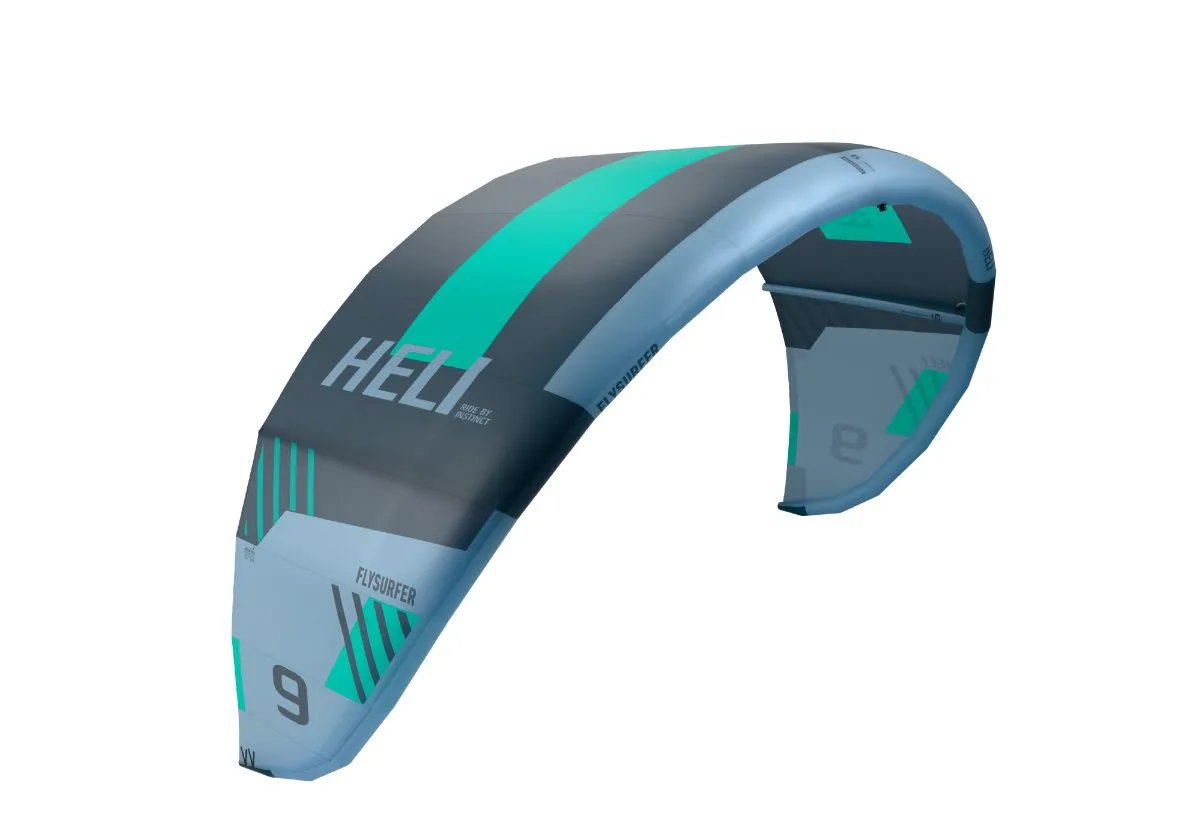
Flysurfer Heli 9 m² kite in a product render on a white background: slate gray and anthracite canopy, turquoise chevrons
Heli, product render (9 m²) · © Flysurfer
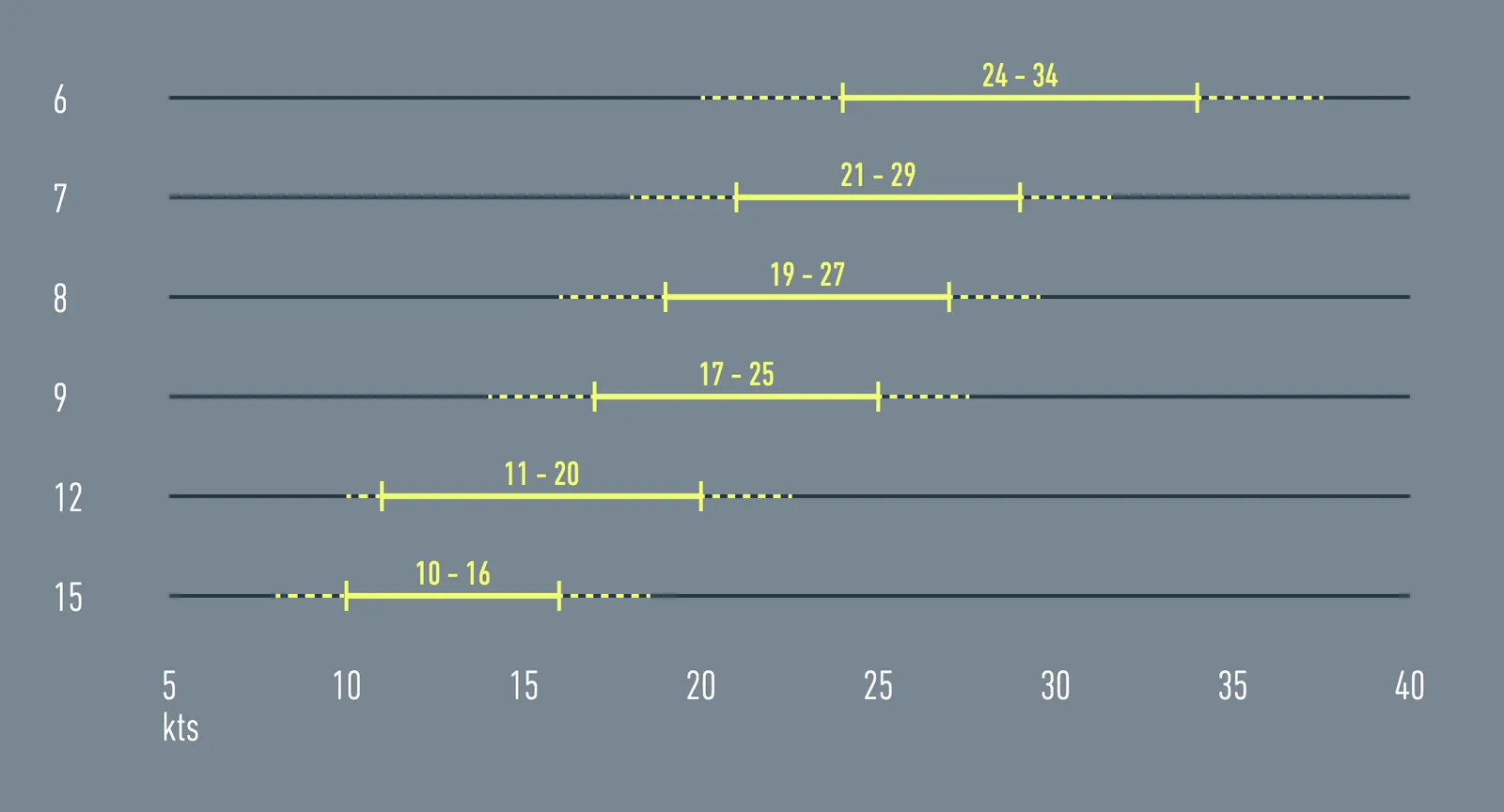
Official wind range chart of the Flysurfer Heli in knots for sizes 6, 7, 8, 9, 12 and 15 m²
Official wind range of the Heli (Flysurfer chart, reference weight not stated) · © Flysurfer
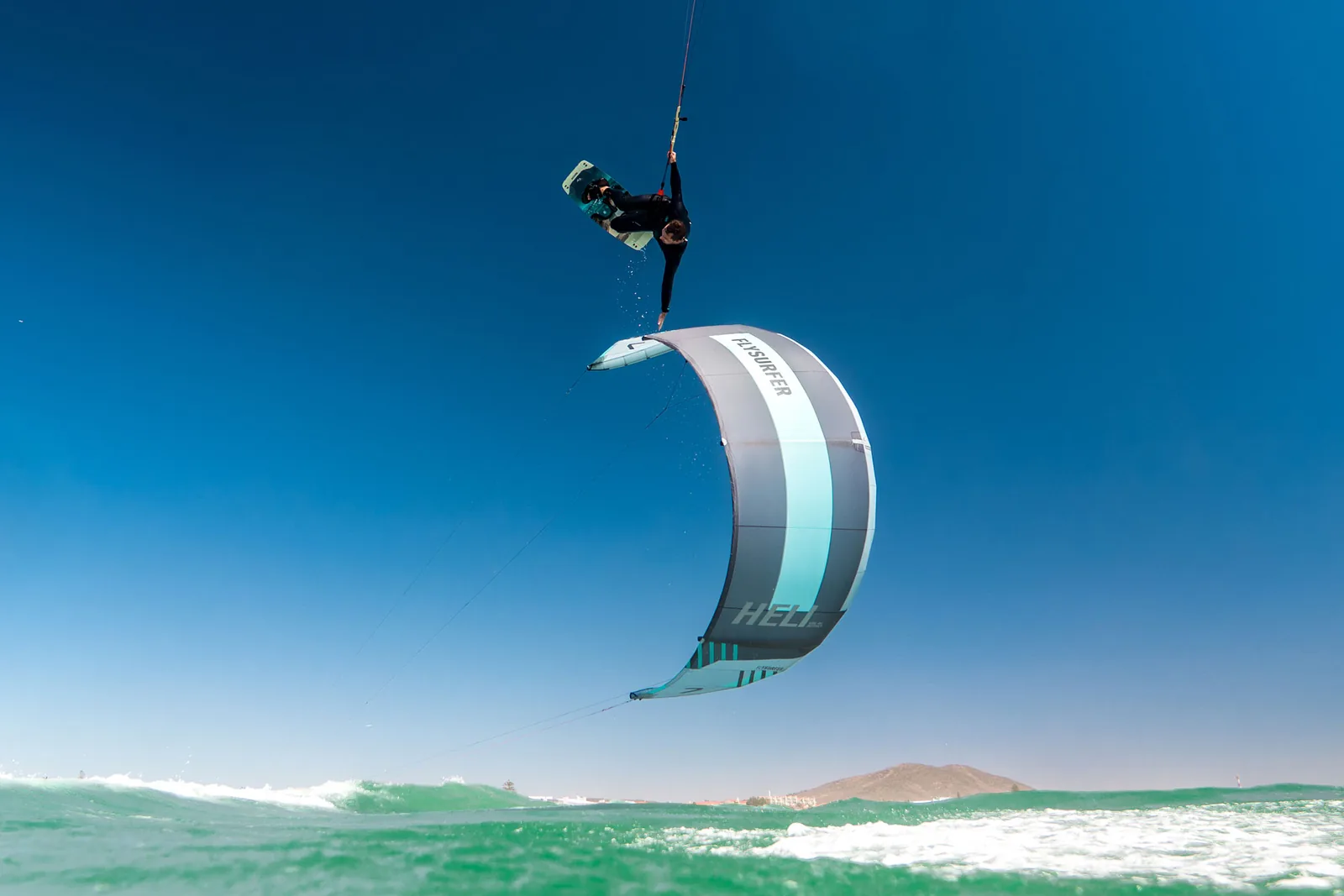
Rider mid-jump above a gray kite with an aqua turquoise stripe, over a turquoise sea with surf
Heli in a jump, photo from the official gallery · © Flysurfer
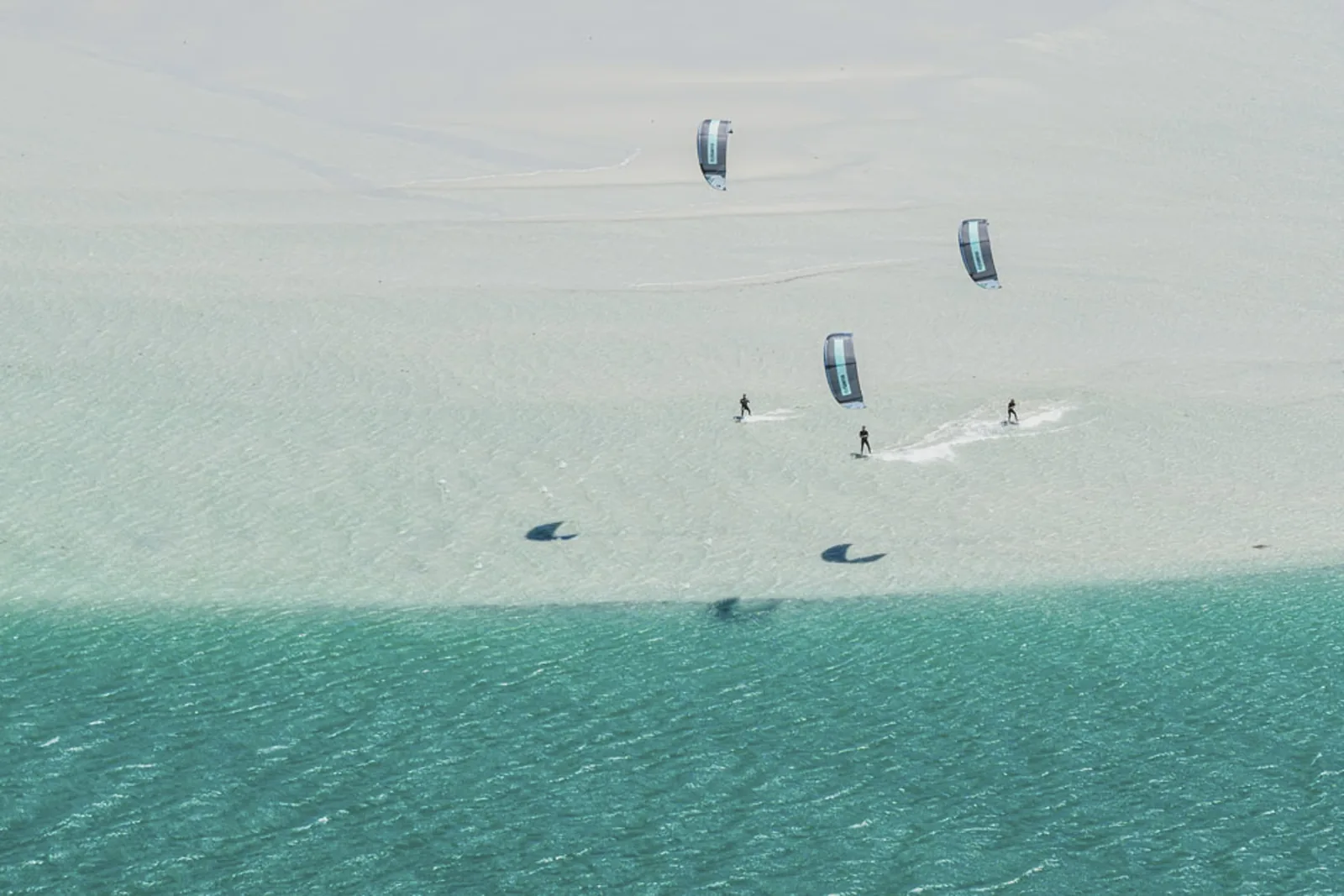
Aerial view of a shallow turquoise lagoon over light sand, with riders on the water, each under a gray-blue kite
Riders under Helis on a lagoon, photo from the official gallery · © Flysurfer
Flysurfer

Flysurfer Heli 2026 test

  • Riding styleFreeride, big air and waves
  • Sizes6 to 15 m²
  • YearModel 2026 · released Feb 2026
  • Wind10 to 34 knots

Verdict in brief

The Heli is Flysurfer’s 3-strut kite for freeride and jumping. Flysurfer makes it its easiest kite to jump and rates it from “Entry” to “Expert” on its house scale. I found no test by an independent outlet: the only published trial, by the retailer Kiteboarding1.eu (May 14, 2026, 12 m², 63 kg rider), describes it as calm, stable, easy to relaunch and generous in hangtime. For me, it’s worth it if you want a forgiving jumping kite. I wouldn’t take it as a light-wind kite.

Retailer trial: Kiteboarding1.eu (May 14, 2026). No rider review on WindUnity (the page doesn’t exist on the site yet).

For you if

  • You want a freeride kite that jumps without being abrupt: the Kiteboarding1.eu tester describes a soft vertical push, a lot of hangtime and calm landings
  • You relaunch often: the relaunch is done on one line according to the product page, the tester finds it easy, including in reverse launch with the two steering lines
  • You want a wide range: six sizes from 6 to 15 m², from 2.3 to 4.12 kg, with 23 m lines on all of them

Not for you if

  • You are looking for the light-wind kite: the tester himself points to the Indie2 for the largest size of a light-wind quiver
  • You want a kite made for kiteloops and committed big air: that is the Era 2’s territory, more specialized
  • You want to read an independent test before buying: there isn’t one, only a retailer trial

Have you ridden this model? Leave the first review

What we know about this model

Our method

Sizes and wind ranges

Your size on this model

Nothing stated for now.

Enter your weight and wind: your size is highlighted in the table.

kitesurfing kite size calculator

To find your size, open the calculator: your weight, the wind, your level. choosing your kite size: weight, wind, level

Sizes, weight and wind ranges
SizeKite weightWindValues in knotsLinesBarAspect ratio
6 m²2.3 kg24–34 knots23 mS (Fusion)4.8
7 m²2.45 kg21–29 knots23 mS (Fusion)4.9
8 m²2.8 kg19–27 knots23 mM (Force or Fusion)5
9 m²2.9 kg17–25 knots23 mM (Force or Fusion)5.1
12 m²3.6 kg11–20 knots23 mL (Force or Fusion)5.4
15 m²4.12 kg10–16 knots23 mL (Fusion)5.9

Wind range read off the official chart (reference weight not stated): adjust it to your weight, your board and your level. A US retailer publishes higher ranges.

More details on these figures

Wind range read off Flysurfer’s official chart (solid numbered segment; the Heli page doesn’t state the reference rider’s weight, whereas the Indie² page says about 75 kg). The Mac Kiteboarding table (US retailer, “Wing Range” text) gives ranges that are wider at the top: 23-35 knots in 6 m², 19-32 in 7, 17-29 in 8, 15-27 in 9, 12-24 in 12 and 10-18 in 15; I couldn’t settle between the two, ask your retailer for the exact range.

Strong points, weak points

Strong points

  • Six sizes from 6 to 15 m² and wind ranges that follow on from one another, from 24-34 to 10-16 knots (Flysurfer chart)
  • The only trial found notes no stalling and finds the relaunch easy; it looks for almost no flaw in it
  • Weight of 2.9 kg in 9 m², between the Stoke 4 (2.66 kg) and the Era 2 (3.14 kg)
  • Rear line adjustment by a knot ladder and Ronstan pulley bridle (brand text repeated by a retailer)

Weak points

  • A single trial, by a retailer, on a 12 m² with a 63 kg rider: nothing on the small sizes or on heavy riders
  • More expensive than the Stoke 4 at the same size: in 9 m²
  • Standard setup too sheeted in according to the tester: he moved the steering lines one notch toward the kite right from the start
  • Wind ranges that differ depending on the source: the table repeated by Mac Kiteboarding gives 15-27 knots in 9 m², Flysurfer’s chart 17-25

The flaw to know about. For me, its real flaw: we know almost nothing independent about it. A single published trial (retailer, 12 m², 63 kg rider), no outlet test, no rider feedback found. The same tester finds it almost lazy in very light wind (12 m², around 5 m/s) and prefers the Indie2 for the largest size of a light-wind quiver. What it means for you: if you often sail under 12 knots, look at a lighter kite.

Model evolution

What changes vs a previous version

  • None: the Heli is a new name in Flysurfer’s inflatable range, I found no previous Heli and no page that presents it as the successor of a kite

Specifications

12 specs, sources at the bottom of the page

Technology
3-strut inflatable kite (“3-Strut L.E.I. Kite”), swept trailing edge profile, Dacron and Teijin D2 canopy, pulley bridle (5 points with Ronstan pulleys according to the brand text repeated by Mac Kiteboarding), rear line adjustment by a knot ladder
Level (Flysurfer’s in-house scale)
Beginner to expert (“Entry - Expert”)
Program (manufacturer)
Freeride, big air, wave (“Freeride, Big Air, Surf”). Flysurfer: its easiest kite to jump
Sizes
6, 7, 8, 9, 12 and 15 m²
Kite weight (kg)
2.3 / 2.45 / 2.8 / 2.9 / 3.6 / 4.12 for 6 / 7 / 8 / 9 / 12 / 15 m²
Aspect ratio
4.8 / 4.9 / 5 / 5.1 / 5.4 / 5.9 for 6 / 7 / 8 / 9 / 12 / 15 m²
Colorways
Dark Turquoise / Dove / Laser Ceramic / Dark Grey
Wind range (Flysurfer chart, reference weight not stated on the page)
24-34 knots in 6 m², 21-29 in 7, 19-27 in 8, 17-25 in 9, 11-20 in 12 and 10-16 in 15 (reading of the official chart). The Mac Kiteboarding table gives 23-35, 19-32, 17-29, 15-27, 12-24 and 10-18
Recommended bar and lines
Fusion [S] in 6 and 7 m², Force or Fusion [M] in 8 and 9, Force or Fusion [L] in 12, Fusion [L] in 15; 23 m lines on all sizes
Pack contents
Kite only, Universal bag, repair kit, safety guide
Inflation
Free Flow² system: main bayonet valve and push-push mechanism (brand text repeated by Mac Kiteboarding)
Release date
n/a: Flysurfer shows no date; official film of February 5, 2026

Riders’ reviews

No reviews

No reviews yet.

Nobody has reviewed this gear yet. Do you use it? Help other riders of your weight — 2 minutes.

Leave your review (2 minutes)

Three screens: you, the gear, your review. Your email will never be published; it is only used to confirm that the review comes from a real person.

1/3 You

Only used to confirm your review and to let you know if it is rejected. Never displayed, never resold.

Your weight *

10 kg ranges only, so that other riders of your build can relate. No exact weight is recorded.

Your level *

Beginner: I’m still taking lessons. Intermediate: I ride on my own. Advanced: transitions and jumps. Expert: freestyle, wave or competition.

Your riding

Optional. If checked, your review stays published with the label “Gear received or tied to a brand” and doesn’t count toward the average rating.

You must be at least 15 to post a review (“Your data” article of the policy).

2/3 Your gear and how you use it
Wind range actually used (knots)
How long you’ve been using it *
Number of sessions (optional)
Rate each criterion (at least 3) *
Low wind
High wind / control
Steering & rotation
Relaunch & depower
Finish & durability

1 = very poor, 5 = excellent. Leave blank any criterion you couldn’t judge.

Do you recommend it? *
3/3 Your review

140 characters minimum — How it behaves in your wind, what disappointed you, who you’d recommend it to.

Rider reviews: confirmed email address, no compensation. “Brand-linked” and “loaned / received” reviews are labeled and excluded from the average. Each review shows its publication date, the date of the experience and, if it was edited, its update date. A review is published or rejected within 7 days at most; if it is rejected, you receive the reason by email and you can correct it. You can complete or delete your review at any time from the email address used to submit it. How do reviews work?

Alternatives to compare

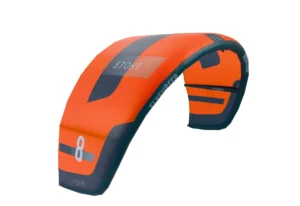
Flysurfer Stoke 4

The brand’s other 3-strut kite, aimed at freeride and wave. In 9 m²: 2.66 kg. Flysurfer presents the Heli as its easiest to jump.

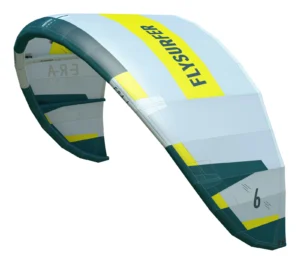
Flysurfer Era 2

The brand’s 5-strut kite for big air and kiteloops. In 9 m²: 3.14 kg

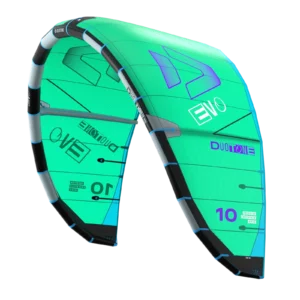
Duotone Evo 2026

Duotone’s versatile 3-strut kite. In 9 m²: 2.75 kg. Each brand draws its own wind chart.

Frequently asked questions

What is the wind range of a Flysurfer Heli?

On Flysurfer’s official chart: 24-34 knots in 6 m², 21-29 in 7, 19-27 in 8, 17-25 in 9, 11-20 in 12 and 10-16 in 15. The page doesn’t say for what weight. A US retailer publishes 23-35, 19-32, 17-29, 15-27, 12-24 and 10-18: ask your retailer for the exact range.

Which sizes does the Flysurfer Heli come in?

The kite alone, in 6, 7, 8, 9, 12 and 15 m². For the price, see the “Where to buy” section of this page.

Is there a test of the Heli?

Not by an independent outlet that I found as of November 9, 2026. The only published trial is the retailer Kiteboarding1.eu’s (May 14, 2026, 12 m², 63 kg rider): a calm, stable kite, easy to relaunch, generous in hangtime, a bit lazy in very light wind.

Heli or Stoke 4: which one should you choose?

The Heli is presented as the brand’s easiest to jump; the Stoke 4 is oriented toward freeride and wave. In 9 m² the Stoke 4 2.66 kg. No test compares them.

What bar should you take with the Heli?

Recommended bar: Fusion [S] for the 6 and 7 m², the Force or the Fusion [M] for the 8 and 9 m², the Force or the Fusion [L] for the 12 m² and the Fusion [L] for the 15 m², with 23 m lines.

Method and limitations of this page

This page brings together the technical specs, tests from the press and blogs, and rider feedback found on the web, without rewriting any of it. When WindUnity has ridden the gear itself, the page says so with the “WindUnity test” badge.

Rider reviews are published as is, with their date. Reviews tied to a brand or based on loaned gear are labeled and excluded from the average.

What’s still missing

  • No test of the Heli by an independent outlet as of November 9, 2026 (a single retailer trial)
  • No rider feedback on the Heli found; rider reviews on WindUnity: none
  • Reference weight of the wind chart not stated on the Heli page; wider ranges at Mac Kiteboarding (I couldn’t settle it)
  • Release date not shown by Flysurfer (February 2026 according to the official film of February 5, 2026)
  • Model year: Flysurfer does not date its models; 2026 retained based on the release date and the Mac Kiteboarding page
  • Availability of the 15 m² not verified (“coming soon” with no weight at Mac Kiteboarding, a price at the Flysurfer shop)
  • Projected area and wingspan not published on the page
  • Wind ranges read by eye off an image: 1 to 2 knots of uncertainty

Sources

Data collected early November 2026

Flysurfer : 2 product pages, brand video, other page

Shops : Kiteboarding1.eu, MACkite

Press and specialist sites : IKSURFMAG

See the details of the 7 sources

Flysurfer

  1. Official HELI wind range chart
  2. HELI shop
  3. Video “HELI - Ride by Instinct!”

Shops

  1. Kiteboarding1.eu, Kite FLYSURFER Heli - review (May 14, 2026)

Press and specialist sites

  1. IKSURFMAG, Flysurfer brand page (no Heli listed)