Skip to content
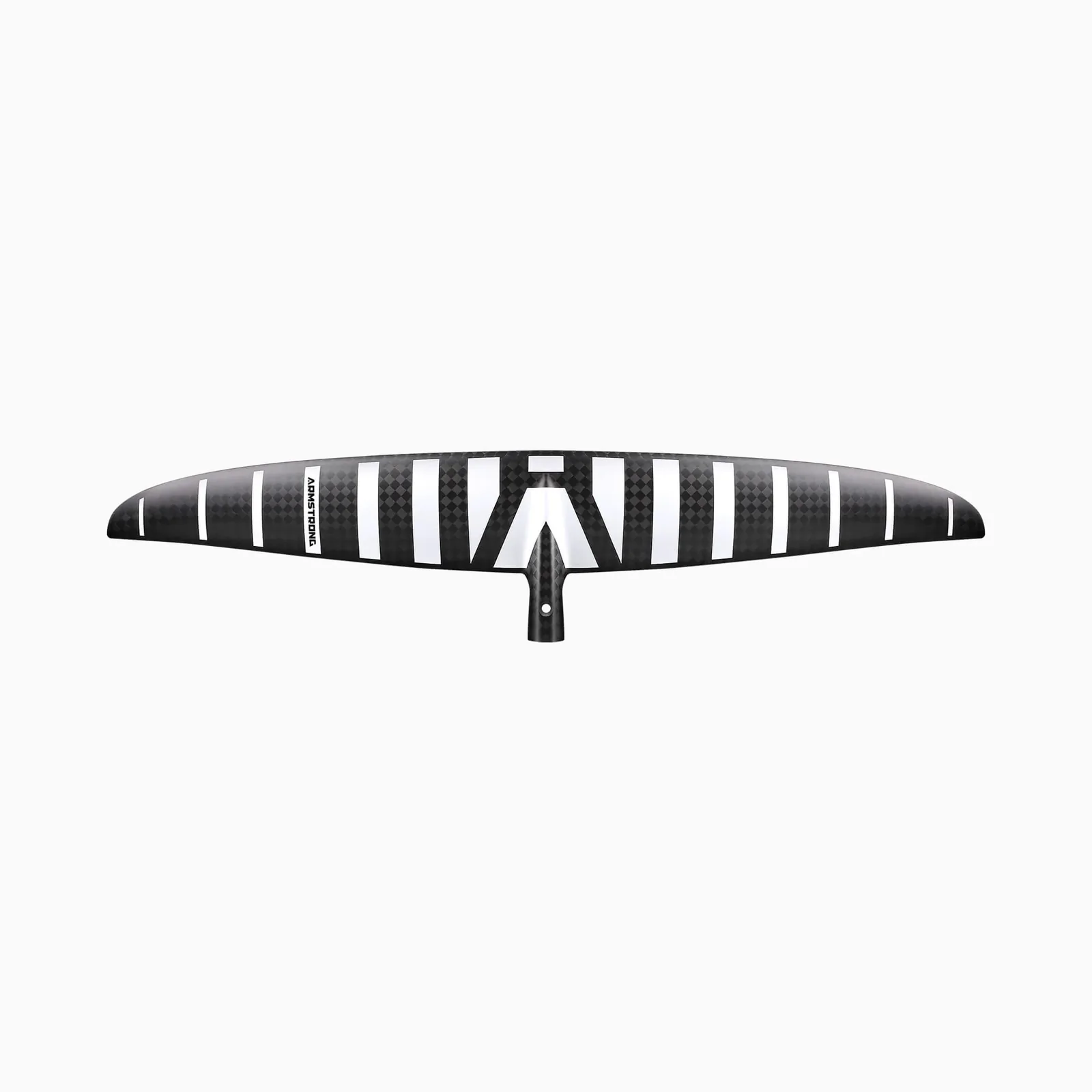
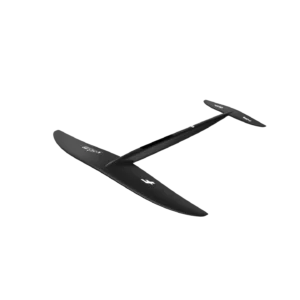
Armstrong HA 880 front wing in black checkered carbon, vertical white stripes and a central white chevron
HA front wing, size 880 cm² · © Armstrong
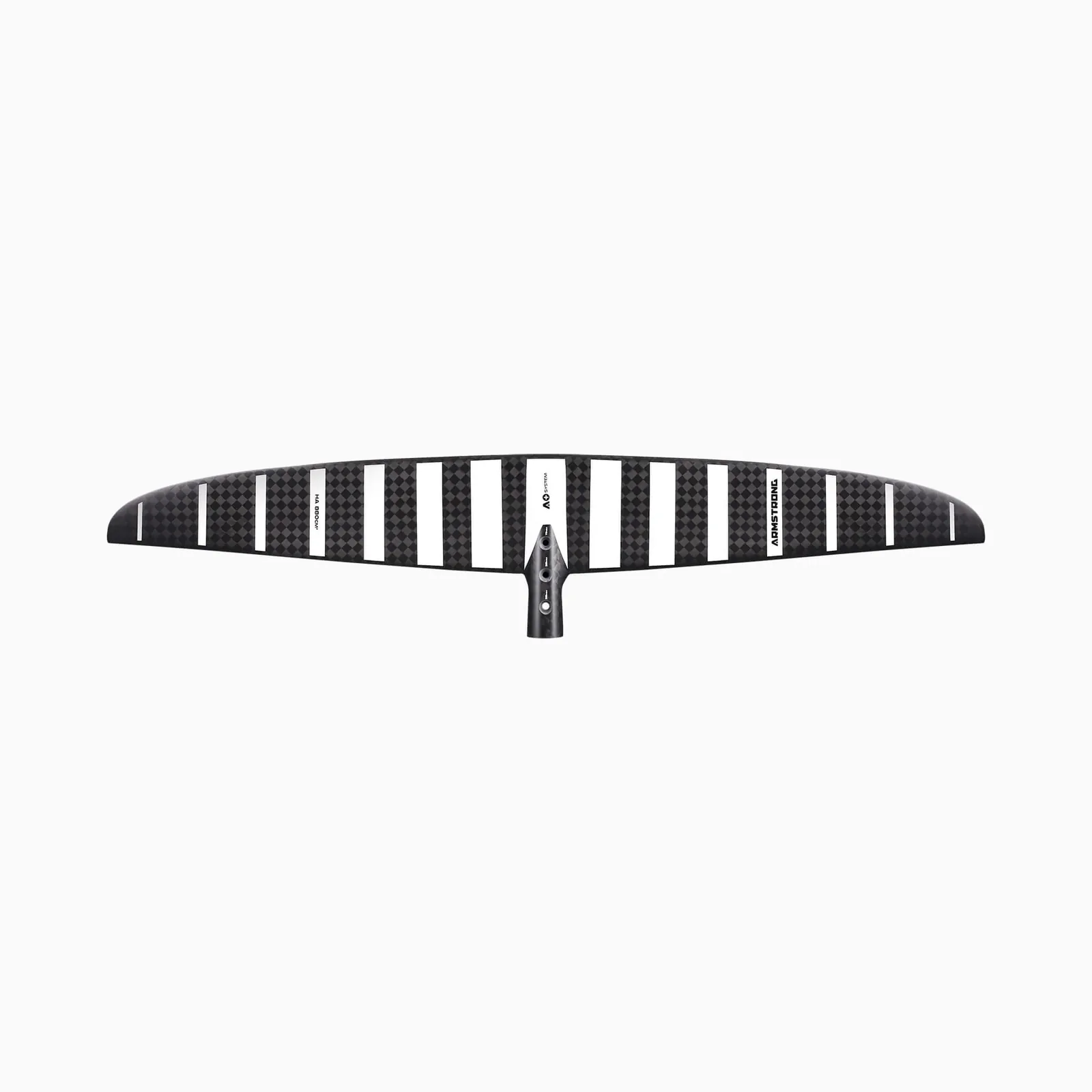
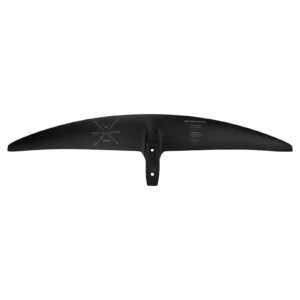
Armstrong HA 880 front wing in black carbon with white stripes, Armstrong text and A+ logo, top view on a light background
The HA front wing, second view · © Armstrong
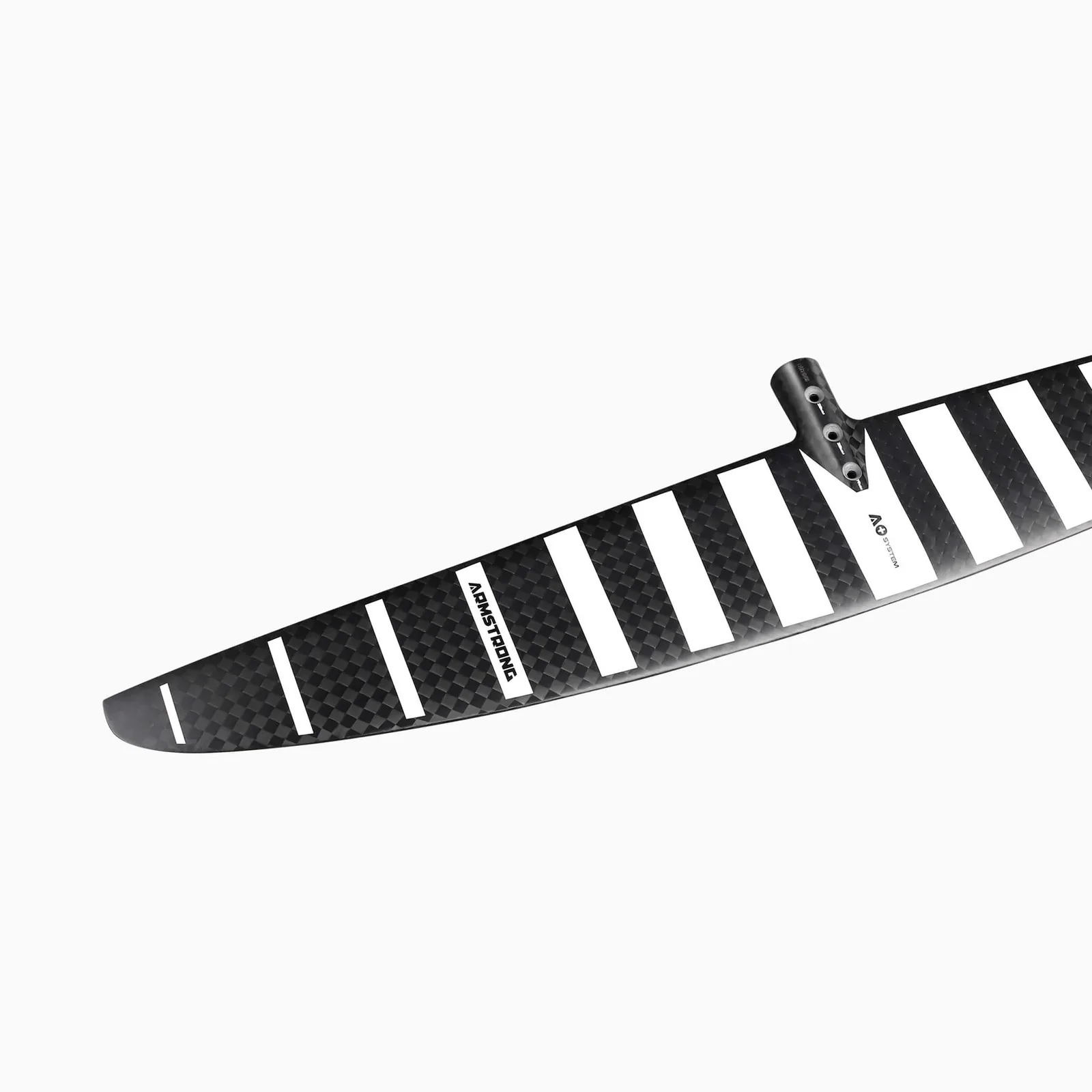
Detail of the Armstrong HA front wing, black woven carbon, white stripes, black mounting base and A+ logo
The HA front wing, perspective view of the mounting base · © Armstrong
Armstrong

Armstrong HA Front Foil test

  • Riding styleSurf foil, wing and downwind, for intermediate to expert riders
  • Front wings480 to 1180 cm²
  • Wingspan72.6 to 106.6 cm
  • Year2024

Verdict in brief

A high-aspect-ratio front wing (9.63 to 11.0), in eight sizes from 480 to 1180 cm². The three tests I read (Tonic Mag, Foiling Magazine, Stand Up Magazin) find a very early takeoff for its size, easy pumping and a lively turn. I recommend it if you surf waves, wing foil or do downwind and are already comfortable on a foil. I wouldn’t take it to start out, or for pure speed: Foiling Magazine points to the MA for charging on flat water.

For you if

  • You surf waves and want to pump far without losing the turn: Tonic Mag pumped as long as with its bigger wings on the 880, with the turn of an 880
  • You wing foil and want a wing that takes off early: Stand Up Magazin finds the lift of the old HA 925 with more turn
  • You’re aiming at downwind: Tonic Mag rode 18 km of the Solent with the 1180, Stand Up Magazin found the bumps behind a reef very glidey

Not for you if

  • You’re starting out in foiling: Armstrong aims it at intermediate to expert riders
  • You want top speed on flat water: Foiling Magazine rates the MA as more at ease for that, and Tonic Mag writes that the 880 is probably not the fastest HA of its size
  • You wing foil at the very top of the speed range: Foiling Magazine writes that in wing you find the top of the speed range, even with the 680

Have you ridden this model? Leave the first review

What we know about this model

Our method
  • Specificationschecked early November 2026
  • 3 tests publishedTonic Mag (HA 880 and 1180, February 14, 2024), Foiling Magazine (HA range, March 6, 2024), Stand Up Magazin (HA 880 for wing, March 26, 2024)
  • Rider reviewsgive yours, and it will appear here

Front wings: sizes and mounting

Front wings: area, span, aspect ratio, stabilizer and mounting
SizeWingspanAspect ratioRecommended stabilizerWing attachment
480 cm²72,6 cm11not published by ArmstrongA+: 2 M6 screws of 28.5 mm, 2 M6 screws of 19.5 mm, 1 M6 barrel nut of 8 mm
580 cm²78 cm10,5not published by ArmstrongA+: 2 M6 screws of 28.5 mm, 2 M6 screws of 19.5 mm, 1 M6 barrel nut of 8 mm
680 cm²82,8 cm10not published by ArmstrongA+: 2 M6 screws of 28.5 mm, 2 M6 screws of 19.5 mm, 1 M6 barrel nut of 8 mm
780 cm²87,7 cm9,86not published by ArmstrongA+: 2 M6 screws of 28.5 mm, 2 M6 screws of 19.5 mm, 1 M6 barrel nut of 8 mm
880 cm²92,3 cm9,68Speed 180 (tested on 880 and 1180)A+: 2 M6 screws of 28.5 mm, 2 M6 screws of 19.5 mm, 1 M6 barrel nut of 8 mm
980 cm²97,4 cm9,68not published by ArmstrongA+: 2 M6 screws of 28.5 mm, 2 M6 screws of 19.5 mm, 1 M6 barrel nut of 8 mm
1080 cm²102 cm9,63not published by ArmstrongA+: 2 M6 screws of 28.5 mm, 2 M6 screws of 19.5 mm, 1 M6 barrel nut of 8 mm
1180 cm²106,6 cm9,63Speed 180 (tested on 880 and 1180)A+: 2 M6 screws of 28.5 mm, 2 M6 screws of 19.5 mm, 1 M6 barrel nut of 8 mm

Weight not yet published by Armstrong (verified on 10/11/2026). We’ll fill in the page as soon as the brand publishes them.

No weight published; A+ screws included.

More details on these figures

Recorded on November 10, 2026; the 480 isn’t listed there. Armstrong publishes no weight, no profile thickness, no tightening torque and no area in square inches. The tests I read cite sizes 580 to 1180 at launch; the 480 is a size added since.

Components and compatibility

Checked on 10/11/2026

Masts

Performance-X Carbon Mast

ultra-high-modulus carbon

Performance-X Carbon Mast
Longueur
72.5 cm
79.5 cm
86.5 cm
93.5 cm

Performance Mk II Carbon Mast

carbon · thickness 13.8 mm

Performance Mk II Carbon Mast
Longueur
72.5 cm
79.5 cm
86.5 cm
93.5 cm

Mk II Carbon Mast

carbon · thickness 15.8 mm

Mk II Carbon Mast
Longueur
65.5 cm
72.5 cm
79.5 cm
86.5 cm

Alloy Mast

aluminum

Alloy Mast
Longueur
58 cm
72 cm
85 cm

Fuselage

Titanium Core Fuselage (A+); also exists in Alloy, 65 and 75 cm · titanium core sheathed in carbon

Titanium Core Fuselage (A+); also exists in Alloy, 65 and 75 cm
Longueur
50 cm
60 cm
70 cm

Stabilisateurs

Surf Mk II

Surf Mk II
Surface
130 cm²
170 cm²
200 cm²

Dart 120

Dart 120
Surface
120 cm²

Dart 140

Dart 140
Surface
140 cm²

Speed 180

Speed 180
Surface
180 cm²

Glide 220

Glide 220
Surface
220 cm²

Flow 235

Flow 235
Surface
235 cm²

Pump 202

Pump 202
Surface
202 cm²

S1 300

S1 300
Surface
300 cm²

Masts, fuselages and stabilizers: lengths, weights not noted. The catalog doesn’t say which are recommended for this front wing, apart from what the cited tests say.

Compatibility

Wing attachment
Armstrong’s A+ system, which assembles mast, fuselage, front wing and stabilizer. Screws supplied with the front wing: 2 M6 screws of 28.5 mm and 2 M6 screws of 19.5 mm in 316 stainless steel with a titanium coating, one M6 barrel nut of 8 mm in titanium, plus a protective cover. Tightening torque not published.
Stabilisateurs
Armstrong doesn’t publish pairings by size. Foiling Magazine tried the Speed 180, Dart 140, Surf 205 and Flow 235: the first two lengthen the glide and the speed, the other two strengthen pitch stability and free up yaw. The magazine pairs smaller stabilizers with smaller front wings. Tonic Mag rode the 880 and 1180 with a Speed 180.
Fuselage
Armstrong doesn’t publish a list of fuselages for the HA. A+ catalog: Titanium Core in 50, 60 and 70 cm, Alloy in 65 and 75 cm. Tonic Mag rode the 880 on a 70 cm fuselage.
Masts
Armstrong doesn’t publish a list of masts for the HA. Tonic Mag mounted the 880 and 1180 on a Performance 795 mast; Armstrong also offers, in A+, the Performance-X, Performance Mk II, Mk II and Alloy.

Stated riding styles

Front wing
Armstrong page: surf, wing and downwind, with low-speed lift and a smooth turn. Brand text repeated by Foiling Magazine: intermediate to expert riders. Tonic Mag: prone, SUP downwind, and wing considered with a single foil. Stand Up Magazin: wing and downwind.
Summary
surf foil · wing · downwind · intermediate to expert

Strong points, weak points

Strong points

  • Eight sizes from 480 to 1180 cm², from 72.6 to 106.6 cm of wingspan, aspect ratio from 9.63 to 11.0
  • Foiling Magazine: it takes off extremely early for its size, across all brands
  • Forgiving pumping: Foiling Magazine calls it tolerant of rough technique, with an exceptionally low stall for the size
  • High- and intermediate-modulus Toray carbon, A+ system, trailing-edge reflex for pitch stability; hardware and cover included

Weak points

  • No weight published, for any of the eight sizes
  • Surf-oriented: in wing, the top of the speed range arrives quickly, even on the 680 (Foiling Magazine)
  • Sufficient speed but not the best for its size (Tonic Mag, HA 880)
  • Not much track record: the tests I read cover the 680, 880 and 1180; nothing detailed on the 480, 580, 780, 980 and 1080

The flaw to know about. For me, its real flaw is that it’s aimed at riders who are already comfortable: the product page aims it at intermediates and experts, and Foiling Magazine places it on the surf side more than the speed side. Also worth knowing: you go down one size compared with the old HA, and I found no published weight/size grid to choose from.

Specifications

8 specs, sources at the bottom of the page

Program (manufacturer)
Surf, wing and downwind; intermediate to expert riders
Sizes (area)
480, 580, 680, 780, 880, 980, 1080 and 1180 cm²
Wingspan
72.6 cm (480), 78.0 (580), 82.8 (680), 87.7 (780), 92.3 (880), 97.4 (980), 102.0 (1080), 106.6 (1180)
Aspect ratio
11.0 (480), 10.5 (580), 10.0 (680), 9.86 (780), 9.68 (880 and 980), 9.63 (1080 and 1180)
Weight
n/a: Armstrong does not publish a weight for the front wing (page of November 10, 2026)
Construction
High- and intermediate-modulus Toray carbon
Mounting system
A+: 2 M6 screws of 28.5 mm (316 stainless steel, rainbow titanium coating), 2 M6 screws of 19.5 mm (316 stainless steel, gold titanium coating), 1 M6 barrel nut of 8 mm in titanium; protective bag supplied
Armstrong availability
All sizes shown as “Sold out” on November 10, 2026

What the published tests say

3 tests published, checked early November 2026

Tonic Mag, “Armstrong Foils HA Foil Range 880 & 1180 2024”

The tester finds so much lift on the 880 that he had to move the foil back to the end of the box for his first wave. He calls it the most efficient wing of its size he has used: he pumps as long as with his bigger wings, with the turn of an 880, and the transition from bottom to top of the wave happens without the slight lag he notes elsewhere. It is probably not the fastest HA of its size, but fast enough and it doesn’t throw him off when it reaches its top speed; the profile thickness clearly reduces the stall. The 1180 rode 18 km of the Solent against wind and tide, with an exceptionally low stall, and held up in big rollers. If he had to keep only one foil for prone, wing and downwind, it would be the 880.

Read the test
Foiling Magazine, “Range Review: Armstrong HA Foils”

The magazine first notes the low end: the new HA takes off extremely early for its size, across all brands, with an exceptionally low stall that leaves time to recover. The pumping forgives rough technique and the roll is lively, even on the big sizes; the hold in whitewater and in choppy water is faultless. In groundswell, it glides without pumping. It is designed for surf (prone and SUP): in wing, you find the top of the speed range, even with the 680, but it stays calm. For speed on flat water, the MA is better suited. Conclusion: a wing that helps you progress, to put on the list of every intermediate-or-above rider who surfs.

Read the test
Stand Up Magazin, “Foil Test New Armstrong HA 880” (article and video)

The tester, who describes himself as a weekend rider, moves from the 925 to the 880: the same lift with a smaller wing, more turn and a bit more speed, still good going upwind. He notes a thicker profile at the leading edge, a slightly shorter wingspan, less pronounced dihedral and three front mounting screws instead of two. In downwind, behind the reef, he finds it very glidey with a lot of lift. He doesn’t throw out his 925 for all that: the improvement is real but measured.

Read the test

Riders’ reviews

No reviews

No reviews yet.

Nobody has reviewed this gear yet. Do you use it? Help other riders of your weight — 2 minutes.

Leave your review (2 minutes)

Three screens: you, the gear, your review. Your email will never be published; it is only used to confirm that the review comes from a real person.

1/3 You

Only used to confirm your review and to let you know if it is rejected. Never displayed, never resold.

Your weight *

10 kg ranges only, so that other riders of your build can relate. No exact weight is recorded.

Your level *

Beginner: I’m still taking lessons. Intermediate: I ride on my own. Advanced: transitions and jumps. Expert: freestyle, wave or competition.

Your riding

Optional. If checked, your review stays published with the label “Gear received or tied to a brand” and doesn’t count toward the average rating.

You must be at least 15 to post a review (“Your data” article of the policy).

2/3 Your gear and how you use it
Wind range actually used (knots)
How long you’ve been using it *
Number of sessions (optional)
Rate each criterion (at least 3) *
Low-end takeoff
Speed & glide
Maneuverability (turns)
Pump
Finish & durability

1 = very poor, 5 = excellent. Leave blank any criterion you couldn’t judge.

Do you recommend it? *
3/3 Your review

140 characters minimum — Takeoff, glide, pump, what disappointed you, who you’d recommend it to.

Rider reviews: confirmed email address, no compensation. “Brand-linked” and “loaned / received” reviews are labeled and excluded from the average. Each review shows its publication date, the date of the experience and, if it was edited, its update date. A review is published or rejected within 7 days at most; if it is rejected, you receive the reason by email and you can correct it. You can complete or delete your review at any time from the email address used to submit it. How do reviews work?

Alternatives to compare

Armstrong UHA

The other high-aspect-ratio front wing in the range: aspect ratio 12.6, from 570 to 1270 cm², aimed at glide and downwind. Since the HA, the product page gives one size less for equivalent lift; the HA remains more lively in turns.

F-One Sk8 V3 2026

A versatile carving and wave front wing, aspect ratio 8.0 to 8.2, from 550 to 1150 cm². Lower aspect ratio than the HA, so more roll and less glide. No test pits them against each other.

Naish Excalibur

High-aspect-ratio wing at 10.2, from 544 to 1544 cm² for downwind and parawing. The HA is more surf. No test pits them against each other.

Frequently asked questions

Where can I check the current price?

See the current prices in the “Where to buy” section of this page.

Which sizes does the Armstrong HA front wing come in?

The front wing alone, in sizes 480, 580, 680, 780, 880, 980, 1080 and 1180. For the price, see the “Where to buy” section of this page.

Which HA size to choose?

Armstrong publishes no weight/size grid for the HA. Its only guidance: if you ride the old HA, go down one size (from the 925 to the 880). On the test side, Tonic Mag sees the 880 as its single foil for prone, wing and downwind, and took the 1180 for SUP downwind. Ask a retailer for advice with your weight and your discipline.

Which stabilizer and mast with the HA?

Armstrong publishes no pairing. Foiling Magazine tried the Speed 180 and Dart 140 (glide and speed), Surf 205 and Flow 235 (pitch stability and looser yaw), keeping a smaller stabilizer for a smaller wing. Tonic Mag rode the 880 and 1180 with a Speed 180, a 70 cm fuselage and a Performance 795 mast.

Is the HA good for a beginner? What level?

No, that’s not its role: Armstrong aims it at intermediate to expert riders. Tonic Mag finds it forgiving at the stall and in pumping, but it is still a high-aspect-ratio wing. To learn, take Armstrong’s S1 instead. I recommend the HA once you link your turns and want to surf or do downwind.

What about used?

I found no reliable used price, so I’m not giving one. What to check: leading and trailing edges (knocks, cracks, delamination), play in the fuselage assembly, threads and A+ screws (M6) in good condition. Watch the generation: the old HA (2021, for example the 925) is chosen one size above the current HA for the same lift, and the wing mount has three screws instead of two.

Method and limitations of this page

This page brings together the technical specs, tests from the press and blogs, and rider feedback found on the web, without rewriting any of it. When WindUnity has ridden the gear itself, the page says so with the “WindUnity test” badge.

Rider reviews are published as is, with their date. Reviews tied to a brand or based on loaned gear are labeled and excluded from the average.

What’s still missing

  • Three tests read: nothing detailed on the 480, 580, 780, 980 and 1080
  • Front wing weight, rider weight range by size, profile thickness, square-inch area and tightening torque: not published by Armstrong
  • All eight sizes are sold out at Armstrong on November 10, 2026
  • No rider feedback read outside press tests
  • Reviews posted on WindUnity: none

Sources

Data collected early November 2026

Press and specialist sites : Tonic Mag, The Foiling Magazine, Stand Up Magazin

Others : Armstrong, Windlounge

See the details of the 6 sources

Press and specialist sites

  1. Tonic Mag, Armstrong HA 880 and 1180 test
  2. Foiling Magazine, Armstrong HA test
  3. Stand Up Magazin, Armstrong HA 880 test

Others

  1. Windlounge, Armstrong HA (price)