Skip to content

Kitesurfing and wing foiling in Le Morne (Mauritius)

Wind month by month, water, spots, dangers, access and verified schools in Le Morne, with the source for every figure.

  • 62 %of days with good kite wind in June
  • 81 %of rideable wing days in June
  • 23.8–28.2 °Cwater by month
  • 3 schoolssee the list
Le Morne

At a glance

  • Best months for kiteMay, June, July, August, SeptemberAt least 40% good kite-wind days: 3 hours or more at 15 knots or more between 10 h and 18 h.
  • Best months for wingJanuary, February, March, April, May, June, July, August, September, OctoberAt least 50% rideable wing days: 3 hours or more at 12 knots or more between 10 h and 18 h.
  • LevelLagoon: beginners with a school (required level: beginner according to lets-kite); reef passes: intermediate to expert, One Eye reserved for experts.
  • Body of waterLarge, shallow, flat lagoon behind a reef, at the foot of Morne Brabant (southwest tip of the island); waves on the reef passes (Little Reef, Manawa, Chameau, One Eye) for experienced riders and experts.
  • AirportSir Seewoosagur Ramgoolam International Airport (Plaisance), 45–60 min by car

My review

I recommend Le Morne if you can travel from May to October, with the core of the season from June to September, and you want to learn or progress on flat water: the lagoon, at the foot of Morne Brabant, is shallow with a sandy bottom, and you can stand almost everywhere (lets-kite, planetkitesurfholidays, kitecorner). The east to southeast wind blows from the side (lets-kite, ION CLUB) and the schools teach on site: take a lesson at the start, most of the reef passes are not for beginners and One Eye is reserved for experts.

For kite, I’d aim for May to September. I have no measurements here (the nearest station, Vacoas, 27 km away, has no usable hourly record, and Plaisance is 37 km away, outside the radius I used): it is the NASA POWER model’s estimate, over 2015-2024, that gives 42 to 62% good kite-wind days from May to September (3 hours or more at 15 knots between 10 h and 18 h), with 62% in June, 59% in July and 53% in August. For wing, the model gives 66 to 81% rideable days from May to September. Le-morne.com, kitecorner, nomadreef and lets-kite describe the same season, from May to October or November.

I’m not giving you the wind strength, and that’s deliberate: the model sees a grid cell of about 55 x 70 km and does not reproduce beach wind. Lets-kite reports 15 to 25 knots from June to September, kitecorner 15 to 30 knots with gusts around 35, le-morne.com 20 to 35 knots in July and August, but these are claims from websites or blogs, not measurements. So I publish neither a strong-wind percentage nor a kite or wing size: choose with the school or the rental shop on site.

If you go from November to March, it’s the weak period, and I’ll be frank: the model gives 18 to 28% good kite-wind days (18% in November, 21% in December), below the 40% rule I apply, and 42 to 55% for wing. The sources mention lighter thermal winds, 12 to 20 knots that often build after midday (le-morne.com; ION CLUB also reports 12 to 20 knots), but also days with no wind, February as a “dead month” (kitecorner) and a slightly higher cyclone risk from February to April (le-morne.com). It’s doable for wing or foil in the lagoon, not a destination to choose for kite at that time of year.

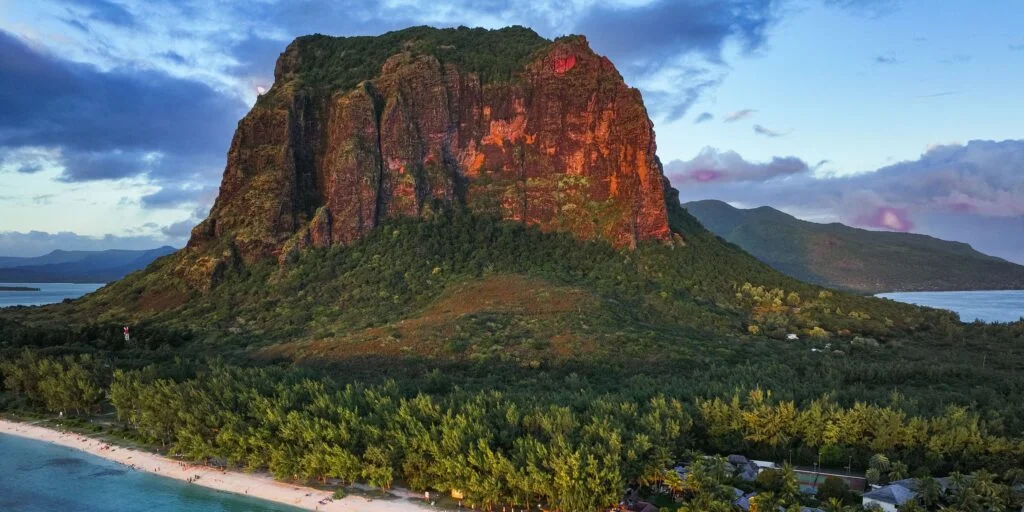
For me, the points to check before booking are access and safety: Plaisance airport is on the other side of the island, 45 minutes to 1 hour by road (nomadreef); the airport’s Wikipedia page lists Air France to Paris-CDG but I have not read the schedules or the flight season. On safety, from the ministry I only read the alerts page (heightened vigilance, measles): also read its Safety and Health sections before you leave. I only have one photo of the place, without a kite in it.

Been there? Leave the first review

Destination page written and kept up to date by Romain · updated on 17/11/2026

Who it’s for

  • Beginners and progressing riders who want flat water with a school: lagoon at the foot of Morne Brabant, you can stand almost everywhere, mostly from May to September.
  • Wing and foil riders: lets-kite describes the lagoon as the most accessible spot for wing foiling and kite foiling; the model gives 66 to 81% rideable days from May to September and 42 to 55% from November to March, with a tide to watch (ION CLUB).
  • Experienced wave riders, with a boat: reef passes (Manawa, One Eye), with the current and coral described by kitecorner and planetkitesurfholidays.

Not for you if…

  • You are going from November to March and want to kite: the model gives 18 to 28% good kite-wind days, the sources mention light thermal winds, days with no wind and a slightly higher risk of cyclones from February to April.
  • You are looking for a quiet body of water in high season: kitecorner reports crowds, mackiteboarding (2018) a lagoon that can be very crowded.
  • You want to ride the passes alone without wave-riding experience: One Eye is reserved for experts, with current, coral and difficult self-rescue; a boat rescue is paid according to lets-kite.

When to go to Le Morne: the wind, month by month

Calculation of 13/11/2026

  • 27 %Jan28°
  • 28 %Feb28°
  • 28 %Mar28°
  • 36 %Apr28°
  • 42 %May27°
  • 62 %Jun25°
  • 59 %Jul24°
  • 53 %Aug24°
  • 47 %Sep24°
  • 25 %Oct25°
  • 18 %Nov26°
  • 21 %Dec27°
Good kite-wind days: 3 hours or more at 15 knots or more between 10:00 and 18:00, 2015-2024 Yellow: the windiest month of the year°C Bottom row: monthly water temperature (NOAA OISST)
See the full 12-month table
Good-wind days by month, median wind and water
MonthWing and foil: % of days at 12 kts or moreKite: % of days at 15 kts or moreStrong wind: % of days at 20 kts or moreKite levelMedian wind (kts)Water (°C)
January5327–27.9
February5428–28.1
March5528–28.2
April5936–27.8
May6642–26.6
June8162–25.2
July7959–24.3
August7753–23.9
September7647–23.8
October5625–24.5
November4218–25.6
December4921–27.1

% of days with at least 15 knots (kite) or 12 knots (wing) for 3 hours between 10:00 and 18:00, over 2015-2024. A statistic, not a forecast.

Sources and limitations of this calculation
  • Estimate from the NASA POWER model (MERRA-2), not a measurement: there is no usable weather station at Le Morne (the nearest, Vacoas, 27 km away, has no usable hourly record; Plaisance, 37 km away, is outside the radius I used). Percentage of days, over 2015-2024, when the wind reaches at least 15 knots (kite) or 12 knots (wing) for 3 hours or more between 10 h and 18 h. The model sees a grid cell of about 55 x 70 km, mixing land and sea, centered inside the island and without the beach breeze: it is a statistic, not a forecast. I publish these percentages because the season they outline, May to September, is the one described by the guides and the schools (le-morne.com, kitecorner, nomadreef, lets-kite). I do not publish a strong-wind percentage, a wind strength or a kite or wing size derived from the model.
  • Hourly NASA POWER API (MERRA-2), 10 m wind converted to knots, grid cell centered on 20.5° S / 57.5° E (0.5° x 0.625°, about 55 x 70 km, average elevation 82.7 m: the southwest interior of the island and Le Morne), Indian/Mauritius time zone, from January 1, 2015 to December 31, 2024. Good-wind day = 3 hours or more at the threshold (12 or 15 knots) between 10 h and 18 h, local time. From 283 to 310 days analyzed depending on the month. No measuring station used.
  • NASA POWER (public API, MERRA-2 reanalysis, 10 m wind, hourly step, 0.5° x 0.625° grid cell, about 55 x 70 km), 2015-2024; 3 hours or more at the threshold between 10 h and 18 h, local time; model estimate, no usable measuring station
  • NOAA OISST v2 high resolution (public domain), monthly average 2015-2024 at the nearest 0.25° grid cell at sea (center -20.625 / 57.375, 18.5 km from the spot), monthly averages served by NOAA PSL; read on November 13, 2026
  • NASA POWER (MERRA-2, T2M at 2 m), monthly average of the daily maximum 2015-2024: grid-cell data of about 55 x 70 km, cooler than the temperature you would feel on the beach
  • Calculated on November 13, 2026: NASA POWER model estimate (MERRA-2) 2015-2024, 3 hours or more at the threshold between 10 h and 18 h; no usable measuring station; a single grid cell calculated.
  • Estimate from the NASA POWER model, not a measurement: no usable weather station at Le Morne (Vacoas, 27 km away, has no usable hourly record; Plaisance, 37 km away, is outside the radius I used). I have no beach measurement to check it against.
  • Grid cell: I publish the only grid cell calculated for this spot (20.5° S / 57.5° E, land and sea mixed, average elevation 82.7 m, which contains Le Morne). I did not calculate an alternative grid cell to measure how sensitive the result is: read the percentages as the shape of the year, not as a promise of wind. The season check is consistent with the guides: 67.7% rideable wing days in season (May to October) versus 46% out of season.
  • Wind strength not published: the model sees a grid cell of 55 x 70 km without the beach breeze, whereas lets-kite reports 15 to 25 knots from June to September, kitecorner 15 to 30 knots with gusts around 35, planetkitesurfholidays 18 to 25 knots from May to November and le-morne.com 20 to 35 knots in July and August. These are claims from websites, blogs or agencies, not measurements: no strong-wind percentage and no kite or wing size is derived from the model.
  • November to March: the model gives 18 to 28% good kite-wind days, below the 40% rule: I do not count any of these months among the best for kite. For wing, 42 to 55%. Le-morne.com describes thermal winds of 12 to 20 knots from November to early January, often in the afternoon, and a more variable February to April (8 to 18 knots, days with no wind); kitecorner calls February the “dead month”; nomadreef writes that it is not a period to plan a kite stay around. ION CLUB, which sells lessons, reports 12 to 20 knots from November to March: a commercial claim.
  • Wind direction not derived from the model: lets-kite lists E, ESE, SE, SSE and S, ION CLUB E or SE, le-morne.com E to SE (sideshore to side-on).
  • Tide: lets-kite gives a depth of 1 to 2 m in the lagoon depending on the tide and writes that at low tide some areas become very shallow; ION CLUB and kitecorner describe knee- to waist-deep water; ION CLUB writes that wing and windsurfing depend on the tide. Ask your school.
  • Water temperatures come from a 0.25° NOAA grid cell in open sea, 18.5 km from the spot: the water in the shallow lagoon may differ. The sources also disagree (le-morne.com writes 23 to 24 °C in July-August, lets-kite 25 to 28 °C all year, planetkitesurfholidays 26 to 29 °C in season).

Water temperature and wetsuit in Le Morne

Water, air and wetsuit by month
MonthWater (°C)Air, average maximum (°C)Wetsuit
January27.928.6shorty or lycra
February28.128.6shorty or lycra
March28.228.4shorty or lycra
April27.827.5shorty or lycra
May26.626shorty or lycra
June25.224.6shorty or lycra
July24.323.9shorty or lycra
August23.923.9shorty or thin 3/2 full suit
September23.824.3shorty or thin 3/2 full suit
October24.525.6shorty or lycra
November25.626.9shorty or lycra
December27.128.3shorty or lycra

ION CLUB’s general chart applied to the month’s average water temperature: ≥ 24 °C shorty or lycra; 20-24 °C shorty or thin 3/2 full suit; 15-19 °C 3/2 or 4/3 full suit with booties; < 15 °C 4/3 to 5/4 with booties, gloves, hood General ION CLUB grid applied to the average water temperature of the grid cell at sea; this is not local advice, the water near shore and the wind can change the choice.

Kitesurfing and wing foiling spots in Le Morne

Le Morne Lagoon (Kite Lagoon, at the foot of Morne Brabant)

  • Level. Beginner with a school (required level: beginner according to lets-kite); advanced riders also use it for freeride, foil and wing
  • Wind. E, ESE, SE, SSE and S according to lets-kite, sideshore to side-on from east to southeast; ION CLUB: E or SE, left sideshore; choppier with a south wind (lets-kite)
  • Body of water. Large lagoon, flat to slightly choppy depending on the tide, behind a reef; sandy bottom, sandbanks and coral heads (kitecorner); depth of 1 to 2 m depending on the tide (lets-kite), knee- to waist-deep according to ION CLUB and kitecorner
  • Getting there. Southwest coast, opposite Plaisance airport; 45 minutes to 1 hour by road (nomadreef)
  • Public beach at Le Morne or access through the neighboring hotels; free parking along the coastal road (lets-kite); lagoon sometimes very crowded (mackiteboarding, 2018): experienced riders position themselves well upwind of the lesson area
  • Booties are essential: sharp coral and very shallow bottom near the beach and in the corners (mackiteboarding, kitecorner)
  • Straight onshore wind at launch and landing from the beach (mackiteboarding); choppier wind about 200 m from the shore (ION CLUB)
  • “The Point”: small, tree-lined, windy launch, with frequent falling kites and tangled lines, reserved for those who are sure they can stay upwind (mackiteboarding, kitecorner)
  • Lets-kite and ION CLUB describe a spot open all year; the most consistent wind runs from May to October (see the calendar); no weather station at the spot (lets-kite: data from the Vacoas station is reserved for the paid offer)
  • Tide. Lets-kite: at low tide some areas become very shallow; ION CLUB: wing and windsurfing depend on the tide. Ask your school which tide it prefers for your level. (source: lets-kite and ION CLUB)

Reef passes: Little Reef, Manawa, Chameau, One Eye

  • Level. Little Reef: first steps in the wave (ION CLUB); Manawa and Chameau: intermediate to advanced; One Eye: experienced wave riders only
  • Wind. Same east to southeast trade wind as in the lagoon; left-hand waves on the reef passes (kitecorner, planetkitesurfholidays)
  • Body of water. Waves breaking on the reef about 400 to 500 m from the beach; One Eye: fast, hollow left over shallow coral, far offshore; Manawa: longer lefts over deeper water, with a channel; currents in the passes (kitecorner, planetkitesurfholidays)
  • Getting there. About 400 to 500 m from the lagoon beach, reached by board or by boat depending on your level (ION CLUB, planetkitesurfholidays)
  • Lets-kite: red flag, do not approach the pass and do not leave the lagoon; in big swell, strong outflowing current in front of the Manawa pass and a wave that re-forms in front of the Riu hotel
  • One Eye: reserved for experienced wave riders with their own gear, self-rescue is difficult (current, offshore wind); the vast majority of serious incidents start with a dropped kite (planetkitesurfholidays)
  • Le-morne.com (a commercial blog that promotes private villas) places the One Eye waves in July and August; planetkitesurfholidays: crowds on small days
  • Paid boat rescue: more expensive in the waves than in the lagoon according to lets-kite; higher still according to kitecorner

Dangers

  • Sharp coral, sea urchins and shallow bottomMackiteboarding and kitecorner describe sharp coral and a shallow bottom in the lagoon: booties against the coral and sea urchins, leg protection advised for beginners (mackiteboarding, 2018 guide). Lets-kite: at low tide some areas of the lagoon become very shallow.
  • Reef passes, currents and offshore windLets-kite: red flag, do not approach the pass and do not leave the lagoon; in big swell, strong outflowing current in front of the Manawa pass. Kitecorner: strong currents in the passes that pull you out to sea, wind that can turn offshore in the evening. Planetkitesurfholidays: at One Eye, the wind blows offshore over a very shallow reef and a self-rescue there is a long swim in a strong current.
  • Reef waves (One Eye, Manawa, Chameau)One Eye is a fast left over shallow coral, reserved for experienced wave riders; Manawa has more water volume and a channel to pass with respect, with a long return, upwind (planetkitesurfholidays). Chameau and One Eye are described as beautiful but dangerous (mackiteboarding, 2018). The vast majority of serious incidents at One Eye start with a dropped kite that can catch in the coral while you are being pulled onto it (planetkitesurfholidays). Paid boat rescue: more expensive in the waves than in the lagoon according to lets-kite, and higher still according to kitecorner.
  • Crowds on the waterKitecorner: crowds in high season. Mackiteboarding (2018): the lagoon can be very crowded, experienced riders position themselves well upwind of the lesson area. Planetkitesurfholidays: crowds at the passes on small days. In the lagoon, position yourself as mackiteboarding advises: experienced riders stay well upwind of the lesson area.
  • Fading wind and the return upwindPlanetkitesurfholidays: the trade wind often fades in the late afternoon, keep some margin to get back, the return from the passes is long and upwind. Kitecorner: the wind can turn offshore in the evening. Mackiteboarding: straight onshore wind at launch and landing. At “The Point”, a small, windy launch: falling kites, frequent tangled lines (mackiteboarding, kitecorner).
  • Cyclones and depressions (austral summer)Le-morne.com (a commercial blog that promotes private villas): from February to April, more variable wind (8 to 18 knots), with days with no wind, stormy days and a slightly higher risk of cyclones or depressions. Nomadreef: summer (November to April) overlaps the cyclone season. I have not read any official source (Mauritian weather service, Météo-France): check the alerts before you leave.
  • Official alerts (ministry page)The “Latest news and alerts” page of the French Ministry for Europe and Foreign Affairs for Mauritius, read on November 17, 2026 (last update shown on September 10, 2026), lists “heightened vigilance for French nationals abroad” (posted on September 10, 2026) and a “rise in measles cases” (March 13, 2026). The security map and the Safety, Entry and Stay, and Health sections have not been read: read them before you leave.

Required level. No official rule I read sets a certificate required to ride at Le Morne. ION CLUB (school) writes that children must be at least 12 for kite lessons, and counts an average of 12 hours to learn from scratch (the school’s own claims); Hang Loose Tours is an IKO school, founded by IKO examiner Christian Stepnow according to its IKO page (status announced by the school, page read on November 17, 2026). One Eye is described as reserved for experienced wave riders with their own gear (ION CLUB, planetkitesurfholidays). Each rental shop has its own rental rule: ask.

Getting to Le Morne from France

Verified on 17/11/2026

Plaisance airport (MRU), Plaine Magnien, 48 km southeast of Port Louis; it is the Air Mauritius hub, with direct flights to Africa and Europe (Wikipedia FR). The airline table on the page I read lists Air France to Paris-Charles-de-Gaulle, among others: I have not read the frequency, the season or the price of flights, ask the airline. Nomadreef (2026) writes that direct flights link several European hubs, the Gulf, Johannesburg and Réunion. Le Morne is on the opposite side of the island, about 45 minutes to 1 hour by road (nomadreef), along the southern coastal road via Souillac, Bel Ombre and Baie du Cap, then the Morne mountain (ION CLUB). Car transfer: nomadreef gives an indicative budget, to be confirmed with your accommodation. The public bus exists but it is slow and impractical with gear bags (nomadreef); mackiteboarding (2018 guide) writes that a rental car is “absolutely essential” to reach the island’s other spots.

Kitesurfing schools in Le Morne

Existence verified on November 17, 2026 on each school’s own page (the school’s website, or the IKO page for Hang Loose Tours); IKO status and services are as announced by the school, and the IKO pages for ION CLUB and Le Morne Kite School have not been read. Four other schools cited by lets-kite 1 km away (Paradise Kitesurfing Mauritius, Airswitch Kitesurfing Mauritius, KiteLagoon Vibes Mauritius, Born To Kite Le Morne) have not been read. No school recommended, no ranking, no reviews.

  • ION CLUB Le MorneLe Morne (storage at the Kite Lagoon, shop at La Gaulette) · Kite + Wing
  • Hang Loose Tours (IKO school)Le Morne, Kite Lagoon · Kite
  • Le Morne Kite School (LMKS)Le Morne, Kite Lagoon · Kite

Budget in Le Morne

Prices checked on 17/11/2026

  • Private kitesurfing lesson, 3 hours over 1 day (Hang Loose Tours) : Current rate: see the school’s page (source: IKO, Hang Loose Tours page)
  • Private kitesurfing lesson, 6 hours over 3 days (Hang Loose Tours) : Current rate: see the school’s page (source: IKO, Hang Loose Tours page)
  • Private kitesurfing lesson, 10 hours over 5 days (Hang Loose Tours) : Current rate: see the school’s page (source: IKO, Hang Loose Tours page)
  • Boat rescue if you get into difficulty: in the lagoon, in the waves : Current rates: see the source cited (source: Lets-kite (rescue by ION CLUB))
  • Car transfer from the airport to Le Morne (indicative range, 2026) : Current rates: see the source cited (source: Nomadreef (independent guide, affiliate links))

Rates are not reproduced here: check the current rates on the official pages cited. The lessons listed carry the label “Advanced”: they are not necessarily introductory rates. ION CLUB and Le Morne Kite School rates have not been read. Nomadreef also gives an hourly rate for a private lesson, as a guide’s order of magnitude, not carried over into a budget line. Accommodation, flights and gear rental are not priced here for lack of a source.

What gear to bring to Le Morne

No size published for Le Morne: the NASA POWER model does not give beach wind strength.

No recommended size: choose with the school or the rental shop on site. For reference, lets-kite reports 15 to 25 knots from June to September, kitecorner 15 to 30 knots, le-morne.com 20 to 35 knots in July and August (claims from websites, not measurements). The wind strengths stated by the websites are not measurements: no size is derived from the model.

Model estimate (3 hours or more at 12 knots or more between 10 h and 18 h): 66 to 81% of days from May to September, 42 to 55% from November to March (NASA POWER, no usable measuring station).

Same principle as for kite: no size published; decide with the school or the rental shop. Lets-kite describes the lagoon as the most accessible spot for wing foiling and kite foiling; ION CLUB writes that wing and windsurfing depend on the tide.

What size kite or wing to bring? Kite calculator Wing calculator

What riders say

Riders’ reviews

Nobody has described their trip here yet. Have you been? Help other riders: real conditions, crowd, level, safety — 2 minutes.

Leave your review of this spot

Two screens: your trip, then your review. Only the overall rating is required on screen 1. Your email is never published; it is only used to confirm your review.

1/2 Your trip
Your overall rating *

1 = disappointing, 5 = excellent.

When did you go? (optional)
How long? (optional)
Your riding on site (optional)

Multiple choices allowed.

Your level (optional)
Rate the spot in detail (optional)

1 = disappointing, 5 = excellent. Leave blank any criterion you couldn’t judge.

Real conditions
Crowd (5 = few people)
Level required (5 = accessible to everyone)
Safety
Do you recommend this spot? (optional)
2/2 Your review

140 characters minimum — Real conditions, crowd, what disappointed you, who you’d recommend it to.

Your email is only used to confirm your review and to let you know if it is rejected. Never displayed, never resold.

Optional. If checked, your review stays published with the label “Trip offered or tied to a school or brand” and doesn’t count toward the average rating.

Rider reviews: confirmed email address, no compensation. “Brand-linked” and “loaned / received” reviews are labeled and excluded from the average. Each review shows its publication date, the date of the experience and, if it was edited, its update date. A review is published or rejected within 7 days at most; if it is rejected, you receive the reason by email and you can correct it. You can complete or delete your review at any time from the email address used to submit it. How do reviews work?

Frequently asked questions

What is the best time for kitesurfing at Le Morne?

From May to October, with the core of the season from June to September: le-morne.com, kitecorner, nomadreef and lets-kite describe this southeast trade wind. The NASA POWER model estimate (no usable measuring station) gives 42 to 62% good kite-wind days from May to September (62% in June), 3 hours or more at 15 knots between 10 h and 18 h, and 66 to 81% rideable wing days.

Can you kite at Le Morne from November to March?

It’s the weak period: the model gives 18 to 28% good kite-wind days from November to March (18% in November) and 42 to 55% for wing. Le-morne.com describes thermal winds of 12 to 20 knots from November to early January, often in the afternoon, then a more variable February to April, with days with no wind and a slightly higher risk of cyclones; kitecorner calls February the “dead month”; nomadreef writes that the austral summer is not a period to plan a kite stay around. ION CLUB reports 12 to 20 knots, a claim from a school that sells lessons.

How are the wind percentages calculated?

These are estimates from a model (NASA POWER, MERRA-2 reanalysis, 2015-2024) over a grid cell of about 55 x 70 km, mixing land and sea, centered inside the island (average elevation 82.7 m). No usable measuring station at Le Morne. A day counts as a good kite-wind day if the wind reaches 15 knots for 3 hours or more between 10 h and 18 h (12 knots for wing). I did not calculate an alternative grid cell: read the percentages as the shape of the year.

Why don’t you give the wind strength or the kite sizes?

The model sees a grid cell of 55 x 70 km and does not reproduce beach wind. The only wind strengths I have read come from websites and blogs (15 to 25 knots from June to September according to lets-kite, 15 to 30 knots with gusts around 35 according to kitecorner, 20 to 35 knots in July and August according to le-morne.com): these are claims, not measurements. Choose your size with the school or the rental shop on site.

Is the Le Morne lagoon suitable for beginners?

Yes, according to the sources I read: lets-kite describes it as a very safe lagoon, with a required level of beginner, and planetkitesurfholidays writes that you can stand almost everywhere on a sandy bottom. The reef passes call for a different level (Little Reef is presented by ION CLUB as the first step into the wave) and One Eye is reserved for experienced wave riders. Take a school and follow its instructions on the tide, the current and the area you must not go beyond.

How do I get from Mauritius airport to Le Morne?

Plaisance airport is in the southeast of the island and Le Morne is in the southwest corner, about 45 minutes to 1 hour by road according to nomadreef (independent guide). ION CLUB describes the southern coastal road west via Souillac, Bel Ombre and Baie du Cap. Nomadreef gives an indicative budget for a car transfer (2026), to be confirmed with your accommodation; the bus is slow and impractical with a gear bag.

Is there a direct flight from France to Mauritius?

Plaisance airport is the Air Mauritius hub, with direct flights to Africa and Europe according to Wikipedia, whose airline table lists Air France to Paris-Charles-de-Gaulle. I have not read the frequency, the season, the price or the baggage policy for a kite bag: ask the airline.

What does the Ministry of Foreign Affairs say about safety in Mauritius?

The “Latest news and alerts” page read on November 17, 2026 (last update shown on September 10, 2026) lists heightened vigilance for French nationals abroad (September 10, 2026) and a rise in measles cases (March 13, 2026). I have not read the security map or the Safety, Entry and Stay, and Health sections: read them before you leave.

Have you ridden here before? Your review helps the next rider choose. Write my review (2 minutes)

To go further

Sources

Checked mid-November 2026

Getting there : Wikipedia FR

Wind and water data : NASA POWER, NOAA OISST v2 high resolution

Schools and centers : ION CLUB Le Morne, IKO, Le Morne Kite School

Spot guides : Lets-kite, Kitecorner, Ventosurf, Nomadreef, Mackiteboarding, Le-morne.com, Planetkitesurfholidays

Others : MEAE

See the details of the 14 sources