Best months for kiteFebruary, March, June, JulyBest months: at least 40% good kite-wind days (3 hours at 15 knots or more between 10 h and 18 h) in both sources. No other month reaches 40% in both sources: January, May, December reach it in only one. “Good”: at least 40% in only one of the two sources.
Best months for wingJanuary, February, March, April, May, June, July, August, November, DecemberBest months: at least 50% rideable wing days (3 hours at 12 knots or more between 10 h and 18 h) in both sources. September (between 34 and 37%) and October (between 41 and 42%) stay below 50%.
LevelBeginner with a school (3 students maximum per lesson); on your own, you need to know how to ride upwind.
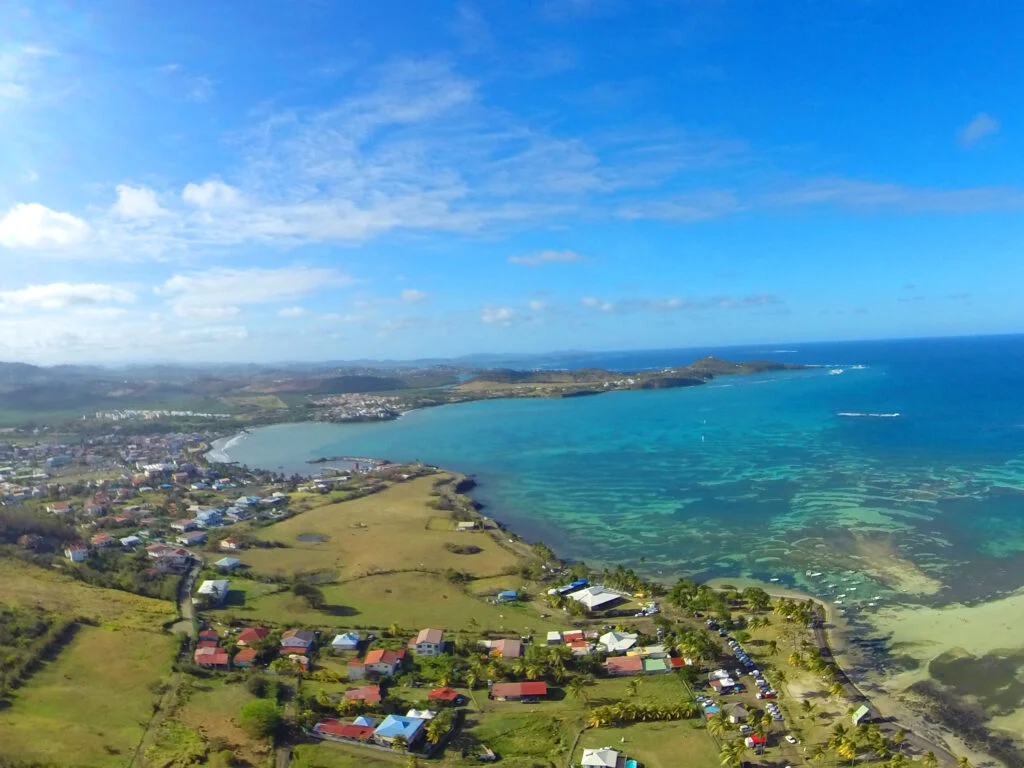
Body of waterFlat, warm lagoon; very shallow in front of the beach; frequent sargassum; September-October with no wind
AirportAimé Césaire (Fort-de-France)
My review
I recommend Pointe Faula for learning or progressing in a flat, warm lagoon with a school, between December and July. The sources read describe flat, shallow water behind a coral barrier, an east trade wind, and three schools set up on the beach (windmaster.app).
The 2015-2024 figures confirm it: February, March, June and July exceed 40% good kite-wind days (3 hours at 15 knots or more between 10 h and 18 h) in both sources, for example February between 48 and 51% and June between 51 and 54%; and wing goes from 75 to 93% rideable days from December to July.
But the figures and the guides don’t overlap completely: the guides say December to April or November to May, the figures also put June and July among the windiest months. Conversely, September and October fall to 6-15% for kite, in the middle of hurricane season.
Know before you rig: the wind comes from the sea toward the beach, the launch is next to swimmers, the water in front of the beach can be only about ten centimeters deep, the riding zones are marked out by a 2004 order and sargassum can turn the beach brown in a day.
For me, aim for February-March or June, book a school, bring something to walk on the seagrass and coral (spots4kite.com mentions water booties) and check the sargassum bulletin. Avoid September and October. For Guadeloupe, this page gives no figures, and the Saint-François lagoon has been closed since May 11, 2026.
Destination page written and kept up to date by Romain · updated on 17/11/2026
Who it’s for
You want to learn or progress in a flat, warm, shallow lagoon with a school, between December and July.
You wing foil: 75 to 93% rideable days from December to July depending on the source.
You want to fill the no-wind days: the UCPA page cites, in the south of the island, Salines beach, Anse Figuier, Le Diamant and Sainte-Anne.
Not for you if…
You’re coming in September or October for kite: 6 to 15% good-wind days, hurricane season, and at least one school on break.
You want to foil at the edge in front of the beach: the sandbars are sometimes only about ten centimeters deep.
You don’t want a launch near swimmers, with wind from the sea toward the beach and coconut trees to avoid.
You plan to ride at Saint-François (Guadeloupe): the lagoon has been closed to nautical activities since May 11, 2026, until further notice.
When to go to Pointe Faula (Le Vauclin, Martinique): the wind, month by month
Calculation of 13/11/2026
Solid part : at least this figure, whether from the station or the modelLight part : possible, according to the most favorable sourceExample in June: at least 51% of days according to both sources, up to 54% according to one of them. Tap or hover over a bar to read the range.
33 %43Jan27°
48 %51Feb27°
42 %44Mar27°
28 %35Apr27°
39 %44May28°
51 %54Jun28°
40 %52Jul28°
19 %25Aug29°
6 %12Sep30°
10 %15Oct29°
13 %25Nov29°
30 %50Dec28°
Good kite-wind days: 3 hours or more at 15 knots or more between 10:00 and 18:00, 2015-2024 Yellow: the windiest month of the year°C Bottom row: monthly water temperature (NOAA OISST)
See the full 12-month table
Good-wind days by month, median wind and water
Month
Wing and foil: % of days at 12 kts or more
Kite: % of days at 15 kts or more
Strong wind: % of days at 20 kts or more
Kite level
Median wind (kts)
Water (°C)
January
76–79
33–43
1–4
Good
13.8
27.2
February
78–84
48–51
3–4
Excellent
14.7
26.9
March
76–85
42–44
2–3
Good
14.2
27
April
76–81
28–35
0–1
Average
13.4
27.4
May
82–93
39–44
0–3
Good
14.1
27.9
June
89
51–54
2
Excellent
14.8
28.2
July
87–88
40–52
1–2
Good
14.6
28.4
August
63–68
19–25
1
Average
12.7
29
September
34–37
6–12
0–2
Low
9.6
29.5
October
41–42
10–15
0–2
Low
10.7
29.3
November
58–64
13–25
0
Low
12.6
28.7
December
75–76
30–50
1
Good
14.7
28
% of days with at least 15 knots (kite) or 12 knots (wing) for 3 hours between 10:00 and 18:00, over 2015-2024. A statistic, not a forecast.
Sources and limitations of this calculation
For Le Vauclin (Pointe Faula), the closest usable Meteostat station is the one at Le Lamentin, 18.1 km away: two sources give a range, the NASA POWER model (grid cell of about 55 km, 2015-2024) and the Le Lamentin station (Meteostat 78925, 2015-2024, 280 to 310 valid days per month). Hence “between X and Y%” rather than a single figure. Neither source measures the wind on the Le Vauclin lagoon. Data: Meteostat.
Same rule for both sources: a day counts when the wind reaches the threshold (12, 15 or 20 knots) for at least 3 hours between 10 h and 18 h, local time (America/Martinique); a day with fewer than 6 hourly readings in the window is discarded. Model: NASA POWER hourly (MERRA-2), 10 m wind converted to knots, point 14.55 N / -60.84 E (Le Vauclin), grid cell centered on 14.5 N / -60.625 E (0.5° x 0.625°, average elevation 6.3 m), from January 1, 2015 to December 31, 2024 (3,653 days). Station: Le Lamentin (Meteostat 78925, 18.1 km from the point), hourly records 2015-2024, 280 to 310 valid days depending on the month. Kite calendar levels: 50% and above Excellent, 35 to 49% Good, 20 to 34% Average, below 20% Low (on the average of the two sources). Best months: at least 40% good kite-wind days in both sources; wing: at least 50% in both.
NASA POWER (public API, MERRA-2 reanalysis, 10 m wind, hourly step, 0.5° x 0.625° grid cell, about 55 x 60 km), 2015-2024; Meteostat station 78925 (Le Lamentin), hourly records 2015-2024, CC BY 4.0 license, “Data: Meteostat”; 10 h-18 h local-time window, 3 hours at the threshold.
NOAA OISST v2 high resolution (public domain), monthly average 2015-2024 at the nearest 0.25° ocean grid cell (14.625 N / -60.875 E, 9.2 km from the point), monthly averages served by NOAA PSL
NASA POWER (MERRA-2, T2M at 2 m), monthly average of the daily maximum 2015-2024, same grid cell as the wind: 55 km grid-cell data, which may differ from the temperature felt on the beach
Calculated on November 13, 2026 with the 3-hours-at-threshold rule between 10 h and 18 h, applied identically to the model and the station; water and air temperatures unchanged.
Model point: Le Vauclin, 14.55 N / -60.84 E. The NASA grid cell (14.5 N / -60.625 E, 0.5° x 0.625°, average elevation 6.3 m) is much larger than the body of water: a single set of figures for Pointe Faula and for the southeast coast of Martinique; Guadeloupe (195 km) has no figure of its own on this page.
The Le Lamentin station (Meteostat 78925) is 18.1 km from the calculation point, not on the Le Vauclin coast: it does not measure the wind on the lagoon. Its hourly data for 2015-2024 give 280 to 310 valid days per month. The neighboring La Caravelle station (78922, 24.5 km) has no usable hourly data.
For kite, the station gives from 20 points less (December) to 7 points more (April) than the model; for wing, from 6 points less (November) to 11 points more (May). I publish both as a range, without choosing either.
The two sources agree on the shape of the year: a trough in September and October (between 6 and 12% and between 10 and 15% good kite-wind days), good kite-wind days mostly from December to March and from May to July. They don’t agree on the detail: July ranges from 40 to 52%, December from 30 to 50%.
The guides read place the season in winter: December to April for windmaster.app, November to May for spots4kite.com, high season from November to May for the Airfly school. The figures also put June and July among the windiest months (between 51 and 54% in June, between 40 and 52% in July); yet windmaster.app writes that the wind already drops in Martinique from July on. The two don’t match up; I publish the figures as they are and I don’t correct them to fit the guides.
Season check of the WindUnity climate ranking of November 13, 2026 (NASA POWER grid cell, 12-knot threshold): reputed season December to June, 75.3% rideable days in the reputed season versus 52.6% outside the season; no suspicion or caution flag.
NASA POWER gives the average wind of a grid cell of several tens of kilometers: it ignores gusts and beach-side breezes. Here it serves as a check on the station, not as a single source.
The median wind and the strong wind (90th percentile) used for sizes are NASA POWER average daytime wind values: gusts can be stronger.
Water temperatures come from a 0.25° grid cell at sea, 9.2 km from the point: the water at the edge, in the shallow lagoon, may differ.
Water temperature and wetsuit in Pointe Faula (Le Vauclin, Martinique)
Water, air and wetsuit by month
Month
Water (°C)
Air, average maximum (°C)
Wetsuit
January
27.2
26.8
shorty or lycra
February
26.9
26.6
shorty or lycra
March
27
26.7
shorty or lycra
April
27.4
27.3
shorty or lycra
May
27.9
27.9
shorty or lycra
June
28.2
28.3
shorty or lycra
July
28.4
28.5
shorty or lycra
August
29
28.9
shorty or lycra
September
29.5
29.2
shorty or lycra
October
29.3
29
shorty or lycra
November
28.7
28.3
shorty or lycra
December
28
27.6
shorty or lycra
ION CLUB general chart applied to the month’s average water: ≥ 24 °C shorty or lycra; 20-24 °C shorty or thin full suit 3/2; 15-19 °C full suit 3/2 or 4/3 with booties; < 15 °C 4/3 to 5/4 with booties, gloves, hood ION CLUB general chart applied to the average water of the offshore grid cell; this is not a local opinion, the water at the shore and the wind can change the choice.
Kitesurfing and wing foiling spots in Pointe Faula (Le Vauclin, Martinique)
Pointe Faula (lagoon, Le Vauclin)
Level. Learning, all levels (windmaster.app); on your own, you need to know how to rig, launch, land and ride upwind (spots4kite.com for the Airfly rental)
Wind. East trade wind, from the sea toward the beach or from the side (windmaster.app); 12 to 20 knots from November to May (spots4kite.com, Airfly)
Body of water. Flat lagoon behind a coral barrier, sand and seagrass; about ten centimeters in front of the beach; warm all year (Airfly)
Getting there. At Le Vauclin, southeast coast of Martinique; accommodation a few hundred meters from the lagoon according to Airfly; distance from the airport not recorded
Swimming zones and channel marked out by order no. 043027 of October 18, 2004 (prefect and mayor): don’t ride in the swimming zones and ask a school where to ride.
Frequent sargassum at Pointe Faula (windmaster.app): check the Météo-France bulletin before you leave.
September-October: kite on only 6 to 15% of days, hurricane season.
Lagoons of François Bay (Martinique)
Level. Lessons with a school, by boat (windmaster.app)
Wind. Trade wind, from northeast to east-southeast (general value given by windmaster.app for the two islands)
Body of water. Flat lagoons between green islets and sandbars, including the Baignoire de Joséphine; a school at the François marina takes its students there by boat
Getting there. North of Le Vauclin (windmaster.app)
Spot not measured separately: the wind figures on this page are those of Le Vauclin.
Cap Est (Le François - Le Vauclin)
Level. Experienced riders only (windmaster.app)
Wind. Trade wind, from northeast to east-southeast (general value given by windmaster.app for the two islands)
Body of water. Small rocky beach, narrow launch with little wind, sargassum nets to cross
Getting there. About 10 minutes from Pointe Faula, walk from a small parking lot (windmaster.app)
A small school takes beginners there by boat to the Baie Simon lagoon (windmaster.app).
Bois Jolan, Sainte-Anne (Guadeloupe)
Level. Kitesurfing for all levels in the official zone (windmaster.app)
Wind. Wind from the side toward the beach (windmaster.app)
Body of water. Flat, very shallow water inside the reef, over sand and seagrass; waves on the reef; official kite zone marked out at Anse du Belley, grass cut for rigging
Getting there. About 195 km from this page’s calculation point, in Guadeloupe; crowds from December to February (windmaster.app)
No wind figures of its own: those on this page apply to Le Vauclin.
Sainte-Anne wanted to ban kitesurfing on its beaches in 2013; it is now allowed in the official zone only (windmaster.app).
Dangers
Very shallow water in front of the beachspots4kite.com: in front of the beach, the sandbars are sometimes only about ten centimeters deep; lessons take place farther out, on the Massy Massy shallows, and the same page writes that shallow water does not prove there is enough depth for a hydrofoil. Martinique Kiteschool lists something to walk on the seagrass, sunglasses, a lycra and/or sunscreen; spots4kite.com adds that, for UCPA sessions, water booties protect the feet from stones or coral when entering the water.
Wind from the sea toward the beach, launch near swimmerswindmaster.app: at Pointe Faula, the wind blows from the sea toward the beach or from the side and pushes you back toward the shore. The launch is at the back of the bay, next to the swimming area, which limits space; there is grass for rigging, but stay near the water to keep the lines away from the coconut trees. Ask the school where to ride before going out.
Swimming zones and access channel (2004 order)Order no. 043027 of October 18, 2004, signed by the prefect of the Martinique Region and the mayor of Le Vauclin, divides the Pointe Faula coastal strip into marked zones: in swimming zones all nautical sports activity is prohibited (article 3), and in access channels speed is limited to 5 knots with anchoring, swimming and fishing prohibited (article 4). spots4kite.com confirms the 5-knot channel and the swimming strip; Airfly writes that the riding zones are marked out by prefectural order. Articles 5 and 6, read as images, deal with anchoring and navigation of nautical clubs at 5 knots in the nautical activities zone; I couldn’t deduce what this changes for kite. Ask a school or the town hall where to ride, and don’t go out in the swimming zones.
Sargasseswindmaster.app: sargassum arrives in irregular waves and can turn a beach brown in a day; Pointe Faula is one of the places in Martinique where it washes up the most, and barriers have been placed in the water at Le Vauclin to hold it back. Météo-France publishes a stranding forecast bulletin: the one of November 9, 2026 indicates entry into low season (vigilance N1), very little sargassum around Martinique and a low risk of inflow over the following two weeks. The Météo-France page is also titled “the 2026 season is shaping up to be among the most intense ever recorded”; windmaster.app writes that the Saint-François marina was covered in it in spring 2026. Check the day’s bulletin before you leave.
September-October: weak wind, hurricane season, schools closed or on breakThe 2015-2024 figures give 6 to 15% good kite-wind days in September and October, with a median wind of 9.6 and 10.7 knots. windmaster.app puts the drop in wind as early as July in Martinique, speaks of weaker, more irregular wind from August to November, adds that the hurricane season covers summer and fall, and that a Pointe Faula school takes time off in September and early October. Martinique Kiteschool writes that it is open from October to June.
Guadeloupe: Saint-François closed to nautical activitiesMunicipal order AM/DMN/2026-05/230 of Saint-François (Guadeloupe) prohibits, from May 11, 2026, swimming and all nautical activity at the sites of La Coulée, the nautical base and the lagoon, “until further notice” (town hall page read on November 17, 2026, no lifting seen). windmaster.app notes the same closure and found no order lifting it. This page does not give figures for Guadeloupe: its wind figures apply to Le Vauclin.
Cap Est: narrow launch and sargassum nets, experienced riderswindmaster.app: Cap Est, between Le François and Le Vauclin, is a small rocky beach with a narrow launch, little wind, a walk from a small parking lot and nets to cross against sargassum; the guide reserves it for experienced riders. A small school takes beginners there by boat to the Baie Simon lagoon.
Required level. No certificate or minimum level set by the texts read. Equipment is rented to independent riders (knowing how to rig, launch, land and ride upwind, according to spots4kite.com for Airfly; independent level “knowing how to ride upwind” at Martinique Kiteschool). Liability insurance is required (Martinique Kiteschool, Airfly: personal policy or FFVL license). The level is not a legal requirement.
Local rules
Coastal strip from the town of Le Vauclin to Pointe Faula: marking plan in swimming zones, nautical activities zones and channel (order no. 043027 of October 18, 2004, prefect and mayor). Guadeloupe: ban on swimming and nautical activities at Saint-François since May 11, 2026 (municipal order).
Order no. 043027 of October 18, 2004: regulation of swimming and nautical activities at Pointe Faula (coastal strip from the town of Le Vauclin to Pointe Faula) (prefect of the Martinique Region (State action at sea) and mayor of Le Vauclin, joint order signed in Fort-de-France) : Article 2: marking plan “at most 300 m offshore”, in four zones: zone 1 excluding all activity (200 m wide at most, in the south), zone 2 swimming (100 m), zone 3 nautical activities, zone 4 access channel to the shore (50 m). Article 3: in swimming zones, all nautical sports activity is prohibited. Article 4: in the channels, speed limited to 5 knots, anchoring, swimming and fishing prohibited. Articles 5 and 6: in the nautical activities zone, anchoring and navigation of nautical clubs at 5 knots (read as an image; meaning for kite not established). Article 9: the order applies only if the marking and signs are in place, the town’s responsibility. Article 11: it repeals orders no. 91-694 and no. 98-2215. The text does not say that kite is prohibited within 300 m: it sets the extent of the marking. Status: read on November 17, 2026 on the Direction de la Mer de la Martinique PDF (4-page scan with no text, articles 1 to 12 read as images, without a second reader); the attached plan (page 4) is not transcribed. The order still appears on the Direction de la Mer page “Marking plan of the town of Le Vauclin”, published on October 23, 2025. I haven’t verified that it hasn’t been amended since 2004 or what marking is in place today.
Municipal order of Saint-François (Guadeloupe) AM/DMN/2026-05/230: temporary ban on swimming and nautical activities from May 11, 2026 (mayor of Saint-François) : Article 1: swimming and all nautical activity are prohibited at the sites of La Coulée, the nautical base and the lagoon until further notice. Article 2: public information by posting at the town hall, the municipal police and the sites. Status: read on November 17, 2026 on the town hall website; no lifting order seen in the pages read; cited because windmaster.app presents Saint-François as a Guadeloupe lagoon for wing, and this page does not cover Guadeloupe.
I haven’t read the plan attached to the 2004 order (page 4 of the PDF), or any more recent order on Pointe Faula, or the marking in place today; I haven’t read the Bois Jolan (Sainte-Anne) orders. Ask a school or the Le Vauclin town hall before rigging.
The rules are in the official text itself, not here: see the sources cited below.
How to get to Pointe Faula (Le Vauclin, Martinique)
Verified on 17/11/2026
Plane: Aimé Césaire Airport in Fort-de-France, at Le Lamentin; Corsair connects it to Paris-Orly with a direct flight, about 8 hours to 8 hours 30 minutes (Corsair website, November 17, 2026); the airport page also lists Air France (Orly and Roissy-Charles-de-Gaulle) and Air Caraïbes (Paris). Road: distance and time to Le Vauclin not recorded; UCPA suggests renting a car to explore the south of the island (stay page). No local transport recorded.
Closest airport with scheduled flights recorded: Fort-de-France Aimé Césaire (FDF), at Le Lamentin. A route is kept only if it appears in at least one official airport or airline page read; the list is not exhaustive.
Direct flights from France
Departure
Airline
Details
Paris-Orly
Corsair
Direct nonstop flight, about 8 hours to 8 hours 30 minutes, Orly 4 (Corsair website, recorded on November 17, 2026).
Paris (Orly and Roissy-Charles-de-Gaulle)
Air France
The airport page states that Air France serves Orly and Roissy-Charles-de-Gaulle (recorded on November 17, 2026).
Paris
Air Caraïbes
The airport page states that Air Caraïbes operates many direct flights per week between Paris, the French West Indies and French Guiana (recorded on November 17, 2026).
Other airlines on the airport page, routes from the regions of France (Corsair cites Bordeaux on the airport page: direct or not and duration not specified) and Guadeloupe (Pointe-à-Pitre): not detailed.
Kite or wing bag. Ask the airline in writing whether a kite or wing bag is accepted, with weight and dimensions.
Kitesurfing schools in Pointe Faula (Le Vauclin, Martinique)
Existence verified on November 17, 2026 on the websites of the schools or centers themselves (pages read); no school recommended, no ranking, no reviews. spots4kite.com also cites the Club Nautique du Vauclin (kite, windsurfing, rental): I haven’t read its website, so it is not listed here.
Airfly (kitesurfing, wingfoil and kitefoil school, surf shop)Pointe Faula, Le Vauclin, Massy Massy shallows · Kite + Wing
Martinique Kiteschool (FFVL school, École Française de Kite label)Pointe Faula, Le Vauclin · Kite + Wing
UCPA Le Vauclin (nautical base and kitesurfing stays)Le Vauclin, base at the spot · Kite
What gear to bring to Pointe Faula (Le Vauclin, Martinique)
The site calculators (kite size, wing size), for a 75 kg intermediate rider. Sizes calculated on the average daytime wind: median wind and strong-day wind (90th percentile) of the month at the Le Vauclin point, from the NASA POWER model.
Kite and wing sizes by month
Month
Median wind (kts)
Strong-wind day (kts)
Kite: size to bring
Wing: size to bring
January
13.8
18
12 m² and 10 m²
6 ou plus m² / 5 m²
February
14.7
18.6
12 m² and 10 m²
6 m² / 5 m²
March
14.2
17.8
12 m² and 10 m²
6 ou plus m² / 5 m²
April
13.4
16.2
12 m² and 10 m²
6 ou plus m² / 5,5 m²
May
14.1
16.7
12 m² and 10 m²
6 ou plus m² / 5,5 m²
June
14.8
17.2
12 m² and 10 m²
6 m² / 5 m²
July
14.6
17.4
12 m² and 10 m²
6 m² / 5 m²
August
12.7
16.1
12 m² and 10 m²
6 ou plus m² / 5,5 m²
September
9.6
15.3
14 m² and 12 m²
6 ou plus m² / 6 m²
October
10.7
15.8
14 m² and 12 m²
6 ou plus m² / 6 m²
November
12.6
16.6
12 m² and 10 m²
6 ou plus m² / 5,5 m²
December
14.7
18
12 m² and 10 m²
6 m² / 5 m²
Take both kite sizes from your month’s row. For wing, the median-wind size and the strong-wind size fall within the table’s range. This average wind comes from a coarse-grid model, with no gusts or local breeze: indicative sizes, to be confirmed with the school.
12-knot wing/foil threshold: 34 to 93% rideable days depending on the month and the source; January, February, March, April, May, June, July, August, November, December exceed 50% in both sources; September and October stay below.
Indicative sizes: see the table above, calculated with the site calculators.
Nobody has described their trip here yet. Have you been? Help other riders: real conditions, crowd, level, safety — 2 minutes.
Leave your review of this spot
Two screens: your trip, then your review. Only the overall rating is required on screen 1. Your email is never published; it is only used to confirm your review.
Rider reviews: confirmed email address, no compensation. “Brand-linked” and “loaned / received” reviews are labeled and excluded from the average. Each review shows its publication date, the date of the experience and, if it was edited, its update date. A review is published or rejected within 7 days at most; if it is rejected, you receive the reason by email and you can correct it. You can complete or delete your review at any time from the email address used to submit it. How do reviews work?
Frequently asked questions
When to go to Pointe Faula for kitesurfing?
The guides don’t agree with each other: windmaster.app puts the best months from December to April (Martinique: strongest and steadiest trade wind from January to mid-April, May and June also frequented), spots4kite.com and the Airfly school a season from November to May (12 to 20 knots). The 2015-2024 figures give at least 40% good kite-wind days (3 hours at 15 knots or more between 10 h and 18 h) in both sources in February, March, June and July, and 6 to 15% in September and October. A statistic, not a forecast. I don’t correct the gap between guides and figures: the model has a 55 km grid cell, the station is 18.1 km inland, and neither measures the wind on the lagoon.
Can beginners start at Pointe Faula?
Yes, with a school. windmaster.app rates the spot “learning, all levels”: shallow sand lagoon where you can stand over much of the school zone (Airfly). Airfly limits lessons to 3 students with a safety boat; Martinique Kiteschool to 3 students with a radio; UCPA to 4 per instructor. The wind comes from the sea toward the beach: one more reason not to learn alone.
Are wing and foil possible at Pointe Faula?
Wing, yes: 75 to 93% rideable days (12 knots or more for 3 hours) from December to July depending on the source, and 34-42% in September and October. Airfly and Martinique Kiteschool teach wingfoil and kitefoil. On the other hand, spots4kite.com warns that the very shallow water in front of the beach does not guarantee the water depth a hydrofoil needs: ask the school where to foil.
Is kitesurfing allowed at Pointe Faula?
Not in the swimming zones. Order no. 043027 of 2004 (prefect and mayor) prohibits all nautical sports activity in swimming zones and limits the channels to 5 knots. It applies only if the marking and signs are in place; I haven’t seen the current marking, and I haven’t found a text that clearly says where kite is allowed in the nautical activities zone. The Pointe Faula schools teach on the water: ask them where to ride before going out.
Do you need a wetsuit at Pointe Faula?
No: the average water temperature ranges from 26.9 to 29.5 °C depending on the month (NOAA OISST, 2015-2024, ocean grid cell), and the Airfly school writes that the water is warm all year, that you ride in shorts and lycra without a wetsuit. Take a lycra for the sun and something to walk on the seagrass and coral (spots4kite.com mentions water booties for UCPA sessions).
What about sargassum?
It arrives in irregular waves and Pointe Faula is one of the places in Martinique where it washes up the most (windmaster.app). The Météo-France bulletin of November 9, 2026 indicated low season, very little sargassum around Martinique and a low risk over two weeks. Check the day’s bulletin before you leave.
How do you get to Pointe Faula?
Via Aimé Césaire Airport in Fort-de-France, at Le Lamentin. Corsair connects it to Paris-Orly with a direct flight, about 8 hours to 8 hours 30 minutes (Corsair website, November 17, 2026); the airport page also lists Air France (Orly and Roissy-Charles-de-Gaulle) and Air Caraïbes (Paris). Road distance and time to Le Vauclin: not recorded. The time difference with Paris is 5 hours in winter and 6 hours in summer (Corsair).
What about Guadeloupe?
This page does not give figures for it: Saint-François is 195 km from the calculation point. windmaster.app describes Bois Jolan at Sainte-Anne as the island’s kite spot, with an official marked zone to respect, and the Saint-François lagoon closed to nautical activities since May 11, 2026 (town hall order read on November 17, 2026).