Best months for kiteJuly, August, September, October, November, DecemberAt least 40% good kite-wind days: 3 hours or more at 15 knots or more between 10 h and 18 h.
Best months for wingJanuary, February, May, June, July, August, September, October, November, DecemberAt least 50% rideable wing days: 3 hours or more at 12 knots or more between 10 h and 18 h.
LevelBeginner with a school on the lagoons and shallow areas (Ilha do Guajiru, Tatajuba, Lagoinha, Cumbuco); open beaches more for independent riders
Body of waterOpen Atlantic Ocean (Cumbuco, Preá, Guajiru), tidal estuaries and lagoons (Ilha do Guajiru, Tatajuba), freshwater lagoons (Lagoa do Jegue at Lagoinha)
AirportFortaleza airport, 30–60 min by car
My review
I’d recommend Ceará if you can go from July to December and want a trade-wind coast with bodies of water for several levels: ocean beach with chop and waves at Cumbuco, tidal lagoon at Ilha do Guajiru where schools teach, shallow estuary at Tatajuba, open strong-wind beach at Preá (Spots4Kite). Jericoacoara I reserve for intermediate to advanced riders: Spots4Kite rates it from intermediate to professional level.
For kite, I’d aim for August to December. I have no measurement station here (none within 69 km): it is the NASA POWER model’s estimate, over 2015-2024, that gives about 91% good-wind days in August (3 hours or more at 15 knots between 10 h and 18 h), 97% in September, 87% in October, 79% in November and 60% in December, with 62% in July. That matches the guides: Spots4Kite places the season from July to December, often until January. From January to June, the model does not exceed 31%, and Spots4Kite describes February-May as the rainy period (Cumbuco, Ilha do Guajiru), with less reliable wind.
I don’t give you the wind strength, and that’s deliberate: the model sees a grid cell of about 55 x 70 km and places very few days at 20 knots, whereas Spots4Kite announces 18-25 knots at Cumbuco and 20-30 knots at Preá in season, and one rider talks about 25 to 35 knots at Preá (2013). So I publish no strong-wind percentage and no kite size: choose with the school or the rental shop.
I wouldn’t block the whole week at Jericoacoara itself: three riders (2013) on WhenWhereKite praise Preá, advise riding there and heading down in the evening on a downwind to Jeri, or write that Jeri’s bay is banned for kite. I have not read a current rule: ask your school.
For me, Ceará’s real flaw isn’t the wind, it’s safety on land. The ministry’s travel advice (diplomatie.gouv.fr, Security section, updated on September 15, 2026) states: “Theft and assaults are frequent, including in the safest areas”, and, for Fortaleza, “The level of insecurity remains very high in the city”. On the beach: don’t stay isolated, bring only the bare minimum, leave nothing unattended.
Destination page written and kept up to date by Romain · updated on 16/11/2026
Who it’s for
Beginners and riders who are progressing: tidal lagoon at Ilha do Guajiru, estuary at Tatajuba, flat pockets at Guajiru at low tide, with schools on site.
Riders traveling from July to December: Spots4Kite places the season from July to December, often until January; the NASA POWER model estimate gives 60 to 97% good kite-wind days from July to December (no nearby measurement station).
Riders who want to link several spots and guided downwinders: several schools on the coast offer them with a support car.
Not for you if…
You’re going from February to May: the model estimate gives 2 to 17% good kite-wind days, and Spots4Kite describes this period as the rainy season, with less reliable wind.
You want short transfers: Jericoacoara is about 4 hours from Fortaleza; Jericoacoara regional airport has no link with Fortaleza on Wikipedia.
You don’t want to deal with the risk of theft and assaults in the Nordeste, or with local beach rules (200 m from swimmers recommended by the Ceará fire brigade).
When to go to Ceará: the wind, month by month
Calculation of 13/11/2026
22 %Jan28°
17 %Feb29°
2 %Mar29°
7 %Apr29°
9 %May29°
31 %Jun28°
62 %Jul27°
91 %Aug27°
97 %Sep27°
87 %Oct27°
79 %Nov28°
60 %Dec28°
Good kite-wind days: 3 hours or more at 15 knots or more between 10:00 and 18:00, 2015-2024 Yellow: the windiest month of the year°C Bottom row: monthly water temperature (NOAA OISST)
See the full 12-month table
Good-wind days by month, median wind and water
Month
Wing and foil: % of days at 12 kts or more
Kite: % of days at 15 kts or more
Strong wind: % of days at 20 kts or more
Kite level
Median wind (kts)
Water (°C)
January
72
22
–
28.4
February
53
17
–
28.6
March
29
2
–
28.9
April
30
7
–
29.1
May
60
9
–
28.8
June
84
31
–
28.3
July
97
62
–
27.4
August
99
91
–
26.9
September
100
97
–
26.9
October
99
87
–
27.3
November
98
79
–
27.8
December
93
60
–
28.2
% of days with at least 15 knots (kite) or 12 knots (wing) for 3 hours between 10:00 and 18:00, over 2015-2024. A statistic, not a forecast.
Sources and limitations of this calculation
Estimate from the NASA POWER model (MERRA-2), not a measurement: there is no weather station within 69 km. Percentage of days, over 2015-2024, when the wind reaches at least 15 knots (kite) or 12 knots (wing) for 3 hours or more between 10 h and 18 h. The model sees a grid cell of about 55 x 70 km off the Jericoacoara and Preá coast, without the beach breeze: it is a statistic, not a forecast. I publish these percentages because the season they draw, from July to December, is the one Spots4Kite describes for Jericoacoara, Cumbuco and Preá. I publish no strong-wind percentage, no wind strength and no kite size drawn from the model.
NASA POWER hourly API (MERRA-2), 10 m wind converted to knots, grid cell centered on 2.5° S / 40.625° W (0.5° x 0.625°, about 55 x 70 km, average elevation 0.6 m: almost entirely ocean, just north of the Jericoacoara and Preá coast), time zone America/Fortaleza, from January 1, 2015 to December 31, 2024. Good-wind day = 3 hours or more at the threshold (12 or 15 knots) between 10 h and 18 h, local time. From 283 to 310 days analyzed depending on the month. No measurement station used.
NASA POWER (public API, MERRA-2 reanalysis, 10 m wind, hourly time step, 0.5° x 0.625° grid cell, about 55 x 70 km), 2015-2024; 3 hours or more at the threshold between 10 h and 18 h, local time; model estimate, no nearby measurement station
NOAA OISST v2 high resolution (public domain), monthly average 2015-2024 on the nearest 0.25° offshore grid cell (center -3.125 / -39.125), monthly averages served by NOAA PSL; read on November 13, 2026
NASA POWER (MERRA-2, T2M at 2 m), monthly average of the daily maximum 2015-2024: grid cell data of about 55 x 70 km, cooler than the temperature felt on land
Calculation of November 13, 2026: NASA POWER model estimate (MERRA-2) 2015-2024, 3 hours or more at the threshold between 10 h and 18 h; no measurement station within 69 km, no station used.
NASA POWER model estimate, no nearby measurement station: no weather station within 69 km. I have no beach measurement to check it against.
Choice of grid cell: I publish the ocean cell north of the Jericoacoara and Preá coast (2.5° S / 40.625° W), because its season matches Spots4Kite’s. On the Cumbuco cell, the same calculation gives 58% in August, 75% in September, 67% in October, 52% in November and 35% in December; on the Jericoacoara land cell, 15% at most. Read the percentages as the shape of the year, not as a promise of wind.
Wind strength not published: the model places very few days at 20 knots, whereas Spots4Kite announces 18-25 knots at Cumbuco and 20-30 knots at Preá in season, and one rider talks about 25 to 35 knots at Preá (2013). No strong-wind percentage and no kite size is drawn from the model.
January: the model gives 22% good kite-wind days, whereas Spots4Kite speaks of a season that often runs until January. I don’t count January among the best months for kite (40% rule).
For wing, February (53%) and May (60%) clear the 50% mark in the model, whereas Spots4Kite describes February-May as a period of rain and less reliable wind: I wouldn’t rely on these two months without a school’s opinion.
Wind direction not drawn from the model: Spots4Kite describes trade winds from the east to southeast, strengthened by the thermal breeze in the afternoon.
Water temperatures come from a 0.25° NOAA grid cell in open sea: the water at the shore may differ.
Water temperature and wetsuit in Ceará
Water, air and wetsuit by month
Month
Water (°C)
Air, average maximum (°C)
Wetsuit
January
28.4
29.1
shorty or lycra
February
28.6
29
shorty or lycra
March
28.9
28.7
shorty or lycra
April
29.1
28.6
shorty or lycra
May
28.8
28.9
shorty or lycra
June
28.3
28.9
shorty or lycra
July
27.4
28.9
shorty or lycra
August
26.9
29
shorty or lycra
September
26.9
29.1
shorty or lycra
October
27.3
29.3
shorty or lycra
November
27.8
29.4
shorty or lycra
December
28.2
29.4
shorty or lycra
ION CLUB’s general chart applied to the month’s average water temperature: ≥ 24 °C shorty or lycra; 20-24 °C shorty or thin 3/2 full suit; 15-19 °C 3/2 or 4/3 full suit with booties; < 15 °C 4/3 to 5/4 with booties, gloves, hood General ION CLUB grid applied to the average water temperature of the grid cell at sea; this is not local advice, the water near shore and the wind can change the choice.
Level. Ocean beach with chop and waves; lessons possible, with the place chosen according to conditions (Spots4Kite)
Wind. East to southeast wind, cross-shore to cross-onshore (Spots4Kite)
Body of water. Chop, small to medium waves; low tide: wider beach and calmer water around the sandbars
Getting there. About 30 to 60 minutes by road from Fortaleza airport (Spots4Kite)
About 4 km of white sand; lots of people on weekends and in high season, more obstacles in front of the village than on the quiet stretches
Fishing and tourist boats, buggies, cars and horses share the beach; be careful when launching and landing at high tide
Lagoa do Cauípe, a freshwater lagoon a few kilometers downwind, shallow and often crowded, for riders who control their line
Starting point for coastal downwinders: return and pickup to be organized
Preá and Jericoacoara
Level. Open strong-wind beach; Barrinha serves as a separate lesson area (Spots4Kite, schools)
Wind. Side-onshore announced by the schools (Mandala Kite, NORTH-KITEBOARDING)
Body of water. Preá: open ocean, with a shallow area near the beach; Barrinha: tide-dependent flat water; Jericoacoara: flat, small waves and chop according to Spots4Kite
Getting there. Spots4Kite: Fortaleza is 4 hours from Jericoacoara; the Jericoacoara regional airport (JJD) is 31 km from the village (Wikipedia)
Preá kite area: from the east end of the fishing village; typical wind of 20 to 30 knots from July to January according to Spots4Kite (schools: 20 to 30 knots from July to February)
Jericoacoara: 25 km of beach according to Spots4Kite, season from July to February, best from August to November; the wind starts around 7 h
Jericoacoara National Park: kitesurfing banned in the park’s inland lagoons, in particular Lagoa do Amâncio (ICMBio, notice of July 11, 2011); I found no more recent text: ask the park or your school before riding in a lagoon
Downwinders: route, landing and pickup to be planned separately
Lagoinha (Paraipaba) and Lagoa do Jegue
Level. Kite On school: “from beginner to advanced”; Jegue lagoon presented as an “ultra-flat” spot (Kite On)
Wind. Not specified in the sources read
Body of water. Beach with waves, and Jegue lagoon (flat water); lagoon level varies depending on the school’s page
Getting there. Not specified in the sources read (Spots4Kite has no Lagoinha page)
Kite On presents Lagoinha as a “small oasis spared by mass tourism”, with trade winds “7 months a year”
Downwinds cited by the school: Lagoa do Jegue, Guajiru, Flexeiras, Mundaú, Baleia, Icaraizinho, Jericoacoara
No Spots4Kite page for this spot (page missing, HTTP 404 on November 13, 2026): few independent sources
Guajiru (Trairi, near Flecheiras)
Level. Beginners with lessons in the low-tide pockets; don’t treat the whole beach as a flat lagoon (Spots4Kite)
Wind. East to southeast; check the wind angle on the stretch of beach you use before rigging (Spots4Kite)
Body of water. Flat pockets at low tide between the sandbars; chop and small waves as the tide rises
Getting there. Not specified in the sources read
Season from July to December, June sometimes early; wind from the mid-teens to the late twenties in knots; February to May less reliable (Spots4Kite)
Rocks and fishing stakes farther upwind and around the point, especially at low tide; local briefing before exploring
Cars, fishing activity and cattle may cross the beach
Don’t confuse with Ilha do Guajiru, near Itarema (a different place)
Level. Beginner to advanced according to Spots4Kite; schools on site (Kitesurf Adventure, HURA Beach)
Wind. Cross-shore, east to southeast (Spots4Kite)
Body of water. Shallow tidal lagoon, flat to choppy, sheltered by a sandbar of about 5 km; ocean outside with chop and small to medium waves
Getting there. Not specified in the sources read
Most reliable wind window: August to November; very strong in November for light riders (Spots4Kite)
Sharp shells in places, slippery sand at low tide, boats on the water; protective shoes useful
Brackish water: clothes may smell as they dry
HURA Beach says there is always enough water to ride at low tide in front of its center (the school’s claim)
Tatajuba (river mouth)
Level. Shallow inner area suited to students with an instructor; ocean for wave riding (Spots4Kite)
Wind. Easterly trade winds, with a thermal contribution in the afternoon (Spots4Kite)
Body of water. Tidal estuary: large shallow area at high tide, sandbars on the ebb tide; small waves on the ocean side
Getting there. Not specified in the sources read
Season from July to January; peak wind often strong, up to 30 knots or more
Reef downwind of the main area
Lagoa da Torta, a freshwater lagoon about 4 km away, is another spot
Local centers: lessons, rental, storage, launch and landing assistance, showers; Ohana Kitesurfing Club announces IKO and ABK instructors
Dangers
CriminalitéTravel advice from the Ministry for Europe and Foreign Affairs, Security section, which classes the Nordeste as an area of heightened vigilance: “The Nordeste states are among those with the highest homicide rate. The vast majority of homicides do not target tourists [...]. Theft and assaults are frequent, including in the safest areas.” For Fortaleza: “The level of insecurity remains very high in the city.” On the Nordeste beaches: “it is recommended not to stay isolated”, “to bring only the bare minimum” and “never to leave personal belongings unattended”.
Road safetyThe ministry writes: “Brazil’s roads are not without danger: reckless drivers and often poor maintenance of a network that is only partly paved. It is therefore advisable not to drive at night or in bad weather, and to favor air travel for long distances.” The transfer from Fortaleza to Jericoacoara takes about 4 hours (Spots4Kite): do it in daylight.
Shared beach (Cumbuco)Spots4Kite reports swimmers in the water and on the beach at Cumbuco, boat traffic, trees on the beach and cars; the beach is busy on weekends and in high season, with less room at high tide.
Ceará State safety rulesThe Ceará Military Fire Brigade points out that kitesurfing requires technical and physical preparation, recommends a vest and helmet (a class V vest under the Brazilian Navy’s NORMAM 03/DPC standard, cited by the fire brigade), recommends riding at least 200 m from the baseline of beaches used by swimmers, and not riding alone. I have not read the Navy standard itself: read it or ask your school.
Ban in the Jericoacoara park lagoonsICMBio announced in 2011 that kitesurfing is banned in the inland lagoons of Jericoacoara National Park, in particular Lagoa do Amâncio, because of disturbance to waterbirds and migratory birds. I found no more recent official text: ask the park or your school for the rule in force before rigging.
Obstacles in the water and on the beachReef downwind of the main Tatajuba area; rocks and fishing stakes around the Guajiru (Trairi) point; sharp shells at Ilha do Guajiru; cattle, cars and fishermen on the beach at Guajiru. Get a local briefing before leaving the usual area.
DownwindFor Cumbuco, Preá, Guriú and Tatajuba, Spots4Kite insists that a coastal downwinder requires its own route, a landing spot and a pickup plan. Schools run guided downwinds with a support car (Kitesurf Adventure); don’t follow another rider without a plan.
SantéThe ministry recommends yellow fever vaccination before any trip to Brazil and flags dengue, chikungunya and Oropouche virus (mosquitoes); see a doctor or a vaccination center before leaving.
Entry formalitiesFrench citizens are exempt from a visa for a stay of less than 90 days; passport valid at least six months after the return date, return or onward ticket required; maximum stay of 90 days in 180 days.
Required level. No official source read sets a required license for renting or riding in Ceará. Mandala Kite writes that the IKO license obtained at the end of the course is recognized worldwide for renting gear and riding alone; Kitesurf Adventure sells IKO certification from 10 hours of lessons. Rental rule specific to each rental shop: ask.
Getting to Ceará from France
Verified on 13/11/2026
From France, flights with a stopover exist via Lisbon (TAP Air Portugal, seasonal LATAM, according to Wikipedia for the Lisbon and Fortaleza airports); Cumbuco: about 30 to 60 minutes by road from the airport (Spots4Kite); Jericoacoara: 4 hours from Fortaleza (Spots4Kite); Jericoacoara airport (JJD, 31 km from the village) is served by Azul from Belo Horizonte-Confins, Gol and Latam from São Paulo-Guarulhos according to Wikipedia: no direct link with Fortaleza appears there.
Direct flights to Fortaleza (FOR) in the 2026-2027 season. A route is included only if it appears in at least two independent sources (Wikipedia tables for the departure and arrival airports, trade press). The exact days and frequencies for winter 2026-2027 are not in these sources: confirm them when you book. No flight price is published: the Air France fare pages read showed earlier dates (May 2026).
Direct flights from France
Departure
Airline
Details
Paris-Charles-de-Gaulle
Air France
Route listed in the Wikipedia EN tables for the Fortaleza and Paris-Charles-de-Gaulle airports. Panrotas (October 2026) announces daily flights in the periods of highest demand in winter 2026-2027, versus five flights a week in 2025. Kayak: direct flight 5 days a week, Air France the only direct carrier from CDG (aggregator, single source). Fortaleza airport is 8 km south of the center (Wikipedia).
Paris-Charles-de-Gaulle : 9 h 11 on average (Kayak, aggregator, single source)
No direct flight from Lyon, Marseille, Nice, Bordeaux or Montpellier found in the sources read.
Kite or wing bag. Ask the airline in writing whether a kite or wing bag is accepted as sports equipment before you book; local rental shops (Kitesurf Adventure) let you travel without gear.
Kitesurfing schools in Ceará
Existence verified on November 13, 2026 on each school’s official website; the IKO listings for Kitesurf Adventure, Kite On and Kite Bliss could not be read (the IKO page was not readable): the IKO status is the one the school announces. No school recommended, no ranking, no reviews.
Kitesurf Adventure (KSA)Cumbuco and Ilha do Guajiru (Ceará) · Kite + Wing
HURA Beach Kite SchoolIlha do Guajiru (Ceará) · Kite + Wing
Ohana Kitesurfing ClubTatajuba (Ceará) · Kite
Mandala Kite SchoolPreá and Jericoacoara (Ceará) · Kite + Wing
NORTH-KITEBOARDING (North Kite Center, Preabeach Experience)Preá (Ceará) · Kite + Wing
Kite OnLagoinha, Paraipaba (Ceará) · Kite
Budget in Ceará
Prices checked on 13/11/2026
Kitesurfing lesson as a pair, per person per hour : Current rate: see the school’s page(source: Kitesurf Adventure, official website)
Kitesurfing lesson one-to-one, per hour : Current rate: see the school’s page(source: Kitesurf Adventure, official website)
Rates are not reproduced here: check the current rates on the schools’ official websites (the rates read included gear). The other schools show no usable prices, and gear rental outside lessons and accommodation are not priced here for lack of a source.
What gear to bring to Ceará
No size published for Ceará: the NASA POWER model does not give the beach wind strength.
No recommended size: choose with the school or the rental shop on site. As a reference point, Spots4Kite announces 18-25 knots at Cumbuco and 20-30 knots at Preá in season (spot guide, not a measurement). Spots4Kite announces 18-25 knots at Cumbuco and 20-30 knots at Preá in season, well above what the model shows: no size is deduced from the model.
Model estimate (3 hours or more at 12 knots or more between 10 h and 18 h): 93 to 100% of days from July to December (NASA POWER, no nearby measurement station).
Same principle as for kite: no size published; decide with the school or the rental shop.
I’d advise planning your sessions at Preá rather than at Jericoacoara itself. Three riders from 2013 push in the same direction: one talks about a “dream Prea spot”, another about favoring riding at Preá and heading down in the evening on a downwind, the third writes that Jeri’s bay is banned for kite and that you have to move away to kite.
Summary of 3 rider accounts.
Riders’ reviews
Nobody has described their trip here yet. Have you been? Help other riders: real conditions, crowd, level, safety — 2 minutes.
Leave your review of this spot
Two screens: your trip, then your review. Only the overall rating is required on screen 1. Your email is never published; it is only used to confirm your review.
Rider reviews: confirmed email address, no compensation. “Brand-linked” and “loaned / received” reviews are labeled and excluded from the average. Each review shows its publication date, the date of the experience and, if it was edited, its update date. A review is published or rejected within 7 days at most; if it is rejected, you receive the reason by email and you can correct it. You can complete or delete your review at any time from the email address used to submit it. How do reviews work?
Frequently asked questions
What is the best time for kitesurfing in Ceará?
According to the NASA POWER model estimate (no nearby measurement station), good kite wind (3 hours or more at 15 knots between 10 h and 18 h) covers about 91% of days in August, 97% in September, 87% in October, 79% in November and 60% in December (62% in July). From January to June, the model does not exceed 31%. Spots4Kite places the season from July to December, often until January, and describes February-May as the rainy season, with less reliable wind.
How are the wind percentages calculated?
These are estimates from a model (NASA POWER, MERRA-2 reanalysis, 2015-2024) on a grid cell of about 55 x 70 km off the Jericoacoara and Preá coast, not measurements: there is no weather station within 69 km. A day counts as good kite wind when the wind reaches 15 knots for 3 hours or more between 10 h and 18 h (12 knots for wing). On other grid cells of the coast, the same calculation gives less, down to 15% at most on the Jericoacoara land cell: read these figures as the shape of the year.
Why don’t you give the wind strength or the kite sizes?
Because the model doesn’t see the beach wind: it places very few days at 20 knots, whereas Spots4Kite announces 18-25 knots at Cumbuco and 20-30 knots at Preá in season. I’d rather not publish a wrong figure: choose your size with the school or the rental shop.
What does the Ministry of Foreign Affairs say about safety in Ceará?
In the Security section of the travel advice (updated on September 15, 2026): “Theft and assaults are frequent, including in the safest areas” in the Nordeste, and for Fortaleza “The level of insecurity remains very high in the city”. The ministry recommends not driving at night or in bad weather. Read the page before you leave.
What is the difference between Guajiru and Ilha do Guajiru?
They are two different places: Guajiru (Trairi, near Flecheiras) is an ocean beach with flat pockets at low tide; Ilha do Guajiru (Itarema) is a tidal lagoon sheltered by a sandbar (Spots4Kite).
How do you get from Fortaleza airport to the Ceará spots?
Cumbuco is about 30 to 60 minutes by road from Fortaleza airport (FOR); Jericoacoara is about 4 hours from Fortaleza (Spots4Kite). Jericoacoara airport (JJD), 31 km from the village, is served by Azul from Belo Horizonte-Confins, Gol and Latam from São Paulo-Guarulhos according to Wikipedia; no direct link with Fortaleza appears there.
Is kitesurfing allowed in Jericoacoara National Park?
ICMBio announced in 2011 that kitesurfing is banned in the park’s inland lagoons, in particular Lagoa do Amâncio, because of disturbance to waterbirds and migratory birds. I found no more recent official text: ask the park or your school for the rule in force before rigging.
What are the entry requirements for a kitesurfing trip to Brazil?
According to the Ministry for Europe and Foreign Affairs, French citizens are exempt from a visa for a stay of less than 90 days; passport valid at least six months after the return date, return or onward ticket required; maximum stay of 90 days in 180 days.
How much does a kitesurfing lesson cost in Ceará?
Kitesurf Adventure shows on its official website lessons, gear included (recorded on November 13, 2026). Prices change: confirm them with the school.

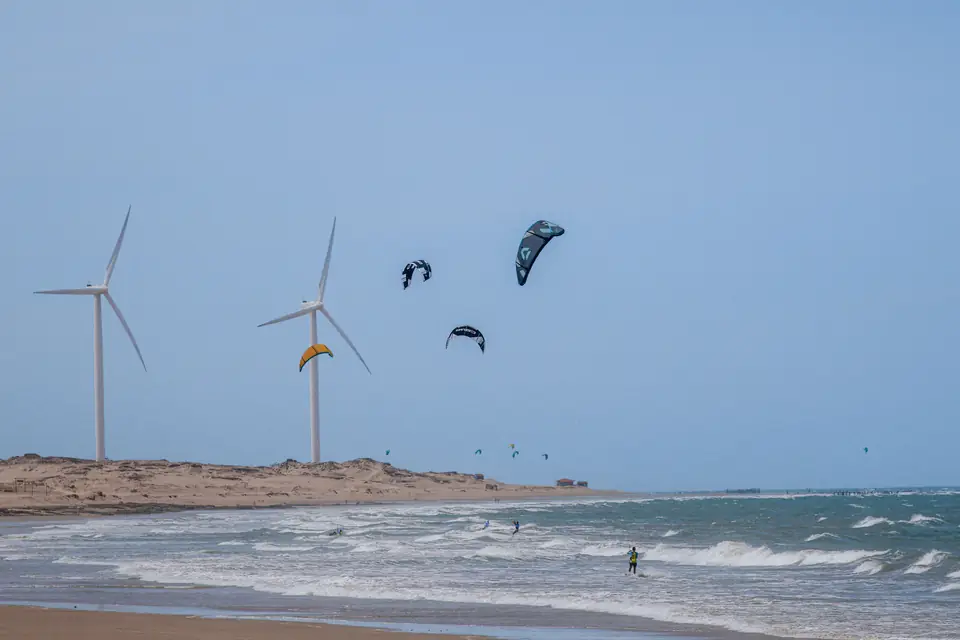
 Photo : Fabiobarros / Wikimedia Commons (CC BY-SA 4.0)
