Skip to content
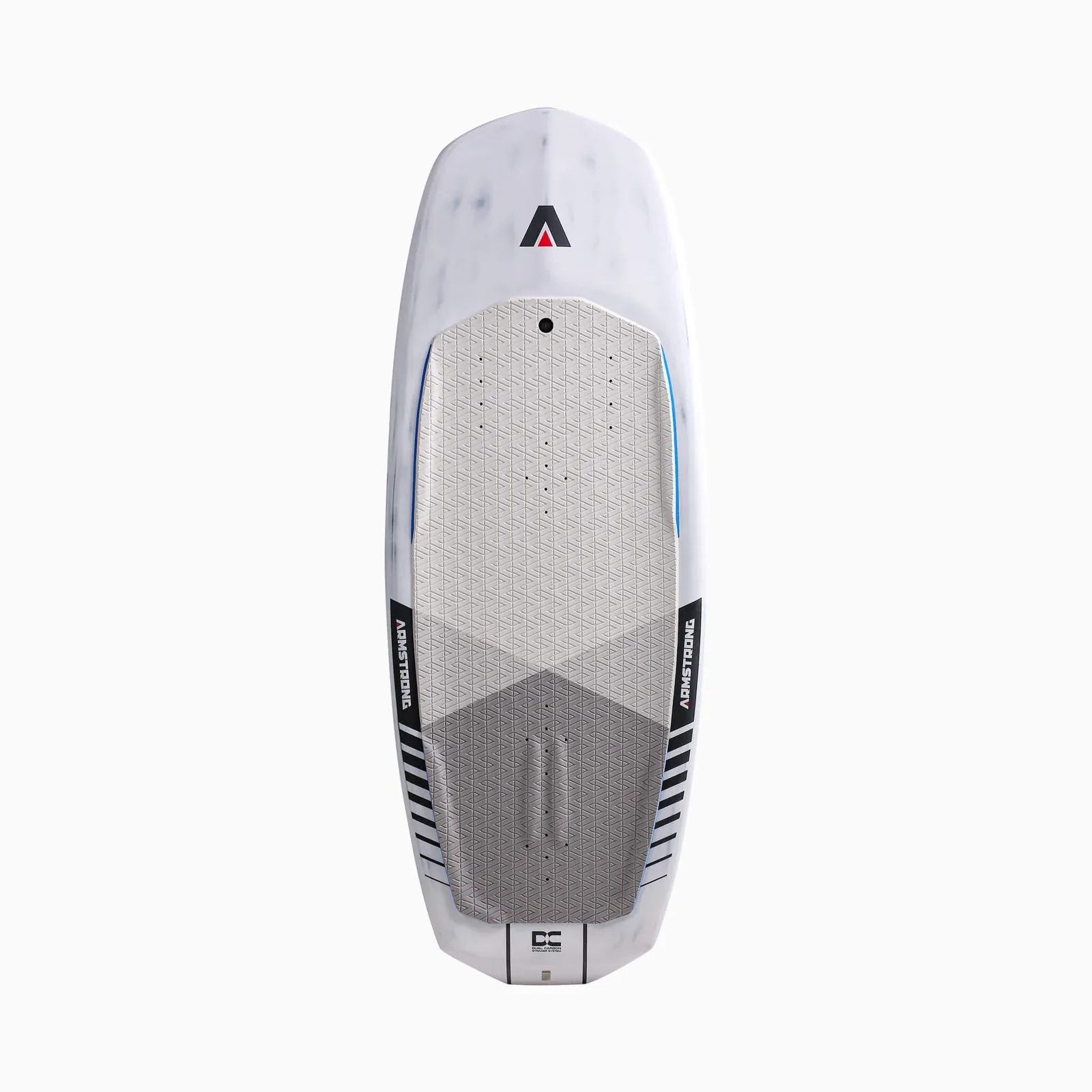
Deck of the Armstrong Wing FG: white hull, light gray pad at the front and darker at the back, red and black logo at the nose
Deck of the Wing FG, 48 L size · © Armstrong
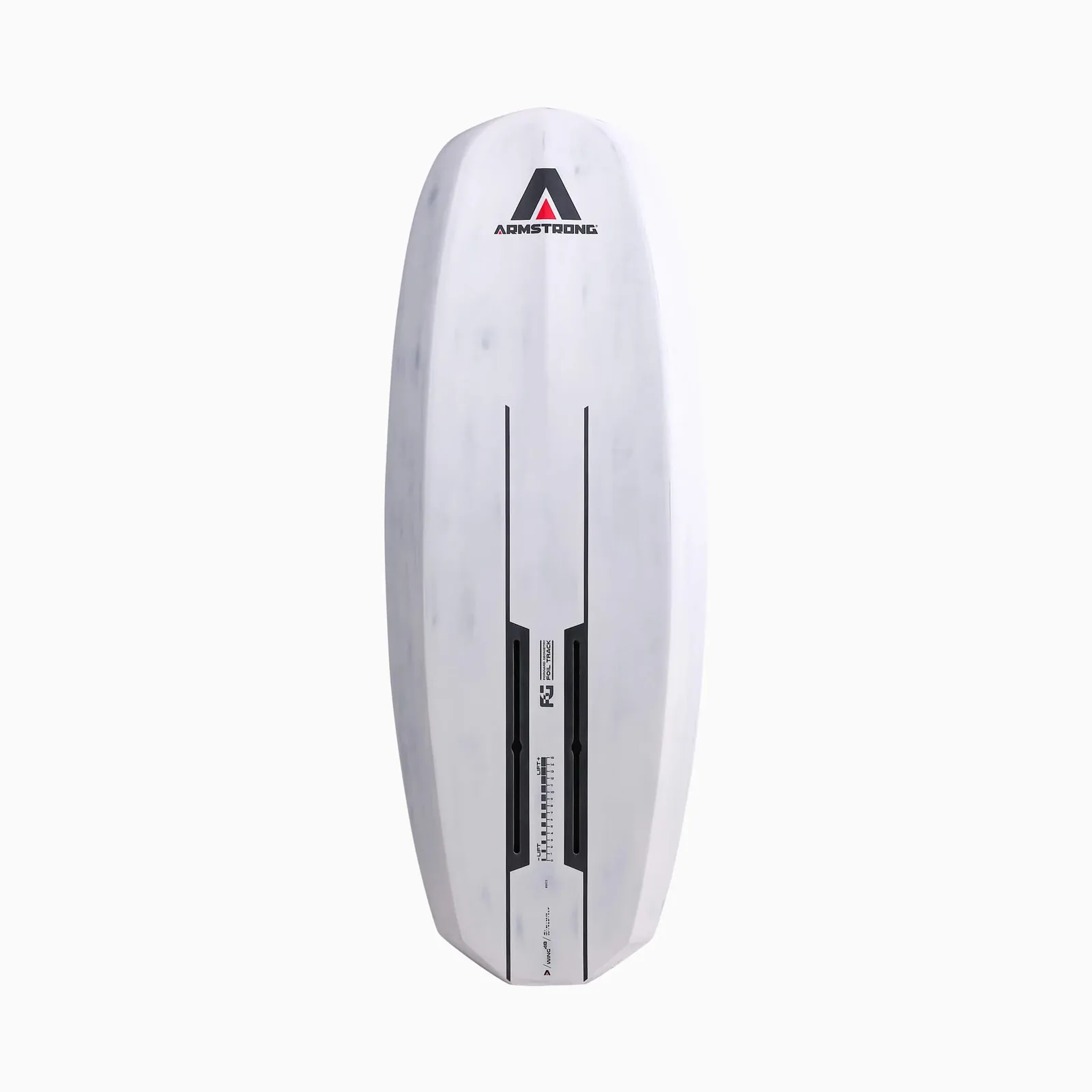
Bottom of the Armstrong Wing FG: white hull, red and black logo at the nose, two long dark foil tracks
Bottom of the Wing FG with its foil tracks, 48 L size · © Armstrong
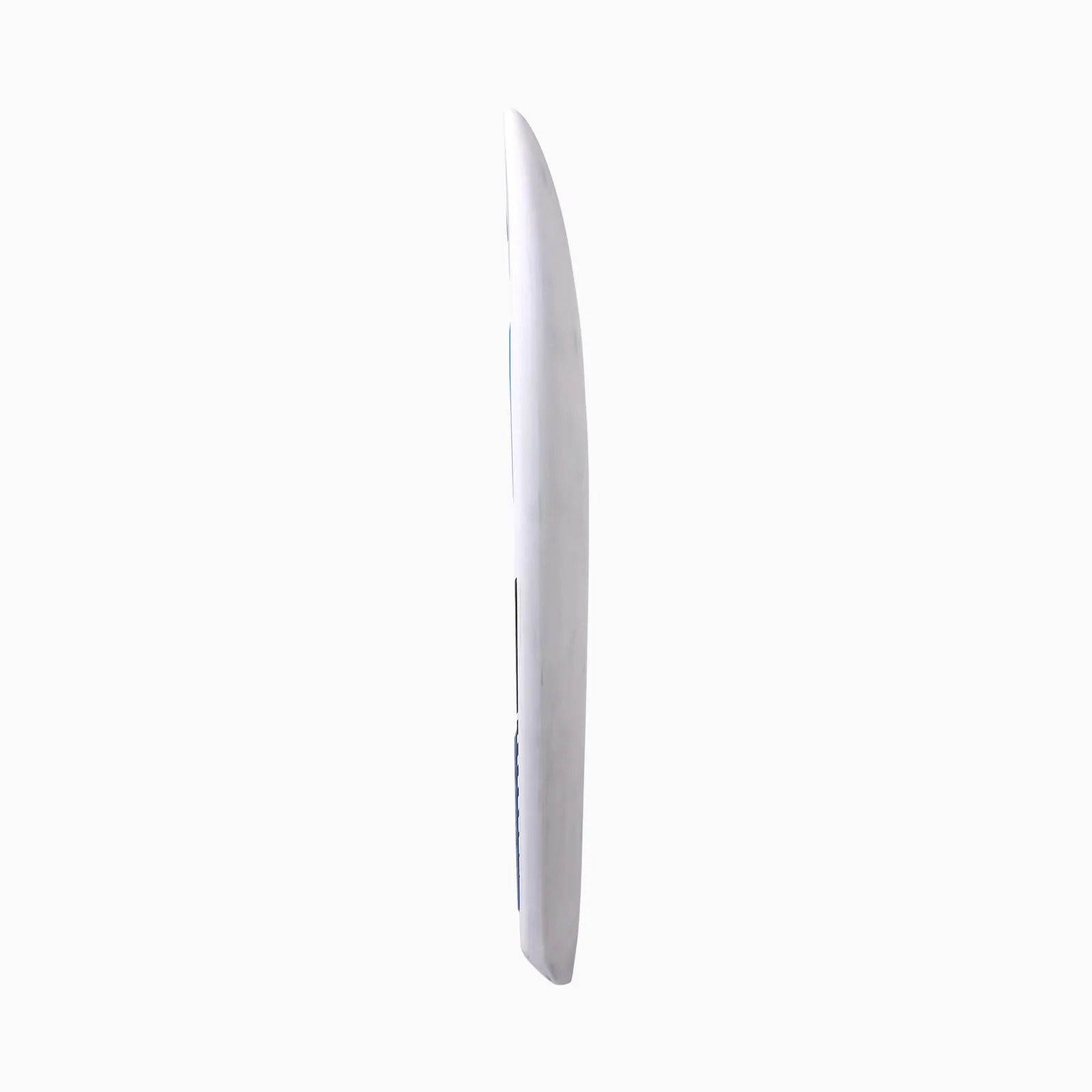
Side view of the Armstrong Wing FG wing board: marbled white hull seen from the side, very thin, slightly raised nose
Profile of the Wing FG, 48 L size · © Armstrong
Armstrong

Armstrong Wing FG Board test

  • Riding styleLight wind, wave
  • Sizes127 to 188 cm
  • YearReleased Nov 2023

Verdict in brief

A carbon wing board in ten sizes, from 34 to 135 L and from 3.5 to 7.9 kg. The volume is hidden in a narrow outline and the foil tracks are moved forward toward the center. Only one published test, Foiling Magazine’s on the 80 L (July 2, 2024): it takes off earlier than the first FG and keeps its stability. I recommend it if you want to change volume without changing board family.

A single test (Foiling Magazine, 80 L, 90 kg rider); none on the other sizes and no rider feedback on this generation (checked on November 8, 2026).

For you if

  • You want a wing board to progress on: ten sizes from 34 to 135 L, so you can go down in volume without leaving the family. That’s the case where I recommend it
  • You want to place your mast where you like it: the foil tracks are moved forward toward the center, and Foiling Magazine mounted it right in the middle, with no shim, with the HA range in 80 L
  • You want a narrow board for its volume: from 43.8 cm wide in 34 L to 69.9 cm in 135 L, with a wedge nose and chamfers along the whole length

Not for you if

  • You want to know which size to take based on your weight: Armstrong gives no rider weight, and the only benchmark is the Foiling Magazine test (80 L for 90 kg)
  • You want to buy it tonight from Armstrong: all ten sizes are sold out on its shop as of November 8, 2026
  • You want a large lightweight board: the 135 L weighs 7.9 kg, 1.2 kg more than Naish’s Chimera 2027 in 130 L (6.7 kg)

Have you ridden this model? Leave the first review

What we know about this model

Our method
  • Specificationschecked early November 2026
  • 1 test publishedFoiling Magazine, test of the Armstrong Wing FG Board in 80 L with a 90 kg rider (page published July 2, 2024)
  • Rider reviewsgive yours, and it will appear here

Sizes, volume, weight and foil box

Sizes, volume, weight and recommended rider
SizeLength × widthThicknessVolumeBoard weightRecommended rider
4'2’’127 × 43.8 cm7.6 cm34 L3.5 kgn.c.
4'4’’132.1 × 47 cm8.3 cm40 L3.7 kgn.c.
4'6’’137.2 × 49.8 cm9.5 cm48 L4.1 kgn.c.
4'8’’142.2 × 52.1 cm10.2 cm58 L4.7 kgn.c.
5'0’’152.4 × 55.9 cm11.4 cm70 L5.2 kgn.c.
5'2’’157.5 × 57.8 cm11.4 cm80 L5.7 kgn.c.
5'4’’162.6 × 59.7 cm12.4 cm90 L6.1 kgn.c.
5'8’’172.7 × 64.1 cm12.7 cm105 L6.7 kgn.c.
5'11’’180.3 × 66.7 cm13.3 cm120 L7.2 kgn.c.
6'2’’188 × 69.8 cm14.6 cm135 L7.9 kgn.c.

Dimensions converted from inches to cm by WindUnity; volume and weight (±5%) come from Armstrong. No rider weight published.

More details on these figures

Length in feet and inches, width and thickness in inches, volume in liters and board weight in kilos: “Specs” table from Armstrong’s page, read on November 8, 2026. The centimeters are converted by WindUnity (1 inch = 2.54 cm), rounded to the millimeter. Weight to within ±5%. Armstrong does not publish a rider weight.

Strong points, weak points

Strong points

  • Ten sizes from 34 to 135 L, with length, width, thickness and weight published for each
  • From 3.5 kg (34 L) to 7.9 kg (135 L), to within ±5%
  • Mast adjustable from the back to the front of the tracks, with any foil brand (Forward Geometry concept)
  • Foiling Magazine test (July 2, 2024): stability kept and earlier takeoff than on the previous generation
  • Carbon construction: double-skin carbon-PVC sandwich, two I-beam stringers, carbon foil tracks
Weak points

  • No recommended rider weight per size
  • Only one published test, in 80 L: nothing on the other sizes
  • The big sizes are heavy: 7.2 kg in 120 L, 7.9 kg in 135 L

The flaw to know about. For me, the real flaw is the lack of a benchmark for choosing your size: no rider weight at Armstrong, and the only test data is an 80 L for a 90 kg rider. A Seabreeze rider (October 8, 2021, first-generation FG) found the rails wide and slippery when wet, with little room for the feet; Foiling Magazine describes on the contrary a large stance area on the current generation, so that criticism is not confirmed here.

Model evolution

Checked on 08/11/2026

  • Previous version Armstrong’s first FG board

What changes vs the first FG

  • Narrower outline for the volume, with a wedge nose and chamfers along the whole length; Armstrong states more speed on the plane, better turns and less windage
  • Reduced-surface bottom for softer takeoffs and touchdowns, flatter and wider stance area
  • Single-side handle, raised markers at the pad corners, multi-position footstrap inserts

Specifications

10 specs, sources at the bottom of the page

Program (manufacturer)
Wing board designed to support progression, ten sizes “for all levels and all weights”; screw-in plugs for multi-position footstraps
Sizes and volumes
34, 40, 48, 58, 70, 80, 90, 105, 120 and 135 L (4'2" to 6'2")
Dimensions (length × width × thickness)
34 L: 127 × 43.8 × 7.6 cm; 80 L: 157.5 × 57.8 × 11.4 cm; 135 L: 188 × 69.9 × 14.6 cm (all ten sizes in the table)
Board weight
From 3.5 kg (34 L) to 7.9 kg (135 L), to within ±5%
Recommended rider weight
n/a: not published by Armstrong
Foil and mast
Carbon foil tracks moved forward toward the center (Forward Geometry), for any foil, mast adjustable from back to front
Construction
Two I-beam stringers from deck to bottom, carbon foil tracks set into the stringer fibers; double-skin carbon-PVC sandwich
Shape
Wedge nose, reduced-surface bottom, chamfers along the whole length, raised pad corners as foot markers, single-side handle
Package contents
Bag supplied according to Foiling Magazine; footstraps and hardware: n/a on the Armstrong page
Release date
November 2023 (StandUp Magazin article of November 7, 2023); the Armstrong page was published in August 2024 and shows no release date

What the published tests say

1 test published, checked early November 2026

Foiling Magazine, test of the Armstrong Wing FG Board in 80 L (page published on July 2, 2024)

Test of the Wing FG in 80 L with a 90 kg rider and the HA range of foils. The mast sits right in the middle of the tracks, with no shim. Hardware judged exemplary, bag supplied with a “foil on” pocket. Pad with angled edges that show where to place the feet, two bumps above the box, large stance area. Narrower for its volume than the first FG, but with the volume better distributed, especially in the nose; hull hollows softened, hence earlier takeoff and less suction at the front. It keeps the stability of the first one, with the scooped deck spreading the volume around the stance area. In the air, the magazine notes clearly less drag than on the first FG and a board that is more agile in turns; in strong wind, the mid sizes are penalized less. Less power is needed to take off, so a smaller wing is enough. The magazine sums up: redesigned nose and outline, which clearly improve early planing and takeoff.

Read the test

Riders’ reviews

No reviews

No reviews yet.

Nobody has reviewed this gear yet. Do you use it? Help other riders of your weight — 2 minutes.

Leave your review (2 minutes)

Three screens: you, the gear, your review. Your email will never be published; it is only used to confirm that the review comes from a real person.

1/3 You

Only used to confirm your review and to let you know if it is rejected. Never displayed, never resold.

Your weight *

10 kg ranges only, so that other riders of your build can relate. No exact weight is recorded.

Your level *

Beginner: I’m still taking lessons. Intermediate: I ride on my own. Advanced: transitions and jumps. Expert: freestyle, wave or competition.

Your riding

Optional. If checked, your review stays published with the label “Gear received or tied to a brand” and doesn’t count toward the average rating.

You must be at least 15 to post a review (“Your data” article of the policy).

2/3 Your gear and how you use it
Wind range actually used (knots)
How long you’ve been using it *
Number of sessions (optional)
Rate each criterion (at least 3) *
Takeoff / low-speed stability
Weight & maneuverability
Stiffness
Foot comfort
Finish & durability

1 = very poor, 5 = excellent. Leave blank any criterion you couldn’t judge.

Do you recommend it? *
3/3 Your review

140 characters minimum — Takeoff, low-speed stability, what disappointed you, who you’d recommend it to.

Rider reviews: confirmed email address, no compensation. “Brand-linked” and “loaned / received” reviews are labeled and excluded from the average. Each review shows its publication date, the date of the experience and, if it was edited, its update date. A review is published or rejected within 7 days at most; if it is rejected, you receive the reason by email and you can correct it. You can complete or delete your review at any time from the email address used to submit it. How do reviews work?

Alternatives to compare

Naish Chimera 2027

Naish: 8 sizes from 40 to 130 L, 3.81 to 6.7 kg. In 70 L: 172.7 × 49.5 cm, 4.79 kg 5.2 kg. The Chimera is longer and narrower; the Wing FG starts lower (34 L) and ends higher (135 L).

Duotone Skybrid SLS 2027

Duotone: 60 to 100 L, 4.7 to 6.0 kg. In 70 L: 170 × 51.5 cm, 5.1 kg 5.2 kg. The Skybrid is longer and narrower, with footstraps supplied; the prices are not in the same currency.

Frequently asked questions

Which sizes of Wing FG Board are there?

Ten sizes: 34 L (4'2", 3.5 kg), 40 L (4'4", 3.7 kg), 48 L (4'6", 4.1 kg), 58 L (4'8", 4.7 kg), 70 L (5'0", 5.2 kg), 80 L (5'2", 5.7 kg), 90 L (5'4", 6.1 kg), 105 L (5'8", 6.7 kg), 120 L (5'11", 7.2 kg) and 135 L (6'2", 7.9 kg). All ten are sold out on Armstrong’s shop as of November 8, 2026.

Which size of Wing FG should you choose based on your weight?

Armstrong publishes no rider weight. The only benchmark for the current product is the Foiling Magazine test: an 80 L for a 90 kg rider. On the first FG, a Seabreeze rider (June 17, 2022) judged their 75 L still big at 68 kg. For the rest, ask the opinion of a shop that has the board as a demo.

What is included with Armstrong’s Wing FG Board?

The board only, in ten sizes from 34 L to 135 L. For the price, see the “Where to buy” section of this page.

Does the Wing FG Board go with my foil?

Armstrong says it’s designed for any foil brand, with tracks moved forward toward the center. Foiling Magazine mounted Armstrong’s HA range right in the middle of the tracks, with no shim. For a foil from another brand, check the track spacing and the screw length with your retailer.

What changes between the Wing FG and Armstrong’s first FG?

The outline is narrower for the volume, with a wedge nose, a reduced-surface bottom and chamfers along the whole length. Foiling Magazine (July 2, 2024) finds that it takes off earlier and with less suction at the front, while keeping stability. No test quantifies the difference.

Method and limitations of this page

This page brings together the technical specs, tests from the press and blogs, and rider feedback found on the web, without rewriting any of it. When WindUnity has ridden the gear itself, the page says so with the “WindUnity test” badge.

Rider reviews are published as is, with their date. Reviews tied to a brand or based on loaned gear are labeled and excluded from the average.

What’s still missing

  • Recommended rider weight per size: not published by Armstrong
  • Only one test, in 80 L; nothing on the other sizes or on other foil brands
  • Model year: Armstrong doesn’t date the board; the model page therefore has no year
  • Delivery contents: bag mentioned by Foiling Magazine only; footstraps and hardware not specified
  • Foil track spacing and pad dimensions: not published on the page
  • No rider feedback on the current generation
  • Rider reviews on WindUnity (N2): none

Sources

Data collected early November 2026

Press and specialist sites : The Foiling Magazine

Forums and riders : Seabreeze

Others : Armstrong, StandUp Magazin

See the details of the 5 sources

Press and specialist sites

  1. Foiling Magazine, Armstrong Wing FG Board test

Forums and riders

  1. Seabreeze, thread on FG sizes (2021 and 2022)

Others

  1. Armstrong, Wing FG Board (online shop)