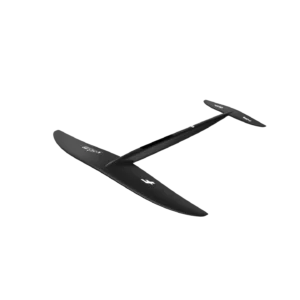
Skip to content
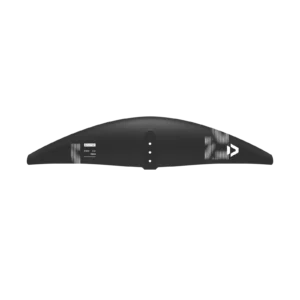
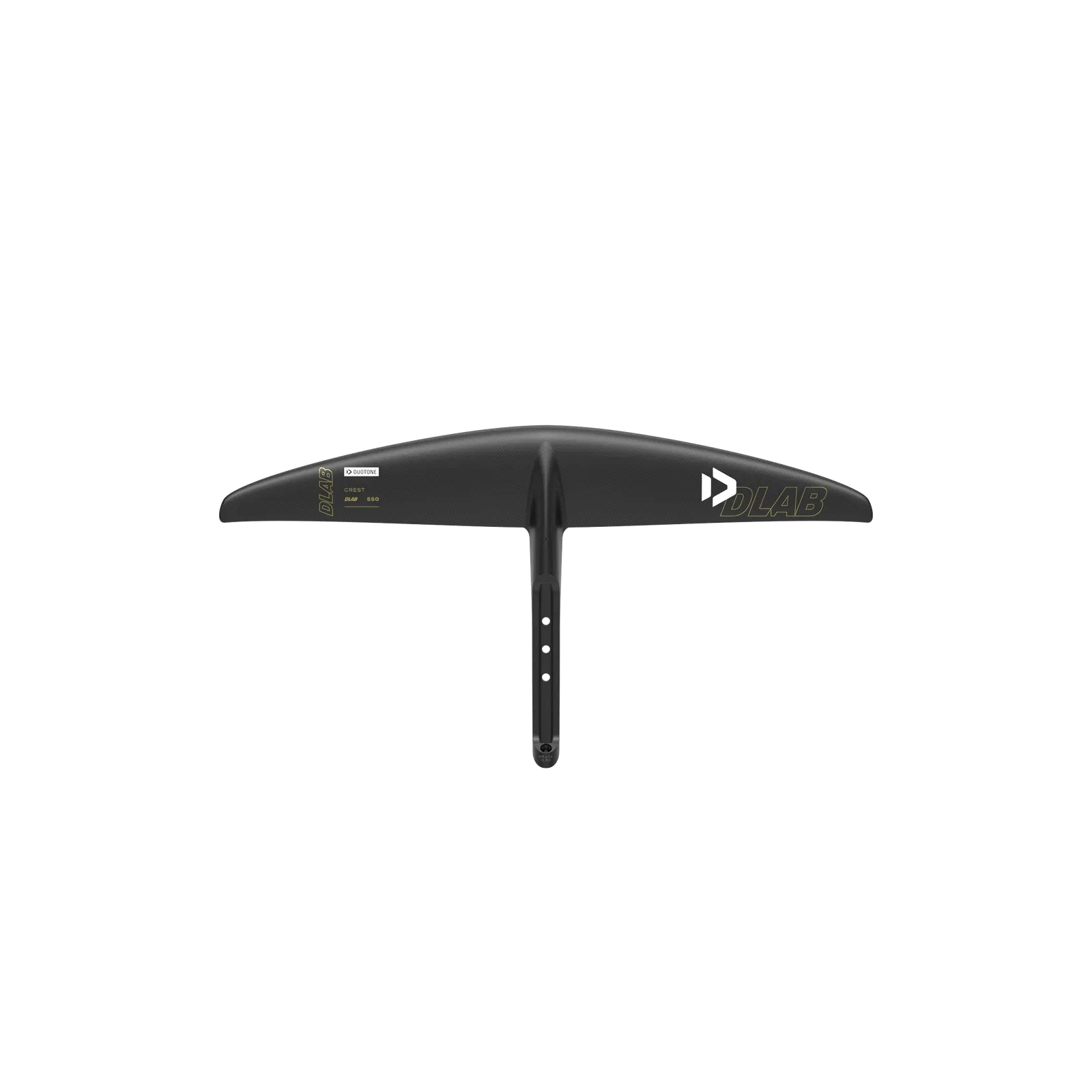
Black Duotone Crest D/LAB 550 front wing seen from above, three-hole center section, Duotone and DLAB logo, transparent background
The Crest D/LAB 550, top view · © Duotone
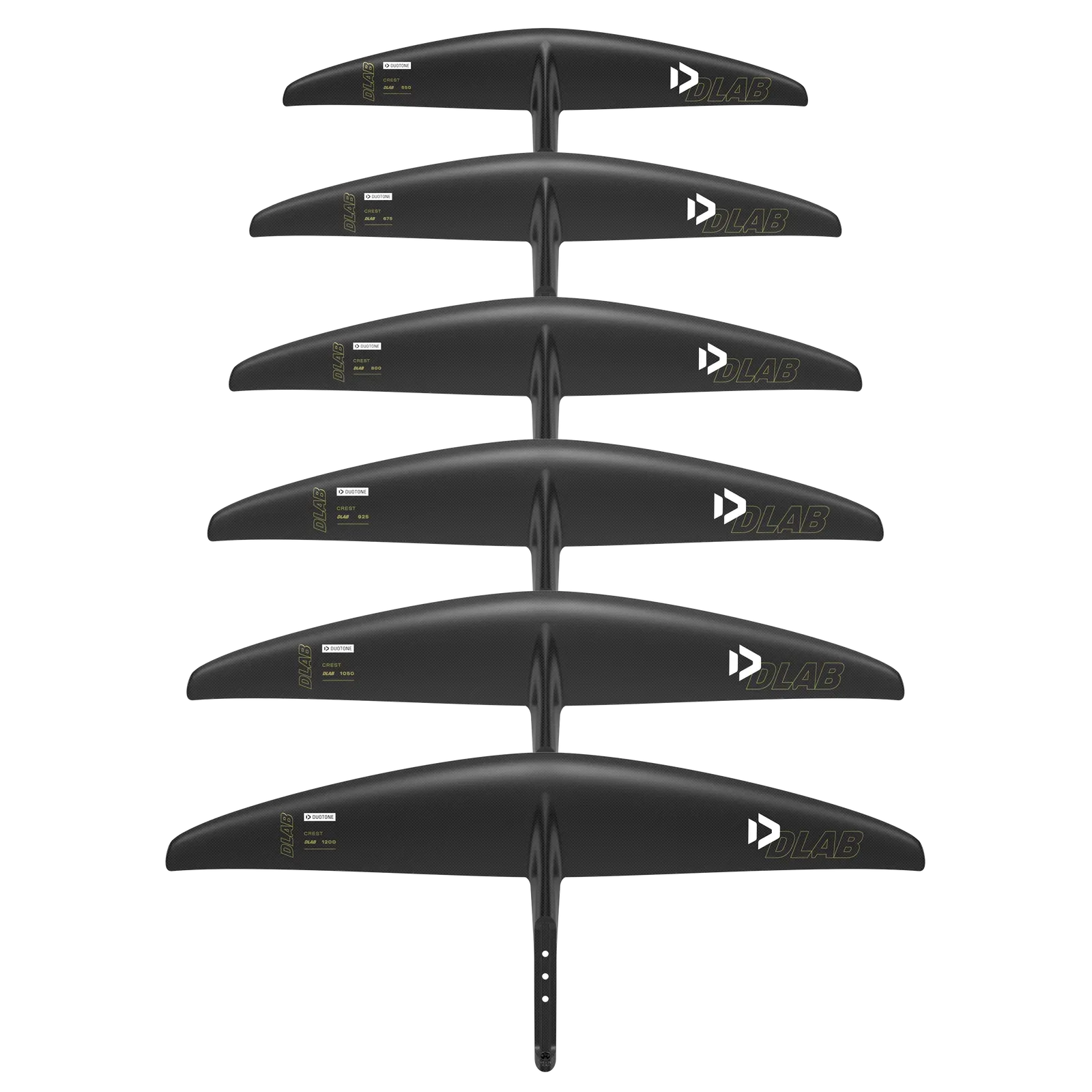
Six black Duotone Crest D/LAB front wings stacked from smallest to largest, Duotone logo and DLAB mention, transparent background
The six sizes of the Crest D/LAB, from 550 to 1200 cm² · © Duotone
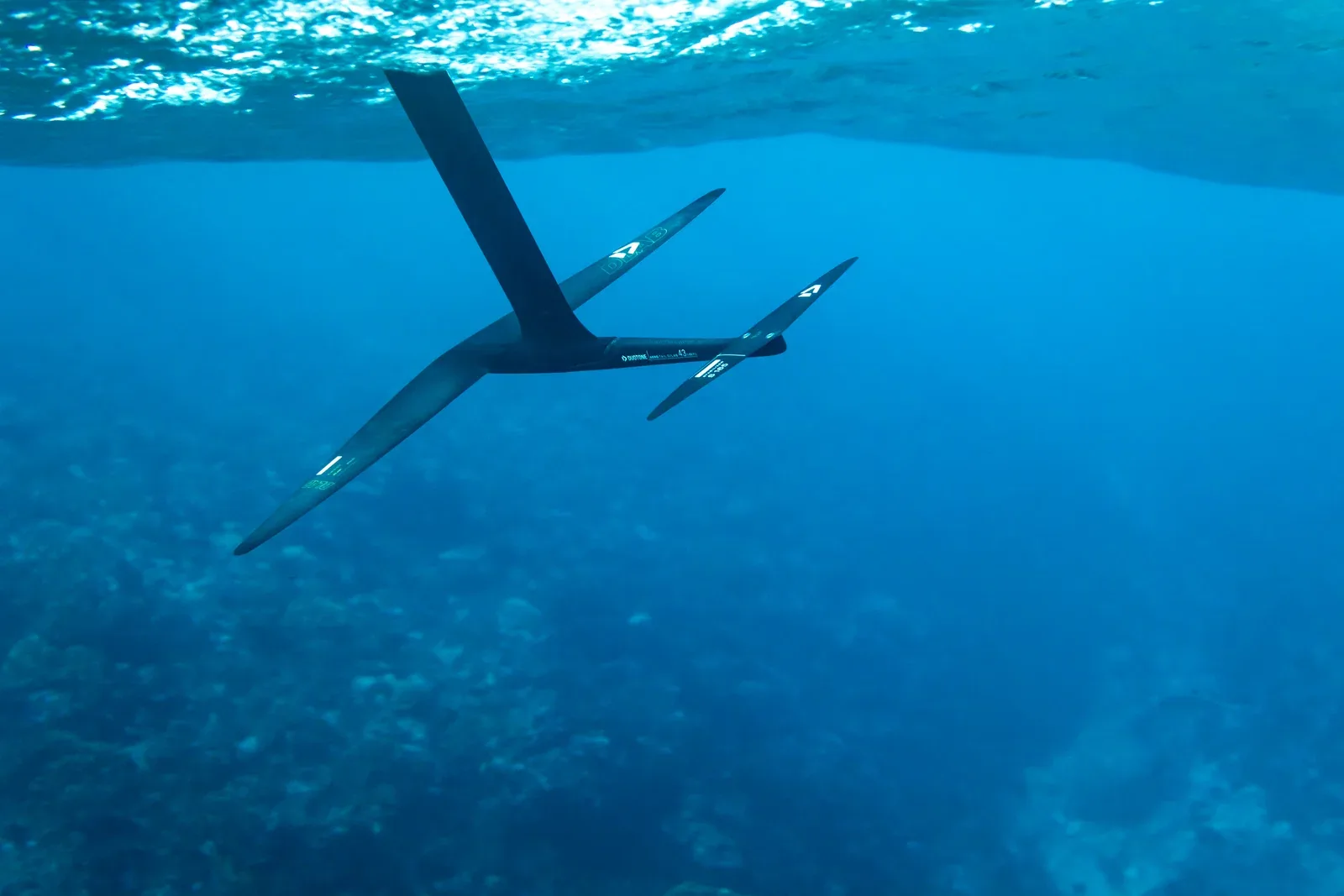
Black Duotone foil seen from below, in clear water above a reef: mast, fuselage, front wing and stabilizer, no rider
A Duotone foil with the Crest D/LAB, seen from below · © Duotone (photo Ben Thouard)
Duotone

Duotone Crest D/LAB 2026 test

  • Riding styleSurf foil: prone, wing, parawing, foil assist, wake
  • Front wings550 to 1200 cm²
  • Wingspan70 to 102 cm
  • YearModel 2026 · released Sep 2025

Verdict in brief

All-round D/LAB carbon wave front wing, in six sizes from 550 to 1200 cm² (front wing only). Foiling Magazine sees it as possibly the most versatile and balanced front wing in the Duotone range; SURF finds glide, a secure feel in tight turns and good speed, but no more than that. Reserved for foilers who are already comfortable, with a D/LAB tail.

For you if

  • You want a single front wing for wing foiling, parawing, prone and foil assist: Foiling Magazine sees it as possibly the most versatile and balanced front wing in the Duotone range, tested for wing foiling, parawing, SUP and with a motor
  • You often dip the wingtip in the water in turns: SURF notes that the wing never stalls when the tip touches the surface, even in a hard turn
  • You’re coming from a Glide and want more turning without losing takeoff: SURF finds it as early as the Glide 2.0, while a customer of the Worthing retailer finds less glide but a lower stall and a wing that is easier to pump

Not for you if

  • You’re starting out in foiling: SURF reserves it for foilers who already master the basic maneuvers and are past the beginner stage
  • You want maximum glide for small waves: SURF points to the Glide 2.0; for long downwind runs, Gliss Evolution (summarizing a rider’s video) sticks with the Glide
  • You’re after top speed, the tightest hook turns or the best jump potential in freestyle: SURF puts these points on the Carve’s side

Have you ridden this model? Leave the first review

What we know about this model

Our method
  • Specificationschecked early November 2026
  • 2 tests publishedFoiling Magazine (800 and 1050 cm², April 20, 2026), SURF Magazin (Manuel Vogel, 1050 cm², March 5, 2026)
  • Rider reviewsgive yours, and it will appear here

Front wings: sizes and mounting

Front wings: area, span, aspect ratio, stabilizer and mounting
SizeWingspanAspect ratioRecommended stabilizerWing attachmentWing weight
550 cm² (85,3 in²)70 cm (27,7 in)9Wing and assist: PX 160 or monobloc MB-PX 145; prone: S 160 or monobloc MB-S 160D/LAB tail: M6x25; mast: 3 M8x50 screws · 15 Nm660 g
675 cm² (104,6 in²)79 cm (31,1 in)9,3Wing and assist: PX 160 or monobloc MB-PX 145; prone: S 160 or monobloc MB-S 160D/LAB tail: M6x25; mast: 3 M8x50 screws · 15 Nm770 g
800 cm² (124 in²)85 cm (33,5 in)9Wing and assist: PX 160 or monobloc MB-PX 145; prone: S 160 or monobloc MB-S 160D/LAB tail: M6x25; mast: 3 M8x50 screws · 15 Nm810 g
925 cm² (143,4 in²)90 cm (35,4 in)8,9Wing and assist: PX 175 or monobloc MB-PX 160; prone: S 160 or monobloc MB-S 160D/LAB tail: M6x25; mast: 3 M8x50 screws · 15 Nm940 g
1050 cm² (162,8 in²)96 cm (37,8 in)8,8Wing and assist: PX 175 or monobloc MB-PX 160; prone: S 160 or monobloc MB-S 160D/LAB tail: M6x25; mast: 3 M8x50 screws · 15 Nm970 g
1200 cm² (186 in²)102 cm (40,2 in)8,6Wing and assist: PX 175 or monobloc MB-PX 160; prone: S 160 or monobloc MB-S 160D/LAB tail: M6x25; mast: 3 M8x50 screws · 15 Nm1100 g

Size = area in cm². Wingspan, aspect ratio, weight excluding screws (±6%) and stabilizers recommended by Duotone.

More details on these figures

Recommended stabilizer for wing and foil assist: PX 160 (550, 675, 800) or PX 175 (925, 1050, 1200), or the monobloc MB-PX 145 then 160; for prone: S 160 or monobloc MB-S 160 on all sizes. The text of the Duotone page announces only the four sizes 675, 800, 925 and 1050; the table and the variants list six, including the 550 and the 1200, which Gliss Evolution and SURF pick up. Foiling Magazine (April 2026) talks about five sizes (550 to 1050). Thickness and camber are not published.

Components and compatibility

Checked on 07/11/2026

Masts

Mast Slim 2.0 D/LAB

high-modulus carbon, one-piece · cord 1 mm · thickness 1 mm · weight tolerance ± 6%

Mast Slim 2.0 D/LAB
LongueurWeight
76 cm1.87 kg
84 cm1.92 kg
94 cm2.18 kg

Stated uses: 76 cm: prone and downwind; 84 cm: freestyle, freeride and most wave days; 94 cm: freerace and big waves.

Fuselage

D/LAB tail (37, 43 or 47 cm) · high-modulus carbon · 2 M8 screws and 1 M6 screw (37 and 43 cm), 2 M6 screws (47 cm)

D/LAB tail (37, 43 or 47 cm)
LongueurStated uses
37 cmPerformance Advanced Wing, Prone, Kite
43 cmPerformance Wing, Prone, Kite
47 cmFree Race Advanced Wing, Kite

Stabilisateurs

Back Wing Stabilizer PX

2 M6x16 screws, 10 Nm

Back Wing Stabilizer PX
Surface
160 cm²
175 cm²
195 cm²

Back Wing Stabilizer S

2 M6x16 screws, 10 Nm

Back Wing Stabilizer S
Surface
145 cm²
165 cm²
185 cm²
210 cm²

Monobloc-Tail PX D/LAB

M6x25, 10 Nm

Monobloc-Tail PX D/LAB
Surface

Monobloc-Tail S D/LAB

M6x25, 10 Nm

Monobloc-Tail S D/LAB
Surface

Duotone publishes the weight of each size, excluding screws, with a tolerance of ± 6%: 0.66 kg (550), 0.77 (675), 0.81 (800), 0.94 (925), 0.97 (1050), 1.10 (1200). 76/84/94 cm mast: 1.87/1.92/2.18 kg. SURF did not give the weight of its set (“n.a.”).

Compatibility

Wing attachment
D/LAB tail: one M6x25 screw, 10 Nm. Mast: three M8x50 screws, 15 Nm (Duotone table). 37, 43 or 47 cm D/LAB tail: two M8 screws plus one M6 screw, or two M6 for the 47 cm, with the M6 screw hidden under the mast.
Stabilisateurs
Duotone recommends one stabilizer per size: a PX (160 on the 550, 675 and 800; 175 on the 925, 1050 and 1200) or a monobloc MB-PX (145, then 160) for wing and foil assist, and an S 160 or a monobloc MB-S 160 for prone. The Duotone page also lists all the D/LAB tails, the S and PX stabilizers and the new monobloc tails.
Fuselage
No separate fuselage: the wing screws onto a D/LAB tail of 37 cm (equivalent to a 60 cm fuselage), 43 cm (66 cm) or 47 cm (70 cm); with a monobloc, the total length is 60, 63 or 66 cm.
Masts
The Mast Slim 2.0 D/LAB (76, 84 or 94 cm) connects to all 3BS fuselages and D/LAB wings. Tests: 84 cm D/LAB Slim mast (Foiling Magazine), 82 cm Aero Mid QM carbon (SURF).

Stated riding styles

Front wing
Duotone page: subtitle “PRONE / FREEFLY / WAKE / FOIL ASSIST”; “expertly crafted for riders seeking peak performance in prone foiling, carving turns with a wing, or enjoying foil assist from wind swell to mid-sized waves”. Kite, downwind and SUP do not appear in the text of the front wing page.
Summary
prone · wing in waves (carving) · foil assist · wake · downwind (only on the page of the S D/LAB monobloc, which pairs it with the Crest) · parawing (according to Foiling Magazine, SURF and Gliss Evolution, not on the Duotone page)

Strong points, weak points

Strong points

  • Takeoff as early as the Glide 2.0 for SURF, with a predictable transition and flight that is immediately stable in the air
  • Wingtips that touch the water without stalling: SURF writes that the wing “never acknowledges this with a stall” in a hard turn
  • Stiff wing: no noticeable flex across the whole system, even on the 1050 (Foiling Magazine)
  • Careful assembly: all the screws are engraved with their length and diameter, and the tail, uses and recommended torques are printed on the wing (Foiling Magazine)

Weak points

  • Good speed but no more than that: SURF speaks of a “not outstanding” level, barely above the Glide 2.0; a Worthing customer finds less speed and less glide than the Glide 2.0
  • Tail and stabilizer to buy separately if you’re not already on D/LAB
  • Two-handed assembly according to the rider summarized by Gliss Evolution: the wing tips forward when you reach for a screw; M6 and M8 screws mixed together; bag with velcro that picks up sand
  • Inconsistent Duotone page on sizes: the text announces 675, 800, 925 and 1050 cm², the table and the variants list six including 550 and 1200; Foiling Magazine (April 2026) talks about five sizes

The flaw to know about. No series defect recorded. What the tests showed: SURF asks for a bit of sensitivity to stabilize the wing on the longitudinal and transverse axes, because it is made for turning and not for the straight line; at around 35 km/h, a Reddit rider (1050) writes that it demands a lot more pitch control than his Blitz 800. The choice of tail and stabilizer changes the behavior: a Worthing customer gained speed and glide by switching to a 160 monobloc.

Specifications

14 specs, sources at the bottom of the page

Riding style
PRONE / FREEFLY / WAKE / FOIL ASSIST (Duotone page); also tested for wing foiling, parawing, SUP and with a motor
Sizes (area)
550, 675, 800, 925, 1050 and 1200 cm² (85.3 to 186.0 in²)
Wingspan
70, 79, 85, 90, 96 and 102 cm (27.7 to 40.2 in)
Aspect ratio
9.0 (550), 9.3, 9.0, 8.9, 8.8 and 8.6 (1200)
Weight excluding screws (± 6%)
0.66, 0.77, 0.81, 0.94, 0.97 and 1.10 kg
Construction
D/LAB (carbon); mustache-type curvature with upturned tips; little exposed hardware
Recommended stabilizer (wing and assist)
PX 160 (550 to 800), PX 175 (925 to 1200) or monobloc MB-PX 145 then 160
Recommended stabilizer (prone)
S 160 or monobloc MB-S 160 on all sizes
Mounting
D/LAB tail: M6x25, 10 Nm; mast: 3 M8x50 screws, 15 Nm
Slim 2.0 D/LAB mast
76 cm, 84 cm, 94 cm
D/LAB tail
37 cm, 43 cm, 47 cm
D/LAB monoblocs
PX: 37/160, 40/145, 43/160; S: 40/160
Buyer reviews on the Duotone shop
17 reviews, average of 4.9 out of 5 (15 ratings of 5 and 2 ratings of 4) as of November 7, 2026
Official videos
“Duotone Crest D/LAB 2026” (September 18, 2025) and “Tech Talk Crest D/LAB 2026” (September 17, 2025), Duotone Wing & Foiling channel

What the published tests say

2 tests published, checked early November 2026

Foiling Magazine, « Duotone Crest D/LAB Review - Foiling Magazine Tests »

The tester places the shape between the Glide and the Carve, with a soft mustache curve at the tips: the wing rolls easily and copes well when the tips exit the water, and he judges it possibly the most versatile and balanced front wing in the Duotone range. The 800 is a good everyday wing, neutral between the feet; the 1050 works well for parawing on a long board, and takes off from flat water with a motor on a 33 L board. No noticeable flex in the system, even on the 1050. He likes the engraved hardware, the bags and the advice printed on the wing. Conclusion: a “no surprises, quiet, well-built daily driver”, versatile enough to progress in almost every discipline. He counts five sizes, from 550 to 1050.

Read the test
SURF Magazin (Manuel Vogel), “Foils 2026: Duotone Crest D/Lab tested - smooth, smoother, Crest!” (article title; the page address and the browser tab say “Crest E/Lab”)

Takeoff as early as the Glide 2.0, predictable transition, stable flight as soon as it comes out of the water and rare unplanned stalls. The wing is made for turning and maneuvering: it takes a bit of sensitivity to stabilize it on both axes, then the acceleration is powerful, and the speed, not exceptional but good, comes in slightly above the Glide 2.0. In maneuvers, smooth jibes, tight turns and 360s are no problem; when the tip touches the surface, the wing keeps going without stalling. Good glide, comfortable in swell and moderate waves. Conclusion: for wing foilers looking for downwind, playful maneuvers and moderate waves, provided they are past the beginner stage. The Glide 2.0 remains recommended for maximum control and glide, the Carve for top speed, tight hook turns and jumps.

Read the test
Articles from shops and schools (1), not counted as tests

These articles come from sites that sell or rent gear: they are cited for information and kept separate from published tests.

Gliss Evolution (retailer), “Duotone Crest D/LAB 2026: Hydro Gav's test and review” (summary of a YouTube video by Hydro Gav)checked on 07/11/2026

Gliss Evolution summarizes the video by Hydro Gav (8 min 33, published April 3, 2026; article updated October 2, 2026), who rode the Crest D/LAB in parawing, wing, prone in waves and a bit of downwind, size not specified. According to this summary: progressive lift with no jerks, forgiving of mistakes, recoverable tip exits, soft turns; it doesn’t pump the best, doesn’t glide the furthest and doesn’t turn the hardest, but very few front wings do all three as well. Flaws cited: two-handed D/LAB assembly, M6 and M8 screws mixed together, a velcro bag that picks up sand. Gliss Evolution specifies that it has no Crest D/LAB in its test fleet. WindUnity only read this text and did not watch the video.

Rider feedback collected from the web (4)

Messages in English summarized by WindUnity, with the exact quotes. None of this is published as a site review.

Reddit r/wingfoil, thread “Duotone Carve 3.0 good or too difficult?” (message from the thread’s author)2026-08-31

Rider learning jibes; had a Glide 1350, a Glide 2.0 900 and a Free 2.0 1300 on order; weight not specified

He buys a Crest 1050 from his retailer after jibe difficulties with the Glide: the Crest turns the way he thinks, stalls very slowly and stays fairly fast; he now does 80% of his jibes in the normal position. The Free 2.0 1300 felt slow and draggy to him after the Crest.

Reddit r/wingfoil, thread “Duotone Carve 2.0 D/LAB 850 keeps pitching up above 30 km/h… setup or technique issue?”2026-10-15

Rider who rides a Crest 1050 and has just bought a Blitz 800; level not specified

At around 35 km/h, the Crest demands much more pitch control than the speed-oriented Blitz, as he expected.

Worthing Watersports, buyer reviews published on the Crest D/LAB page (Judge.me, verified purchase, 5 out of 5)2025-10-17

Mike D., 92 kg, rides at sea (south-coast swell) and on flat water inland, coming from Glide 2.0 1100 and 900; keeps a Glide 1350 and a Carve 950

After 15 sessions: freer-feeling and more maneuverable than the Glide 2.0, more powerful, a clearly lower stall, which helps to catch slow swell and get through turns in chop; slightly less fast and with less glide than the Glide 2.0, but much easier to pump on a diagonal. The 160 S and PX monoblocs improved speed and glide even further.

Worthing Watersports, same page (buyer review)2025-09-13

Ben G., experienced wing foiler, two sessions on a river in gusts of 20 to 35 knots, 85 L board, 4 and 3 m wings; compared with the Carve 850 D/LAB 2.0 and the Glide 900 D/LAB 2.0

Low end “seriously impressive”, stall almost at a standstill; more low end and glide than the Carve 850 (less lively), less glide than the Glide 900 but much more maneuverability, and a stall that lets the wing come back down gently.

Riders’ reviews

No reviews

No reviews yet.

Nobody has reviewed this gear yet. Do you use it? Help other riders of your weight — 2 minutes.

Leave your review (2 minutes)

Three screens: you, the gear, your review. Your email will never be published; it is only used to confirm that the review comes from a real person.

1/3 You

Only used to confirm your review and to let you know if it is rejected. Never displayed, never resold.

Your weight *

10 kg ranges only, so that other riders of your build can relate. No exact weight is recorded.

Your level *

Beginner: I’m still taking lessons. Intermediate: I ride on my own. Advanced: transitions and jumps. Expert: freestyle, wave or competition.

Your riding

Optional. If checked, your review stays published with the label “Gear received or tied to a brand” and doesn’t count toward the average rating.

You must be at least 15 to post a review (“Your data” article of the policy).

2/3 Your gear and how you use it
Wind range actually used (knots)
How long you’ve been using it *
Number of sessions (optional)
Rate each criterion (at least 3) *
Low-end takeoff
Speed & glide
Maneuverability (turns)
Pump
Finish & durability

1 = very poor, 5 = excellent. Leave blank any criterion you couldn’t judge.

Do you recommend it? *
3/3 Your review

140 characters minimum — Takeoff, glide, pump, what disappointed you, who you’d recommend it to.

Rider reviews: confirmed email address, no compensation. “Brand-linked” and “loaned / received” reviews are labeled and excluded from the average. Each review shows its publication date, the date of the experience and, if it was edited, its update date. A review is published or rejected within 7 days at most; if it is rejected, you receive the reason by email and you can correct it. You can complete or delete your review at any time from the email address used to submit it. How do reviews work?

Alternatives to compare

Duotone Free 2.0 2026

Freeride front wing from the same brand, three sizes from 1300 to 1900 cm², aspect ratio from 6.8 to 7.2 for taking off early and progressing. SURF notes no very tight turns in it, with the Crest and the Carve being livelier; a Reddit rider finds the Free 1300 slow and draggy after a Crest 1050.

Axis Spitfire

Competing surf front wing, ten sizes from 628 to 1,554 cm², aspect ratio from 6.1 to 9.1 to be bolted onto an Axis fuselage; Axis does not publish weights. The published tests cover the 840 and 900 for the Spitfire, and the 800 and 1050 for the Crest.

F-One Sk8 V3 2026

F-One carving and wave wing, seven sizes from 550 to 1150 cm², aspect ratio from 8.0 to 8.2. Same territory as the Crest, with a lower aspect ratio than the Crest sizes (8.6 to 9.3).

Duotone Carve 3.0 D/LAB

Another D/LAB front wing, five sizes from 500 to 1100 cm², aspect ratio from 6.7 to 7.4. 42250). SURF credits it with the best top speed, the tightest hook turns and the best jump potential; the Crest is its “golden mean” between Carve and Glide.

Frequently asked questions

Which sizes does the Duotone Crest D/LAB 2026 come in?

Six sizes: 550, 675, 800, 925, 1050 and 1200 cm², front wing alone. Wingspan runs from 70 to 102 cm, aspect ratio from 8.6 to 9.3 and weight excluding screws from 0.66 to 1.10 kg. The text of the Duotone page announces only four (675 to 1050); the table lists six. For the price, see the “Where to buy” section of this page.

Which stabilizer with the Crest D/LAB?

For wing and foil assist, Duotone recommends a PX 160 (550 to 800) or a PX 175 (925 to 1200), or a monobloc MB-PX 145 then 160; for prone, an S 160 or a monobloc MB-S 160. SURF tested the 1050 with an MB-S 160, Foiling Magazine the 800 and the 1050 with a PX160 monobloc; a Worthing customer finds that the 160 monoblocs improved speed and glide even further compared with a PX175.

What do the tests say about the Crest D/LAB?

Foiling Magazine (800 and 1050, April 20, 2026) describes it as a versatile “no surprises, quiet, well-built daily driver”. SURF Magazin (1050, March 5, 2026) finds it takes off as early as the Glide 2.0, with secure turns and good speed, but no more than that; it reserves it for foilers who are already comfortable. The 550, 675, 925 and 1200 sizes have no published test.

Crest, Carve or Glide: which one should you choose?

SURF recommends the Glide 2.0 for maximum control, ease and glide in mini waves, the Carve for top speed, tight hook turns and jumps, and sees the Crest as the middle ground. Gliss Evolution (summarizing Hydro Gav’s video) keeps the Glide for long-distance downwind and the Carve for a very lively front wing in freestyle.

Do you need the whole D/LAB system to fit a Crest D/LAB?

The wing screws onto a D/LAB tail (37, 43 or 47 cm), an S or PX stabilizer, or a monobloc, and mounts on a D/LAB mast with three M8x50 screws; the Mast Slim 2.0 D/LAB page indicates compatibility with 3BS fuselages and D/LAB wings. SURF notes that, as the system is modular, it also fits on an aluminum mast (AL 3BS QM). Gliss Evolution warns that you have to buy the mast, fuselage and tail separately if you’re not already equipped with D/LAB, and cites the Crest SLS 2027 for a lower budget.

Method and limitations of this page

This page brings together the technical specs, tests from the press and blogs, and rider feedback found on the web, without rewriting any of it. When WindUnity has ridden the gear itself, the page says so with the “WindUnity test” badge.

Rider reviews are published as is, with their date. Reviews tied to a brand or based on loaned gear are labeled and excluded from the average.

What’s still missing

  • Tests: only the 800 and 1050 (Foiling Magazine) and the 1050 (SURF); nothing on the 550, 675, 925 and 1200
  • Thickness and camber: not published by Duotone
  • Weight of a complete set: not given by SURF
  • Inconsistent Duotone page on sizes: four in the text (675 to 1050), six in the table (550 to 1200), five at Foiling Magazine (550 to 1050)
  • Buyer reviews from the Duotone shop (17 reviews, average of 4.9 out of 5): not included, as these are reviews from the brand’s own shop
  • SURF writes “Crest E/Lab” in the text (and “D/Lab” in the article title): product identified by its numbers (1050, 96 cm, aspect ratio 8.8, MB-S 160)
  • Reviews posted on WindUnity: none

Sources

Data collected early November 2026

Duotone : 5 product pages

Shops : GlissEvolution, Worthing Watersports

Press and specialist sites : The Foiling Magazine, SURF Magazin

See the details of the 9 sources

Duotone

  1. PX D/LAB monobloc 2026 (EN)
  2. S D/LAB monobloc 2026 (EN)

Shops

  1. Gliss Evolution, summary of the Hydro Gav video
  2. Worthing Watersports, Crest D/LAB page and buyer reviews

Press and specialist sites

  1. Foiling Magazine, Crest D/LAB test
  2. SURF Magazin, Crest D/LAB test